Presentation: From DVDs to Global Streaming: How Netflix’s Commerce Architecture Actually Evolved
Our take
The evolution of Netflix’s commerce architecture, as detailed by Kasia Trapszo, provides a compelling case study in the necessity of continuous adaptation within large-scale, globally-facing platforms. It's not merely a story of technological upgrades; it's a testament to the resilience of systems built to evolve alongside shifting business needs and regulatory landscapes. The journey from a U.S.-centric DVD rental service to a global streaming giant demanded a complete rethinking of foundational infrastructure, moving away from monolithic designs toward a domain-oriented, microservices approach. This mirrors trends we’re seeing across the industry, particularly as companies grapple with the complexities of international expansion and the need for agile development cycles. The challenges of navigating diverse payment systems and stringent regulatory mandates highlight the often-overlooked operational hurdles that accompany global reach. The related work on AWS Introduces Specification Driven Composition for Flexible Data Workflows speaks to this need for adaptable and modular architectures, allowing for independent scaling and updates within complex systems. Furthermore, the surge in demand during live-event broadcasts, like the premiere of *Squid Game*, underscored the importance of real-time responsiveness and scalability – a pressure point that many platforms struggle to address effectively.
The decomposition of monolithic architectures, a core element of Netflix's transformation, is a pattern that resonates deeply with modern software engineering principles. It allows teams to work independently, iterate faster, and deploy changes with reduced risk. The emphasis on domain boundaries, ensuring that services are aligned with specific business functions, is crucial for maintaining coherence and preventing technical debt from accumulating. This echoes the exploration of compositional approaches explored in [Hyperparameters fine tuning for MARL comparative study [D]]( /post/hyperparameters-fine-tuning-for-marl-comparative-study-d-cmtaeirv20qitmi9zvzyvd8na), where independent agents learn and operate within defined spaces. While the contexts are vastly different, the underlying principle of modularity and independent operation remains relevant. The ability to quickly adapt and re-architect systems to handle unexpected spikes in demand, as seen with live events, is a differentiator. It’s a capability that moves beyond simple scaling and requires a fundamentally flexible architecture capable of dynamically allocating resources and routing traffic. The discussion of real-world challenges in implementing retrieval-augmented generation (RAG) systems, as presented in How Does a RAG Reranker Really Work?, highlights similar difficulties in ensuring robust and adaptable AI-powered services.
What makes Netflix’s story particularly instructive is the transparent acknowledgement of continual evolution. It’s not presented as a “solved” problem, but rather as an ongoing process of refinement and adaptation. This perspective is vital for organizations facing similar challenges – the pursuit of perfection is a trap; the ability to learn and adjust is the key to survival. The relentless pressure to innovate, driven by both competitive forces and changing user expectations, demands a culture of experimentation and a willingness to embrace new technologies. This isn’t about chasing the latest buzzwords, but about strategically leveraging technology to solve real business problems and improve the user experience. The emphasis on domain-driven design and microservices is not a one-time fix, but a foundational architecture that enables ongoing agility.
Looking ahead, the increasing prevalence of edge computing and the growing importance of personalization present new architectural challenges. How will platforms like Netflix continue to evolve their commerce infrastructure to seamlessly integrate these emerging technologies while maintaining scalability and resilience? The lessons learned from their past transformations – the importance of modularity, the embrace of continuous adaptation, and the focus on user outcomes – will undoubtedly shape their future trajectory. One critical question to watch is how AI will be further embedded within the commerce platform itself, not just in content recommendations, but in areas like fraud detection, pricing optimization, and customer support. The ability to anticipate and adapt to these future trends will determine which platforms thrive in an increasingly competitive landscape.
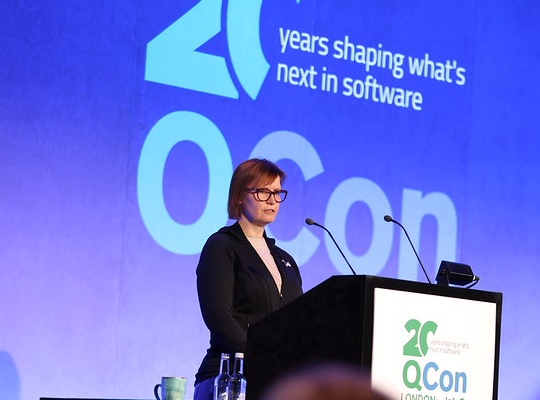
Kasia Trapszo discusses how Netflix evolved its commerce platform from a U.S. DVD service into global infrastructure. She explains navigating international payment realities, adapting to strict regulatory mandates, decomposing monolithic architectures along domain boundaries, and re-architecting systems for massive live-event demand - proving great systems survive by continually evolving.
By Kasia TrapszoRead on the original site
Open the publisher's page for the full experience