Specification Engineering: The New Skill After Prompt Engineering
Our take
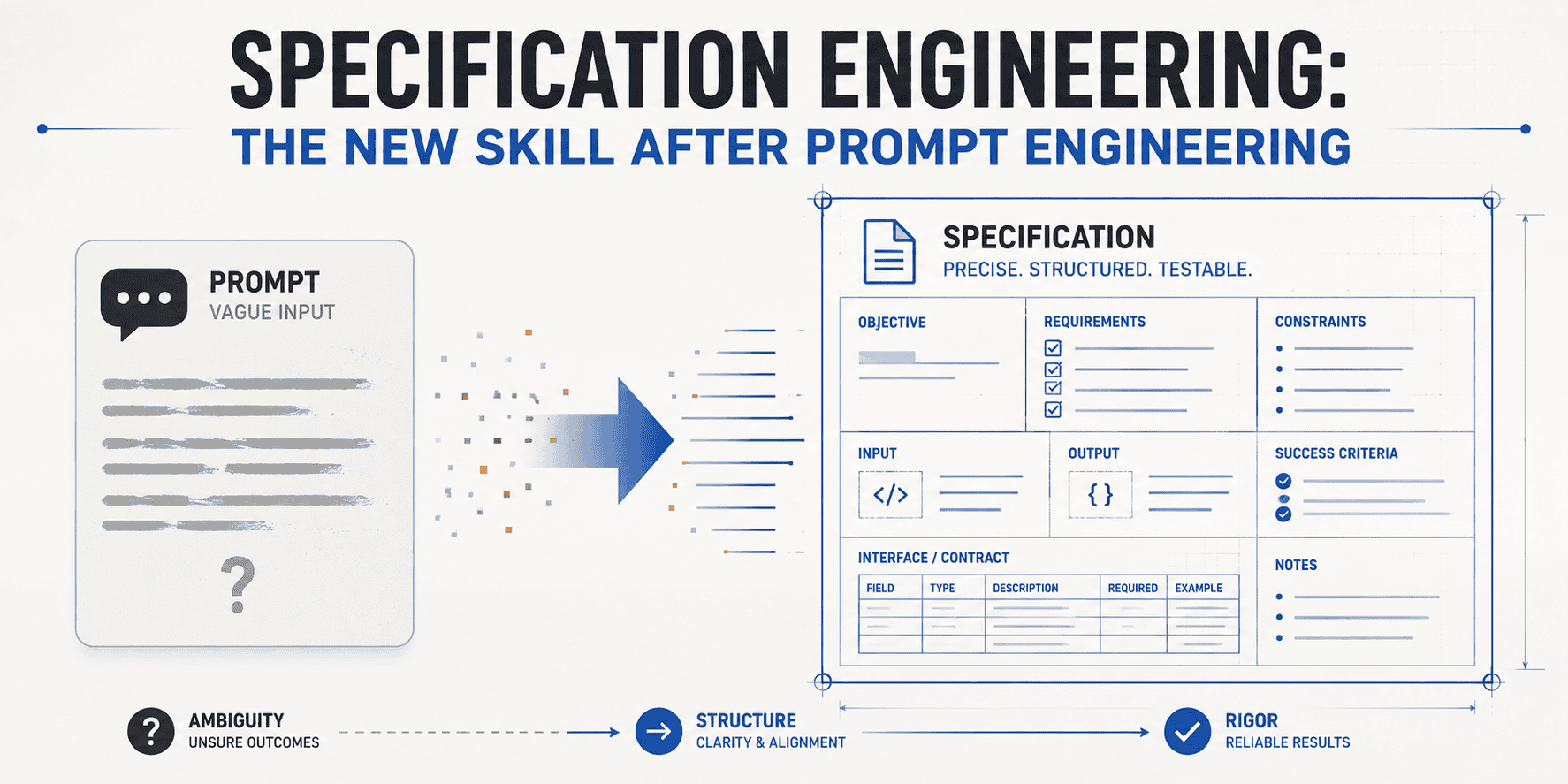
The rapid evolution of AI has brought us a cascade of new concepts, and the shift from prompt engineering to specification engineering represents a particularly insightful one. Prompt engineering, as many of our readers will know, focused on refining the *input* to large language models (LLMs) – learning the art of phrasing queries to elicit desired responses. It was, in essence, about mastering the conversation. However, the limitations of this approach are becoming increasingly apparent. As we grapple with more complex tasks and seek truly transformative applications, simply refining our questions isn’t enough. We need to fundamentally rethink how we structure the *work* itself. Understanding the nuances of positional encoding, for example, as explored in I never understood positional encoding until I read this article., highlights the importance of how information is presented to the model, a concept that specification engineering seeks to address more holistically. This shift acknowledges that the true power of AI isn't just in its ability to respond, but in its potential to fundamentally reshape workflows.
Specification engineering, then, moves beyond the query and focuses on defining the entire process – outlining the steps, data dependencies, and desired outcomes with a level of detail previously reserved for traditional software engineering. It’s about creating a blueprint for AI to execute, rather than simply issuing instructions. This is particularly relevant given the ongoing discussions around the limitations of non-physical intelligence, as highlighted in Non-Physical Intelligence Has A Ceiling. Without a clear specification, AI risks operating in a vacuum, unable to effectively translate abstract reasoning into practical results. The emerging field acknowledges that LLMs, powerful as they are, are ultimately tools, and like any tool, their effectiveness hinges on how skillfully they are employed. Consider the implications for optimizing LLM performance; research into optimal quantization bit-widths, such as that detailed in [What is currently considered the theoretically optimal quantization bit-width for LLMs? [D]](/post/what-is-currently-considered-the-theoretically-optimal-quant-cmsnjmpv108v1mi9zkzf6rowc), demonstrates the need for precise configuration and a deep understanding of model internals – principles central to the specification engineering approach.
The implications of this shift are profound. It signals a move away from ad-hoc experimentation and towards a more structured, engineering-driven approach to AI development. This means a greater emphasis on modularity, testability, and maintainability – qualities that have long been hallmarks of robust software systems. Specification engineering isn’t about replacing prompt engineering entirely; rather, it’s about layering a higher level of abstraction on top of it. Prompts will still be necessary, but they’ll operate within a framework defined by a comprehensive specification. This framework will dictate the overall architecture, data flow, and evaluation metrics, ensuring that the AI system operates consistently and predictably. We anticipate a growing demand for professionals who can bridge the gap between AI expertise and domain-specific knowledge – individuals who can not only craft effective prompts but also design and implement robust AI workflows.
Ultimately, the rise of specification engineering reflects a maturing of the AI landscape. We’re moving beyond the initial excitement of generative models and confronting the practical challenges of deploying AI at scale. It’s a call to action for those of us building with AI: to move beyond the art of the prompt and embrace the discipline of the specification. The question now is, how will specification engineering evolve as AI models become increasingly sophisticated, and what new tools and methodologies will emerge to support this burgeoning field?
Read on the original site
Open the publisher's page for the full experience