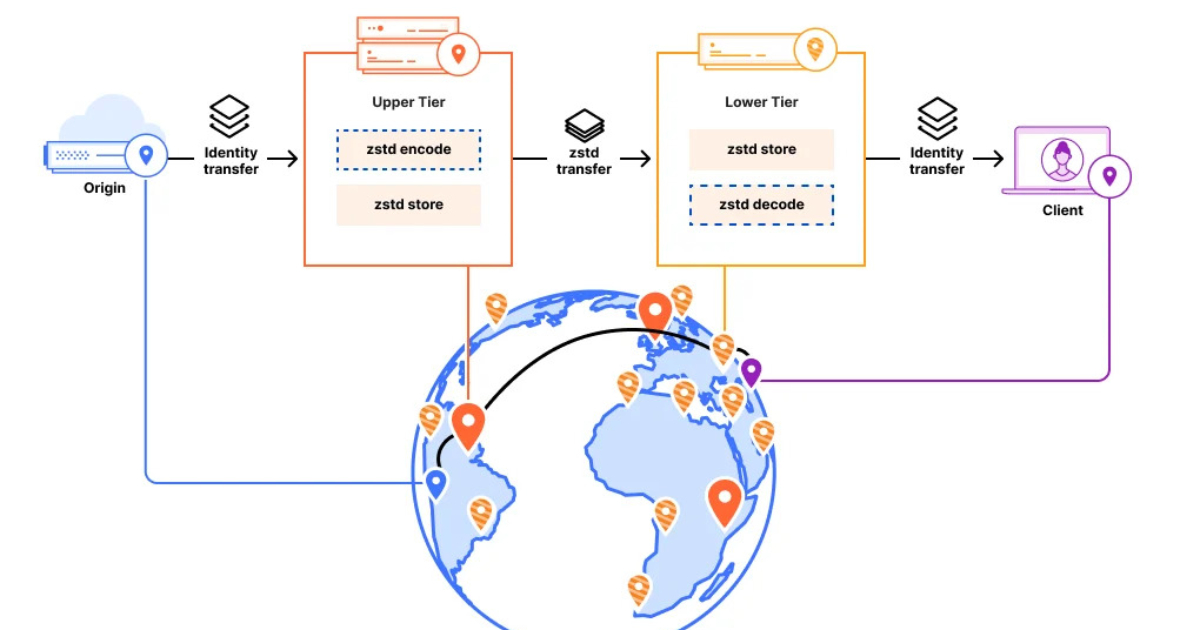
Cloudflare's prototype for cache transcoding is a quiet but meaningful step toward making the edge work harder with less. By compressing eligible content, mainly uncompressed text like HTML, JSON, CSS, and JavaScript, with Zstandard before it hits disk, the company is looking at potentially petabytes of extra effective capacity. That is not just a clever trick; it is a reframing of what storage efficiency can mean at scale. The company is careful to say broader testing is still needed, and that caution is appropriate. But the direction is worth paying attention to because it points at a larger truth: sometimes the biggest wins come from making existing systems waste less, not from building something new.
This move fits into a pattern of incremental, high-leverage engineering that we have seen from Cloudflare before. Their recent work on Cloudflare's Data Innovation Frees 100 TB, Boosts DNS Performance showed how rethinking in-memory representation can free up significant resources. And when they migrated their own blog to EmDash, as detailed in Cloudflare's Blog Finds Performance Gains with EmDash, Its New CMS, it was another example of applying internal discipline to get more from less. Cache transcoding is cut from the same cloth: it is not about flashy features, but about operational efficiency that compounds across a distributed network. For developers and operators who rely on Cloudflare's edge, the practical implication is straightforward. If this prototype holds up in production, it could mean higher cache hit rates without adding hardware or expanding footprint. That translates into lower latency and better performance for end users, and potentially lower costs for the people running the infrastructure.
What stands out here is the choice of Zstandard. It is not the most aggressive compressor, but it offers a strong balance between speed and ratio, which matters when you are compressing on the fly at the edge. The fact that Cloudflare is focusing on uncompressed text is also telling. That is exactly the kind of content that tends to dominate page loads, and it is often served with minimal compression because of CPU constraints. By moving that work to the storage layer, they are sidestepping a classic tradeoff. The question we would ask is how this interacts with existing compression layers. If content is already gzip-compressed when it arrives at the cache, does the transcoding skip it, or is there a recompression step? That detail will determine how much of the theoretical gain becomes real-world benefit.
For our readers, the takeaway is not that you should rush to change your own caching strategy. It is that the most meaningful performance gains are often invisible, buried in how data is stored and retrieved. The work also signals that edge providers are running out of easy wins and are now looking at storage efficiency as a first-class lever. That is a shift worth watching. The concrete detail to track is whether Cloudflare publishes real-world hit rate data after broader testing. That will tell us if cache transcoding is a niche optimization or a new baseline for how edge storage should work.