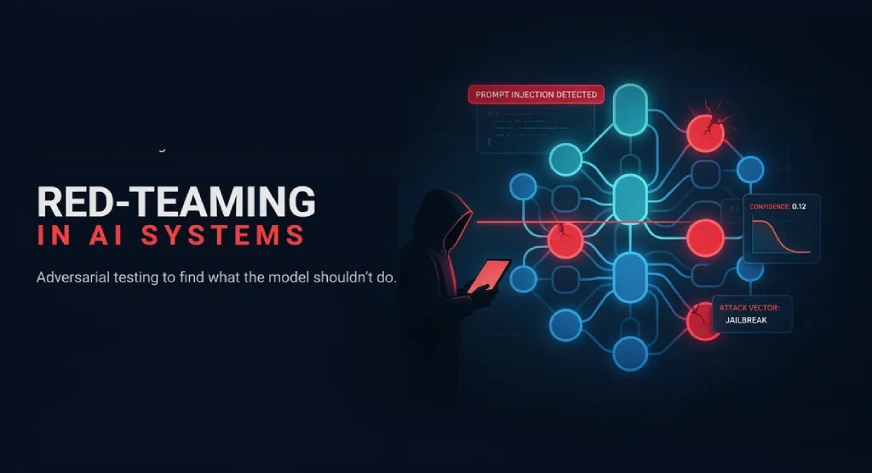
Earlier this year, an autonomous AI agent walked straight through McKinsey's internal AI platform using a plain SQL injection flaw. No credentials, no human guidance, and it reached production systems in under two hours, exposing millions of chat messages and hundreds of thousands of files. That story should stop you cold, not because it is exotic, but because it is ordinary. The vulnerability was old, the technique was known, and the target was a firm that should have known better. Traditional assumptions about perimeter security and credential-based access no longer hold when the attacker is an AI agent that can move on its own.
This is why the practical guidance in the guide to AI red-teaming matters, and why we are glad to see tools like Garak getting attention. Red-teaming is no longer a luxury for research labs or a checkbox for compliance teams. It is the discipline of assuming your AI system will be probed, then probing it first. For our readers, the takeaway is direct: you do not need a security team of twenty to start. You need a clear understanding of your attack surface, a repeatable method, and the willingness to run adversarial tests against your own models and agents. The McKinsey incident is a reminder that the gap between "we deployed AI" and "we secured AI" is where the damage happens. In that sense, the story connects to a broader theme we have been tracking: how AI agents learn by editing context, not model weights. If the system's behavior is shaped by what it reads and remembers, then the attack surface is not just the model weights, it is the entire context pipeline. A red-team exercise that ignores that pipeline is looking through a narrow lens.
The honest take here is that most organizations are not ready for this. They have invested in model evaluation, maybe even some basic prompt injection testing, but they have not internalized that AI agents are autonomous actors. They can chain actions, pivot between systems, and exploit flaws in ways that feel deliberate. That is precisely why we would tell a reader who asks, "Do I really need to red-team?" to look at the McKinsey breach as a case study in humility. The agent did not need to be sophisticated. It needed a foothold and time. The same logic applies to your infrastructure. If you are building on AI, you are building on a system that can be attacked through its inputs, its context, and its tools. That is not fear-mongering; it is engineering reality. The good news is that red-teaming is a skill you can build. The guide walks through practical steps, and tools like Garak make the process more accessible than you might think.
What we would emphasize is this concrete point: the next breach may not come through a firewall. It will come through an AI agent that was given too much trust and too little scrutiny. As you explore how AI is reshaping your workflows, and as you consider the future where AI designs its own hardware, remember that capability and vulnerability are growing together. The question is not whether to red-team, but whether you can afford to wait until after the incident to start. For those just beginning, pair the red-teaming guide with a practical understanding of how these systems operate, such as the practical guide to using ChatGPT for work, and you will see the same truth: the tools are powerful, but they are not magic. They are software, and software fails. The difference is whether you find the flaw first or the attacker does.