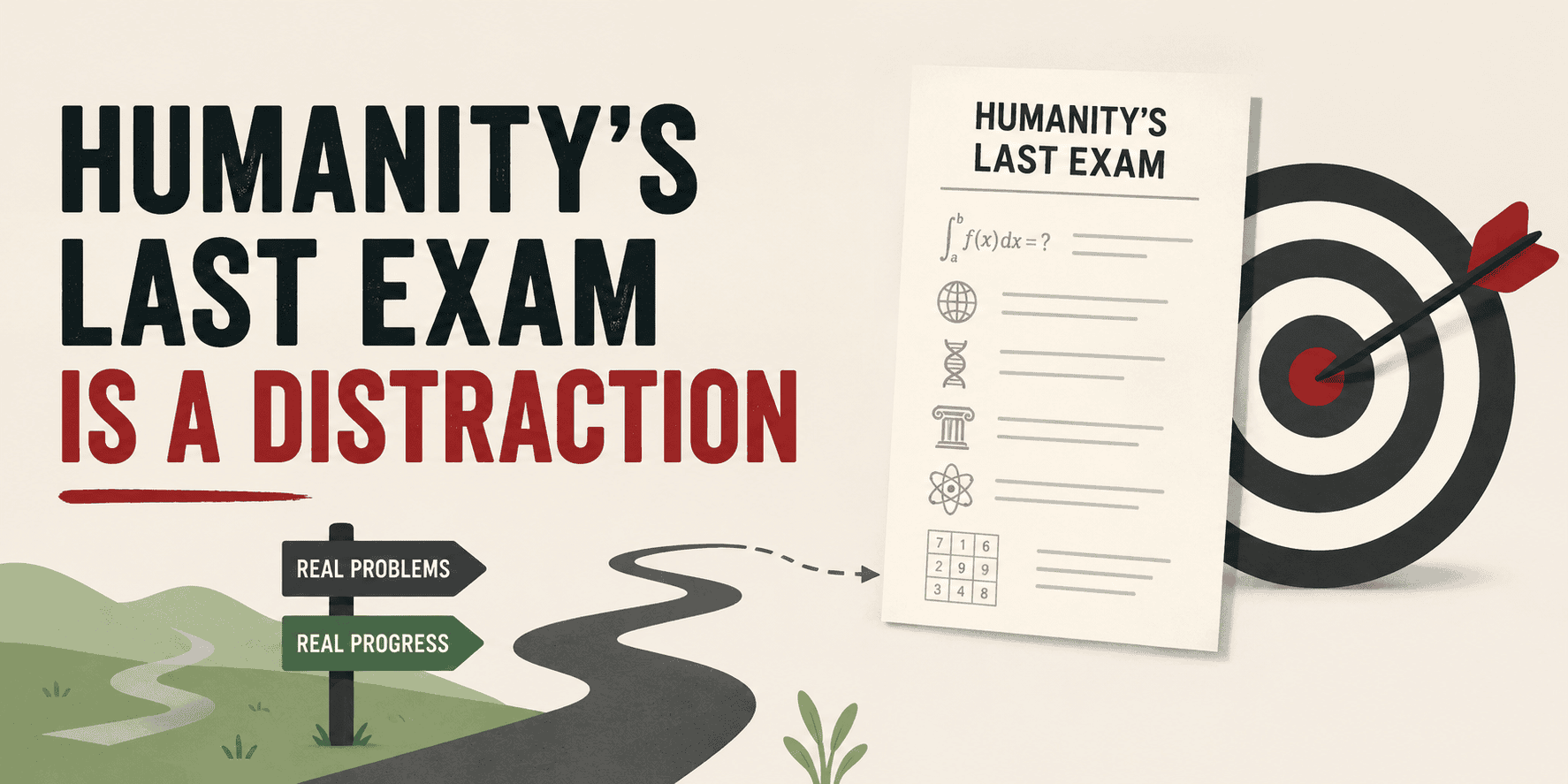
The concept, designed to assess AI systems' ability to reason and problem-solve across a broad spectrum of human knowledge, highlights a critical need: moving beyond narrow task proficiency to genuine general intelligence. It's a worthy ambition, especially as we see the proliferation of agentic AI frameworks like those detailed in 10 Agentic AI Frameworks You Should Know in 2026, where the ability to navigate complex, unstructured environments is paramount. This benchmark implicitly acknowledges that current AI, even the most sophisticated large language models, often lack the nuanced understanding and common sense reasoning that we take for granted. The debate surrounding its effectiveness is healthy and necessary.
The diverse opinions from experts underscore a key challenge in AI evaluation: defining and measuring "intelligence" itself. While "Humanity's Last Exam" attempts to provide a comprehensive assessment, the inherent subjectivity in human knowledge and the potential for biases within the dataset remain significant concerns. The careful curation of these varied perspectives is valuable, illustrating that there's no single, universally accepted metric for gauging AI's progress. The focus on reasoning, rather than simply regurgitating information, is particularly important. Those building with APIs like the Claude API in Python are increasingly aware of the need to guide models toward logical conclusions and avoid generating nonsensical or harmful outputs, highlighting the ongoing development in this space. Furthermore, the emergence of tools like Hugging Face's ML Intern, as demonstrated in Getting Started with Hugging Face ML Intern: Your First ML Agent, shows a shift towards automating aspects of the machine learning lifecycle, which, while powerful, also demands robust evaluation methods to ensure quality and reliability.
Ultimately, the verdict – that "Humanity's Last Exam" is a valuable but imperfect tool – feels entirely reasonable. It serves as a useful pressure test, prompting developers to push the boundaries of AI reasoning capabilities. However, it shouldn't be viewed as the definitive measure of AI progress. The complexities of intelligence are far too multifaceted to be captured by any single benchmark. Ongoing refinement and diversification of evaluation methods are crucial. We need to move beyond isolated tests and embrace more holistic assessments that consider factors like adaptability, ethical considerations, and the ability to learn continuously from new experiences. The very act of creating and debating these benchmarks is a signal of the industry's growing maturity, reflecting a deeper understanding of the challenges that lie ahead.
Looking forward, the question isn't whether we'll devise increasingly sophisticated AI evaluation methods, but rather how we adapt our approach to keep pace with the accelerating rate of AI innovation. As AI systems become more autonomous and integrated into critical infrastructure, the need for robust, reliable, and ethically sound evaluation techniques will only intensify. The "last exam" may be a distraction, but the underlying imperative – ensuring that AI aligns with human values and contributes positively to society – remains a central challenge that demands continuous attention and forward-focused solutions.