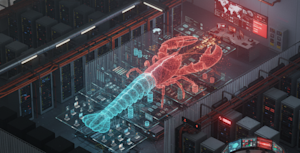
- Explore how a single command can turn any open-source repo into an AI agent backdoor.
Just two months ago, researchers at the Data Intelligence Lab at the University of Hong Kong introduced CLI-Anything, a new state-of-the-art tool that analyzes any repo’s source code and generates a structured command line interface (CLI) that AI coding agents can operate with a single command.
Claude Code, Codex, OpenClaw, Cursor, and GitHub Copilot CLI are all supported, and since its launch in March, CLI‑Anything has climbed to more than 30,000 GitHub stars.
But the same mechanism that makes software agent-native opens the door to agent-level poisoning. The attack community is already discussing the implications on X and security forums, translating CLI-Anything's architecture into offensive playbooks.
The security problem is not what CLI-Anything does. It is what CLI-Anything represents.
CLI-Anything generates SKILL.md files, the same instruction-layer artifacts that Snyk’s ToxicSkills research found laced with 76 confirmed malicious payloads across ClawHub and skills.sh in February 2026. A poisoned skill definition does not trigger a CVE and never appears in a software bill of materials (SBOM). No mainstream security scanner has a detection category for malicious instructions embedded in agent skill definitions, because the category simply did not exist eighteen months ago.
Cisco confirmed the gap in April. “Traditional application security tools were not designed for this,” Cisco’s engineering team wrote in a blog post announcing its AI Agent Security Scanner for IDEs. “SAST [static application security testing] scanners analyze source code syntax. SCA [software composition analysis] tools check dependency versions. Neither understands the semantic layer where MCP [Model Context Protocol] tool descriptions, agent prompts, and skill definitions operate.”
Merritt Baer, CSO of Enkrypt AI and former Deputy CISO at Amazon Web Services (AWS), told VentureBeat in an exclusive interview: “SAST and SCA were built for code and dependencies. They don’t inspect instructions.”
This is not a single-vendor vulnerability. It is a structural gap in how the entire security industry monitors software supply chains. This is the pre-exploitation window. CLI-Anything is live, the attack community is discussing it, and security directors who act now get ahead of the first incident report.
The integration layer no stack can see
Traditional supply-chain security operates on two layers. The code layer is where SAST works, scanning source files for insecure patterns, injection flaws, and hardcoded secrets. The dependency layer is where SCA works, checking package versions against known vulnerabilities, generating SBOMs, and flagging outdated libraries.
Agent bridge tools like CLI-Anything, MCP connectors, Cursor rules files, and Claude Code skills operate on a third layer between the other two. Call it the agent integration layer: configuration files, skill definitions, and natural-language instruction sets tell an AI agent what software can do and how to operate it. None of it looks like code. All of it executes like code.
Carter Rees, VP of AI at Reputation, told VentureBeat in an exclusive interview: “Modern LLMs [large language models] rely on third-party plugins, introducing supply chain vulnerabilities where compromised tools can inject malicious data into the conversation flow, bypassing internal safety training.”
Researchers at Griffith University, Nanyang Technological University, the University of New South Wales, and the University of Tokyo documented the attack chain in an April paper, “Supply-Chain Poisoning Attacks Against LLM Coding Agent Skill Ecosystems.” The team introduced Document-Driven Implicit Payload Execution (DDIPE), a technique that embeds malicious logic inside code examples within skill documentation.
Across four agent frameworks and five large language models, DDIPE achieved bypass rates between 11.6% and 33.5%. Static analysis caught most samples, but 2.5% evaded all four detection layers. Responsible disclosure led to four confirmed vulnerabilities and two vendor fixes.
The kill chain security leaders need to audit
Here's the anatomy of the kill chain: An attacker submits a SKILL.md file to an open-source project containing setup instructions, code examples, and configuration templates. It looks like standard documentation. A code reviewer would wave it through because none of it is executable. But the code examples contain embedded instructions that an agent will parse as operational directives.
A developer uses an agent bridge tool to connect their coding agent to the repository. The agent ingests the skill definition and trusts it, because no verification layer exists to distinguish benign from malicious intent at the instruction level.
The agent executes the embedded instruction using its own legitimate credentials. Endpoint detection and response (EDR) sees an approved API call from an authorized process and passes it. Data exfiltration, configuration changes, and credential harvesting are all moving through channels that the monitoring stack considers normal traffic.
Rees identified the structural flaw that makes this chain lethal. “A significant vulnerability in enterprise AI is broken access control, where the flat authorization plane of an LLM fails to respect user permissions,” he told VentureBeat. A compromised skill definition riding that flat authorization plane does not need to escalate privileges. It already has them. Every link in that chain is invisible to the current security stack.
Pillar Security demonstrated a variant of this chain against Cursor in January 2026 (CVE-2026-22708). Implicitly trusted shell built-in commands could be poisoned through indirect prompt injection, converting benign developer commands into arbitrary code execution vectors. Users saw only the final command. The poisoning happened through other commands the IDE never surfaced for approval.
The evidence is already in production
In a documented attack chain from April 2026, a crafted GitHub issue title triggered an AI triage bot wired into Cline. The bot exfiltrated a GITHUB_TOKEN, which the attacker used to publish a compromised npm dependency that installed a second agent on roughly 4,000 developer machines for eight hours. There was just one issue title. Attackers had eight hours of access. No human approved the action.
Snyk’s ToxicSkills audit scanned 3,984 agent skills from ClawHub, the public marketplace for the OpenClaw agent framework, and skills.sh in February 2026. The results: 13.4% of all skills contained at least one critical security issue. Daily skill submissions jumped from less than 50 in mid-January to more than 500 by early February. The barrier to publishing was a SKILL.md markdown file and a GitHub account one week old. No code signing. No security review. No sandbox.
OpenClaw is not an outlier. It is the pattern. “The bar to entry is extremely low,” Baer said. “Adding a skill can be as simple as uploading a Word doc or lightweight config file. That’s a radically different risk profile than compiled code.” She pointed to projects like ClawPatrol that have started cataloging and scanning for malicious skills, evidence the ecosystem is moving faster than enterprise defenses.
The ClawHavoc campaign, first reported by Koi Security in late January 2026, initially identified 341 malicious skills on ClawHub. A follow-up analysis by Antiy CERT expanded the count to 1,184 compromised packages across the platform. The campaign delivered Atomic Stealer (AMOS) through skill definitions with professional documentation. Skills named solana-wallet-tracker and polymarket-trader matched what developers actively searched for.
The MCP protocol layer carries similar exposure. OX Security reported in April that researchers poisoned nine out of 11 MCP marketplaces using proof-of-concept servers. Trend Micro initially found 492 MCP servers exposed to the internet with zero authentication; by April, that number had grown to 1,467. As The Register reported, the root issue lies in Anthropic’s MCP software development kit (SDK) transport mechanism. Any developer using the official SDK inherits the vulnerability class.
VentureBeat Prescriptive Matrix: Three-layer agent supply-chain audit
VentureBeat developed a Prescriptive Matrix by mapping the three attack layers documented in the research and incident reports above against the detection capabilities of current SAST, SCA, and agent-layer tools. Each row identifies what security teams should verify and where no scanner has coverage today.
Layer
Threat
Current detection
Why it misses
Recommended action
1. Code
Prompt injection in AI-generated code
SAST scanners
Most SAST tools have no detection category for prompt injection in AI-generated code
Confirm that SAST scans AI-generated code for prompt injection. If not, have an open vendor conversation this quarter.
2. Dependencies
Malicious MCP servers, agent skills, plugin registries
SCA tools
SCA generates no AI-specific bill of materials. Agent-layer dependencies are invisible.
Confirm SCA includes MCP servers, agent skills, and plugin registries in the dependency inventory.
3. Agent integration
Poisoned SKILL.md files, malicious instruction sets, adversarial rules files
None until April 2026
No tool inspects the semantic meaning of agent instruction files. Baer: “We’re not inspecting intent.”
Deploy Cisco Skill Scanner or Snyk mcp-scan. Assign a team to own this layer.
Baer’s diagnosis of Layer 3 applies across the entire matrix: “Current scanners look for known bad artifacts, not adversarial instructions embedded in otherwise valid skills.” Cisco’s open-source Skill Scanner and Snyk’s mcp-scan represent the first tools purpose-built for this layer.
Security director action plan
Here's how security leaders can get ahead of the problem.
Inventory every agent bridge tool in the environment. This includes CLI-Anything, MCP connectors, Cursor rules files, Claude Code skills, GitHub Copilot extensions. If the development team is using agent bridge tools that have not been inventoried, the risk cannot be assessed.
Audit agent skill sources the same way package registries get audited. Baer’s framing is precise: “A skill is effectively untrusted executable intent, even if it’s just text.” Shut off ungoverned ingestion paths until controls are in place. Stand up a review and allowlisting process for skills. The OWASP Agentic Skills Top 10 (AST01: Malicious Skills) provides the procurement framework to align controls against.
Deploy agent-layer scanning. Evaluate Cisco’s open-source Skill Scanner and Snyk’s mcp-scan for behavioral analysis of agent instruction files. If dedicated tooling is unavailable, require a second engineer to read every SKILL.md before installation.
Restrict agent execution privileges and instrument runtime. AI coding agents should not run with the same credential scope as the developer who invoked them. Rees confirmed the structural flaw: The flat authorization plane means a compromised skill does not need to escalate privileges. Baer’s prescription: “Instrument runtime observability. What data is the agent accessing, what actions is it taking, and are those aligned with expected behavior?”
Assign ownership for the gap between layers. The most dangerous attacks succeed because they fall between detection categories. Assign a team to own the agent integration layer. Review every SKILL.md, MCP config, and rules file before it enters the environment.
The gap that already has a name
Baer underscored the dangers of this new attack vector. “This feels very similar to early container security, but we’re still in the ‘we’ll get to it’ phase across most orgs," she said. She added that, at AWS, it took a few high-profile wake-up calls before container security became table stakes. The difference this time is speed. “There’s no build pipeline, no compilation barrier. Just content," she said.
CLI-Anything is not the threat. It is the proof case that the agent integration layer exists, that it is growing fast, and that the attacker community has already found it. The 33,000 developers who starred the repository are telling security teams where software development is heading. Eighteen months ago, the detection category for agent-integration-layer poisoning did not exist. Cisco and Snyk shipped the first tools for it in April. The window between those two facts is closing. Security directors who have not begun inventory are already behind.
- AI agents leak secrets when credential security is overlooked
On March 30, BeyondTrust proved that a crafted GitHub branch name could steal Codex’s OAuth token in cleartext. OpenAI classified it Critical P1. Two days later, Anthropic’s Claude Code source code spilled onto the public npm registry, and within hours, Adversa found Claude Code silently ignored its own deny rules once a command exceeded 50 subcommands. These were not isolated bugs. They were the latest in a nine-month run: six research teams disclosed exploits against Codex, Claude Code, Copilot, and Vertex AI, and every exploit followed the same pattern. An AI coding agent held a credential, executed an action, and authenticated to a production system without a human session anchoring the request.
The attack surface was first demonstrated at Black Hat USA 2025, when Zenity CTO Michael Bargury hijacked ChatGPT, Microsoft Copilot Studio, Google Gemini, Salesforce Einstein and Cursor with Jira MCP on stage with zero clicks. Nine months later, those credentials are what attackers reached.
Merritt Baer, CSO at Enkrypt AI and former Deputy CISO at AWS, named the failure in an exclusive VentureBeat interview. “Enterprises believe they’ve ‘approved’ AI vendors, but what they’ve actually approved is an interface, not the underlying system.” The credentials underneath the interface are the breach.
Codex, where a branch name stole GitHub tokens
BeyondTrust researcher Tyler Jespersen, with Fletcher Davis and Simon Stewart, found Codex cloned repositories using a GitHub OAuth token embedded in the git remote URL. During cloning, the branch name parameter flowed unsanitized into the setup script. A semicolon and a backtick subshell turned the branch name into an exfiltration payload.
Stewart added the stealth. By appending 94 Ideographic Space characters (Unicode U+3000) after “main,” the malicious branch looked identical to the standard main branch in the Codex web portal. A developer sees “main.” The shell sees curl exfiltrating their token. OpenAI classified it Critical P1 and shipped full remediation by February 5, 2026.
Claude Code, where two CVEs and a 50-subcommand bypass broke the sandbox
CVE-2026-25723 hit Claude Code’s file-write restrictions. Piped sed and echo commands escaped the project sandbox because command chaining was not validated. Patched in 2.0.55. CVE-2026-33068 was subtler. Claude Code resolved permission modes from .claude/settings.json before showing the workspace trust dialog. A malicious repo set permissions.defaultMode to bypassPermissions. The trust prompt never appeared. Patched in 2.1.53.
The 50-subcommand bypass landed last. Adversa found that Claude Code silently dropped deny-rule enforcement once a command exceeded 50 subcommands. Anthropic’s engineers had traded security for speed and stopped checking after the fiftieth. Patched in 2.1.90.
“A significant vulnerability in enterprise AI is broken access control, where the flat authorization plane of an LLM fails to respect user permissions,” wrote Carter Rees, VP of AI and Machine Learning at Reputation and a member of the Utah AI Commission. The repository decided what permissions the agent had. The token budget decided which deny rules survived.
Copilot, where a pull request description and a GitHub issue both became root
Johann Rehberger demonstrated CVE-2025-53773 against GitHub Copilot with Markus Vervier of Persistent Security as co-discoverer. Hidden instructions in PR descriptions triggered Copilot to flip auto-approve mode in .vscode/settings.json. That disabled all confirmations and granted unrestricted shell execution across Windows, macOS, and Linux. Microsoft patched it in the August 2025 Patch Tuesday release.
Then, Orca Security cracked Copilot inside GitHub Codespaces. Hidden instructions in a GitHub issue manipulated Copilot into checking out a malicious PR with a symbolic link to /workspaces/.codespaces/shared/user-secrets-envs.json. A crafted JSON $schema URL exfiltrated the privileged GITHUB_TOKEN. Full repository takeover. Zero user interaction beyond opening the issue.
Mike Riemer, CTO at Ivanti, framed the speed dimension in a VentureBeat interview: “Threat actors are reverse engineering patches within 72 hours. If a customer doesn’t patch within 72 hours of release, they’re open to exploit.” Agents compress that window to seconds.
Vertex AI, where default scopes reached Gmail, Drive and Google’s own supply chain
Unit 42 researcher Ofir Shaty found that the default Google service identity attached to every Vertex AI agent had excessive permissions. Stolen P4SA credentials granted unrestricted read access to every Cloud Storage bucket in the project and reached restricted, Google-owned Artifact Registry repositories at the core of the Vertex AI Reasoning Engine. Shaty described the compromised P4SA as functioning like a "double agent," with access to both user data and Google's own infrastructure.
VentureBeat defense grid
Security requirement
Defense shipped
Exploit path
The gap
Sandbox AI agent execution
Codex runs tasks in cloud containers; token scrubbed during agent runtime.
Token present during cloning. Branch-name command injection executed before cleanup.
No input sanitization on container setup parameters.
Restrict file system access
Claude Code sandboxes writes via accept-edits mode.
Piped sed/echo escaped sandbox (CVE-2026-25723). Settings.json bypassed trust dialog (CVE-2026-33068). 50-subcommand chain dropped deny-rule enforcement.
Command chaining not validated. Settings loaded before trust. Deny rules truncated for performance.
Block prompt injection in code context
Copilot filters PR descriptions for known injection patterns.
Hidden injections in PRs, README files, and GitHub issues triggered RCE (CVE-2025-53773 + Orca RoguePilot).
Static pattern matching loses to embedded prompts in legitimate review and Codespaces flows.
Scope agent credentials to least privilege
Vertex AI Agent Engine uses P4SA service agent with OAuth scopes.
Default scopes reached Gmail, Calendar, Drive. P4SA credentials read every Cloud Storage bucket and Google’s Artifact Registry.
OAuth scopes non-editable by default. Least privilege violated by design.
Inventory and govern agent identities
No major AI coding agent vendor ships agent identity discovery or lifecycle management.
Not attempted. Enterprises do not inventory AI coding agents, their credentials, or their permission scopes.
AI coding agents are invisible to IAM, CMDB, and asset inventory. Zero governance exists.
Detect credential exfiltration from agent runtime
Codex obscures tokens in web portal view. Claude Code logs subcommands.
Tokens visible in cleartext inside containers. Unicode obfuscation hid exfil payloads. Subcommand chaining hid intent.
No runtime monitoring of agent network calls. Log truncation hid the bypass.
Audit AI-generated code for security flaws
Anthropic launched Claude Code Security (Feb 2026). OpenAI launched Codex Security (March 2026).
Both scan generated code. Neither scans the agent’s own execution environment or credential handling.
Code-output security is not agent-runtime security. The agent itself is the attack surface.
Every exploit targeted runtime credentials, not model output
Every vendor shipped a defense. Every defense was bypassed.
The Sonar 2026 State of Code Developer Survey found 25% of developers use AI agents regularly, and 64% have started using them. Veracode tested more than 100 LLMs and found 45% of generated code samples introduced OWASP Top 10 flaws, a separate failure that compounds the runtime credential gap.
CrowdStrike CTO Elia Zaitsev framed the rule in an exclusive VentureBeat interview at RSAC 2026: collapse agent identities back to the human, because an agent acting on your behalf should never have more privileges than you do. Codex held a GitHub OAuth token scoped to every repository the developer authorized. Vertex AI’s P4SA read every Cloud Storage bucket in the project. Claude Code traded deny-rule enforcement for token budget.
Kayne McGladrey, an IEEE Senior Member who advises enterprises on identity risk, made the same diagnosis in an exclusive interview with VentureBeat. "It uses far more permissions than it should have, more than a human would, because of the speed of scale and intent."
Riemer drew the operational line in an exclusive VentureBeat interview. "It becomes, I don't know you until I validate you." The branch name talked to the shell before validation. The GitHub issue talked to Copilot before anyone read it.
Security director action plan
Inventory every AI coding agent (CIEM). Codex, Claude Code, Copilot, Cursor, Gemini Code Assist, Windsurf. List the credentials and OAuth scopes each received at setup. If your CMDB has no category for AI agent identities, create one.
Audit OAuth scopes and patch levels. Upgrade Claude Code to 2.1.90 or later. Verify Copilot's August 2025 patch. Migrate Vertex AI to the bring-your-own-service-account model.
Treat branch names, pull request descriptions, GitHub issues, and repo configuration as untrusted input. Monitor for Unicode obfuscation (U+3000), command chaining over 50 subcommands, and changes to .vscode/settings.json or .claude/settings.json that flip permission modes.
Govern agent identities the way you govern human privileged identities (PAM/IGA). Credential rotation. Least-privilege scoping. Separation of duties between the agent that writes code and the agent that deploys it. CyberArk, Delinea, and any PAM platform that accepts non-human identities can onboard agent OAuth credentials today; Gravitee's 2026 survey found only 21.9% of teams have done it.
Validate before you communicate. "As long as we trust and we check and we validate, I'm fine with letting AI maintain it," Riemer said. Before any AI coding agent authenticates to GitHub, Gmail, or an internal repository, verify the agent's identity, scope, and the human session it is bound to.
Ask each vendor in writing before your next renewal. "Show me the identity lifecycle management controls for the AI agent running in my environment, including credential scope, rotation policy, and permission audit trail." If the vendor cannot answer, that is the audit finding.
The governance gap in three sentences
Most CISOs inventory every human identity and have zero inventory of the AI agents running with equivalent credentials. No IAM framework governs human privilege escalation and agent privilege escalation with the same rigor. Most scanners track every CVE but cannot alert when a branch name exfiltrates a GitHub token through a container that developers trust by default.
Zaitsev's advice to RSAC 2026 attendees was blunt: you already know what to do. Agents just made the cost of not doing it catastrophic.
- Agentic SOC tools arrive as attacker dwell times hit new lows.
CrowdStrike CEO George Kurtz highlighted in his RSA Conference 2026 keynote that the fastest recorded adversary breakout time has dropped to 27 seconds. The average is now 29 minutes, down from 48 minutes in 2024. That is how much time defenders have before a threat spreads. Now CrowdStrike sensors detect more than 1,800 distinct AI applications running on enterprise endpoints, representing nearly 160 million unique application instances. Every one generates detection events, identity events, and data access logs flowing into SIEM systems architected for human-speed workflows.
Cisco found that 85% of surveyed enterprise customers have AI agent pilots underway. Only 5% moved agents into production, according to Cisco President and Chief Product Officer Jeetu Patel in his RSAC blog post. That 80-point gap exists because security teams cannot answer the basic questions agents force. Which agents are running, what are they authorized to do, and who is accountable when one goes wrong.
“The number one threat is security complexity. But we’re running towards that direction in AI as well,” Etay Maor, VP of Threat Intelligence at Cato Networks, told VentureBeat at RSAC 2026. Maor has attended the conference for 16 consecutive years. “We’re going with multiple point solutions for AI. And now you’re creating the next wave of security complexity.”
Agents look identical to humans in your logs
In most default logging configurations, agent-initiated activity looks identical to human-initiated activity in security logs. “It looks indistinguishable if an agent runs Louis’s web browser versus if Louis runs his browser,” Elia Zaitsev, CTO of CrowdStrike, told VentureBeat in an exclusive interview at RSAC 2026. Distinguishing the two requires walking the process tree. “I can actually walk up that process tree and say, this Chrome process was launched by Louis from the desktop. This Chrome process was launched from Louis’s Claude Cowork or ChatGPT application. Thus, it’s agentically controlled.”
Without that depth of endpoint visibility, a compromised agent executing a sanctioned API call with valid credentials fires zero alerts. The exploit surface is already being tested. During his keynote, Kurtz described ClawHavoc, the first major supply chain attack on an AI agent ecosystem, targeting ClawHub, OpenClaw's public skills registry. Koi Security's February audit found 341 malicious skills out of 2,857; a follow-up analysis by Antiy CERT identified 1,184 compromised packages historically across the platform. Kurtz noted ClawHub now hosts 13,000 skills in its registry. The infected skills contained backdoors, reverse shells, and credential harvesters; Kurtz said in his keynote that some erased their own memory after installation and could remain latent before activating. "The frontier AI creators will not secure itself," Kurtz said. "The frontier labs are following the same playbook. They're building it. They're not securing it."
Two agentic SOC architectures, one shared blind spot
Approach A: AI agents inside the SIEM. Cisco and Splunk announced six specialized AI agents for Splunk Enterprise Security: Detection Builder, Triage, Guided Response, Standard Operating Procedures (SOP), Malware Threat Reversing, and Automation Builder. Malware Threat Reversing is currently available in Splunk Attack Analyzer and Detection Studio is generally available as a unified workspace; the remaining five agents are in alpha or prerelease through June 2026. Exposure Analytics and Federated Search follow the same timeline. Upstream of the SOC, Cisco's DefenseClaw framework scans OpenClaw skills and MCP servers before deployment, while new Duo IAM capabilities extend zero trust to agents with verified identities and time-bound permissions.
“The biggest impediment to scaled adoption in enterprises for business-critical tasks is establishing a sufficient amount of trust,” Patel told VentureBeat. “Delegating and trusted delegating, the difference between those two, one leads to bankruptcy. The other leads to market dominance.”
Approach B: Upstream pipeline detection. CrowdStrike pushed analytics into the data ingestion pipeline itself, integrating its Onum acquisition natively into Falcon’s ingestion system for real-time analytics, detection, and enrichment before events reach the analyst’s queue. Falcon Next-Gen SIEM now ingests Microsoft Defender for Endpoint telemetry natively, so Defender shops do not need additional sensors. CrowdStrike also introduced federated search across third-party data stores and a Query Translation Agent that converts legacy Splunk queries to accelerate SIEM migration.
Falcon Data Security for the Agentic Enterprise applies cross-domain data loss prevention to data agents' access at runtime. CrowdStrike’s adversary-informed cloud risk prioritization connects agent activity in cloud workloads to the same detection pipeline. Agentic MDR through Falcon Complete adds machine-speed managed detection for teams that cannot build the capability internally.
“The agentic SOC is all about, how do we keep up?” Zaitsev said. “There’s almost no conceivable way they can do it if they don’t have their own agentic assistance.”
CrowdStrike opened its platform to external AI providers through Charlotte AI AgentWorks, announced at RSAC 2026, letting customers build custom security agents on Falcon using frontier AI models. Launch partners include Accenture, Anthropic, AWS, Deloitte, Kroll, NVIDIA, OpenAI, Salesforce, and Telefónica Tech. IBM validated buyer demand through a collaboration integrating Charlotte AI with its Autonomous Threat Operations Machine for coordinated, machine-speed investigation and containment.
The ecosystem contenders. Palo Alto Networks, in an exclusive pre-RSAC briefing with VentureBeat, outlined Prisma AIRS 3.0, extending its AI security platform to agents with artifact scanning, agent red teaming, and a runtime that catches memory poisoning and excessive permissions. The company introduced an agentic identity provider for agent discovery and credential validation. Once Palo Alto Networks closes its proposed acquisition of Koi, the company adds agentic endpoint security. Cortex delivers agentic security orchestration across its customer base.
Intel announced that CrowdStrike’s Falcon platform is being optimized for Intel-powered AI PCs, leveraging neural processing units and silicon-level telemetry to detect agent behavior on the device. Kurtz framed AIDR, AI Detection and Response, as the next category beyond EDR, tracking agent-speed activity across endpoints, SaaS, cloud, and AI pipelines. He said that “humans are going to have 90 agents that work for them on average” as adoption scales but did not specify a timeline.
The gap no vendor closed
What security leaders need
Approach A: agents inside the SIEM (Cisco/Splunk)
Approach B: upstream pipeline detection (CrowdStrike)
Gap neither closes
Triage at agent volume
Six AI agents handle triage, detection, and response inside Splunk ES
Onum-powered pipeline detects and enriches threats before the analyst sees them
Neither baselines normal agent behavior before flagging anomalies
Agent vs. human differentiation
Duo IAM tracks agent identities but does not differentiate agent from human activity in SOC telemetry
Process tree lineage distinguishes at runtime. AIDR extends to agent-specific detection
No vendor’s announced capabilities include an out-of-the-box agent behavioral baseline
27-second response window
Guided Response Agent executes containment at machine speed
In-pipeline detection reduces queue volume. Agentic MDR adds managed response
Human-in-the-loop governance has not been reconciled with machine-speed response in either approach
Legacy SIEM portability
Native Splunk integration preserves existing workflows
Query Translation Agent converts Splunk queries. Native Defender ingestion lets Microsoft shops migrate
Neither addresses teams running multiple SIEMs during migration
Agent supply chain
DefenseClaw scans skills and MCP servers pre-deployment. Explorer Edition red-teams agents
EDR AI Runtime Protection catches compromised skills post-deployment. Charlotte AI AgentWorks enables custom agents
Neither covers the full lifecycle. Pre-deployment scanning misses runtime exploits and vice versa
The matrix makes one thing visible that the keynotes did not. No vendor shipped an agent behavioral baseline. Both approaches automate triage and accelerate detection. Based on VentureBeat's review of announced capabilities, neither defines what normal agent behavior looks like in a given enterprise environment.
Teams running Microsoft Sentinel and Copilot for Security represent a third architecture not formally announced as a competing approach at RSAC this week, but CISOs in Microsoft-heavy environments need to test whether Sentinel's native agent telemetry ingestion and Copilot's automated triage close the same gaps identified above.
Maor cautioned that the vendor response recycles a pattern he has tracked for 16 years. “I hope we don’t have to go through this whole cycle,” he told VentureBeat. “I hope we learned from the past. It doesn’t really look like it.”
Zaitsev’s advice was blunt. “You already know what to do. You’ve known what to do for five, ten, fifteen years. It’s time to finally go do it.”
Five things to do Monday morning
These steps apply regardless of your SOC platform. None requires ripping and replacing current tools. Start with visibility, then layer in controls as agent volume grows.
Inventory every agent on your endpoints. CrowdStrike detects 1,800 AI applications across enterprise devices. Cisco’s Duo Identity Intelligence discovers agentic identities. Palo Alto Networks’ agentic IDP catalogs agents and maps them to human owners. If you run a different platform, start with an EDR query for known agent directories and binaries. You cannot set policy for agents you do not know exist.
Determine whether your SOC stack can differentiate agent from human activity. CrowdStrike’s Falcon sensor and AIDR do this through process tree lineage. Palo Alto Networks’ agent runtime catches memory poisoning at execution. If your tools cannot make this distinction, your triage rules are applying the wrong behavioral models.
Match the architectural approach to your current SIEM. Splunk shops gain agent capabilities through Approach A. Teams evaluating migration get pipeline detection with Splunk query translation and native Defender ingestion through Approach B. Palo Alto Networks’ Cortex delivers a third option. Teams on Microsoft Sentinel, Google Chronicle, Elastic, or other platforms should evaluate whether their SIEM can ingest agent-specific telemetry at this volume.
Build an agent behavioral baseline before your next board meeting. No vendor ships one. Define what your agents are authorized to do: which APIs, which data stores, which actions, at which times. Create detection rules for anything outside that scope.
Pressure-test your agent supply chain. Cisco’s DefenseClaw and Explorer Edition scan and red-team agents before deployment. CrowdStrike’s runtime detection catches compromised agents post-deployment. Both layers are necessary. Kurtz said in his keynote that ClawHavoc compromised over a thousand ClawHub skills with malware that erased its own memory after installation. If your playbook does not account for an authorized agent executing unauthorized actions at machine speed, rewrite it.
The SOC was built to protect humans using machines. It now protects machines using machines. The response window shrank from 48 minutes to 27 seconds. Any agent generating an alert is now a suspect, not just a sensor. The decisions security leaders make in the next 90 days will determine whether their SOC operates in this new reality or gets buried under it.