Twenty months. That is the number Meta's infrastructure VP, Barak Yagour, just gave us at VB Transform 2026, and it should snap every engineering leader in this industry out of their current roadmap. He stood there with AI glasses on his face and told a room of practitioners that agentic queries hitting Meta's data systems grew 30x in a single half, breaking assumptions the company spent two decades building. That is not a futuristic concern; that is a present-tense disruption happening inside one of the most sophisticated data organizations on the planet. If Meta's assumptions are breaking, yours are already fractured. The related coverage on Scale Sandboxes Instantly: A New Approach to Concurrent AI Workloads shows that even infrastructure builders are scrambling to handle concurrent AI demands, while Explore the Future of AI Deployment: Key Topics at QCon AI New York confirms that agent authorization and guardrails are now the industry's top concerns. The window Yagour describes is real, and it is closing faster than most annual planning cycles. Let's be direct about what is actually breaking. Yagour named three assumptions that are failing simultaneously: capacity, identity, and velocity. The capacity math is the most visceral. One engineer used to mean one unit of load; now that same engineer spawns ten agents, each spawning subagents, and a 1,000-person org can generate the load of 100,000 users overnight. Your autoscaling rules and cost centers were not built for that, and pretending they were is a recipe for a very expensive surprise. Identity is arguably worse because it is not a scale problem but a category problem. An agent is not a human user, and it is not a deployed service. It makes decisions, takes actions, and leaves a trail that your access control lists cannot represent. If your security team cannot answer the question "who is this agent and why does it want this data?" in real time, you do not have a governance strategy; you have a hope. And velocity, the third assumption, is the one that stings the most. GitHub Copilot now writes 46% of the average user's code at Meta, but as Yagour pointed out, the CI/CD pipeline does not get faster just because a machine is the author. You compressed the thinking time and left the plumbing untouched. That is not acceleration; that is a bottleneck moving upstream. Our take is straightforward: stop treating agentic AI as a feature to add and start treating it as the new primary workload for your infrastructure. Yagour's answer at Meta is not to block agent traffic but to make infrastructure agent-aware, with dynamic controls that understand agent hierarchies and cost attribution that traces consumption back to the use case that spawned it. He is also rethinking data governance with what he calls trusted data environments, where agents can explore freely but every output is traced back to its source and scrutinized. That is the right instinct: autonomy without governance is chaos, and the human check cannot be removed, only moved. For our readers, the practical takeaway is this: if you are not already designing for agent hierarchies, dynamic identity, and real-time data streaming, you are already behind. The shift from batch ETL to real-time streaming is not an optimization; it is a survival requirement when your models are reasoning about a user's current intent rather than matching keywords. And when Yagour says storage must become schema-aware to stop GPU starvation, he is describing a future where your data lake is not a repository but a liability. The one number to hold onto is the 42% of Instagram users who told Meta they want to change the algorithm fundamentally. That is not a product request; it is a demand for a different relationship with software, one where you tell the system what you want and it reasons about your intent. Agents are the mechanism for that shift, and your infrastructure is either ready for them or it is going to be rebuilt around you. The specific detail to watch is whether SQL survives as the interface for agents or whether Meta's experiments, where they are questioning it entirely, lead to something new.
business intelligence tools
Your infrastructure was built for humans. Agents need a new foundation.
Meta VP Barak Yagour opened VB Transform 2026 with a pointed warning: enterprise infrastructure was built for humans, not agents, and the cracks are already showing.
4 min readVentureBeat
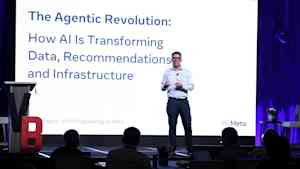
Organizations need to transform to meet the needs of agentic AI.
Meta VP of Engineering Barak Yagour opened his talk at VB Transform 2026 wearing a pair of Ray-Ban Meta AI glasses, a small sign of how far AI has already worked its way into physical life. His argument went further: enterprise infrastructure was built for humans, not for agents, and it's starting to show.