generative AI for data analysis
generative AI for data analysis at Beyond Market Intelligence is a file of 212 stories. The newest of them: “Capital One's new open-source tool finds code flaws and suggests fixes before they ship”, “Explore how open-source AI reaches new scale with Kimi K3's ambitious debut.”, and “From prompt to publish: Canva puts AI website building in every user's hands.”. Capital One has released VulnHunter, an open-source, agentic AI tool designed to find software flaws before attackers do. Beijing's Moonshot AI just dropped the heaviest open-source model yet, and it lands like a gauntlet. Acme AI is the next-generation, AI-powered spreadsheet platform built to replace Excel and redefine how analysts, data scientists, and enterprise teams work… The list below is every generative AI for data analysis story on Beyond Market Intelligence, newest first.

Capital One's new open-source tool finds code flaws and suggests fixes before they ship
Capital One has released VulnHunter, an open-source, agentic AI tool designed to find software flaws before attackers do. It scans source code, maps potential exploit paths, and proposes fixes before production deployment. What stands out is the "attacker-first forward analysis" and built-in falsification engine, which actively tries to disprove its own findings. For a company scarred by its 2019 breach, this is a confident, practical move. It signals a mature bet: the best defense is helping everyone secure their code, not just your own.

Explore how open-source AI reaches new scale with Kimi K3's ambitious debut.
Beijing's Moonshot AI just dropped the heaviest open-source model yet, and it lands like a gauntlet. Kimi K3's 2.8-trillion parameters put it toe-to-toe with Anthropic's and OpenAI's best on benchmarks, closing a gap many assumed was permanent. This is a comeback story worth watching, especially as the company opens its weights on July 27. For enterprises tired of proprietary lock-in, the choice just got more interesting. The race isn't over; it's simply widened.

From prompt to publish: Canva puts AI website building in every user's hands.
Code is about to get a lot more visual. Canva Code 2.0 brings AI-powered website building to every user, including free accounts. The focus isn't just on generating functional code but on making the output genuinely yours. With drag-and-drop editing and direct access to Canva's design library, the gap between a raw prototype and a polished, on-brand experience just closed significantly. It's about giving everyone the tools to build something that looks like it came from them.

ChatGPT learns to listen and speak at the same time, like a real conversation
OpenAI has launched GPT-Live, a significant upgrade to ChatGPT’s voice capabilities, fundamentally redesigning how users interact with the AI. Featuring a full-duplex architecture, GPT-Live allows for simultaneous listening and speaking, mimicking natural human conversation and eliminating frustrating delays. Rolling out globally today, GPT-Live prioritizes a more fluid, intuitive experience, particularly for paid users, and introduces visual cards for enhanced interaction.

A focused AI model emerges to reshape coding and autonomous agents.
SpaceX has launched Grok 4.5, its first AI model specifically designed for coding and autonomous agents, leveraging its $60 billion acquisition of Cursor. Unlike competitors, Grok 4.5 prioritizes cost-effectiveness, utilizing half the tokens per task and costing significantly less than rivals like Anthropic's Claude Opus – a strategy Musk believes will drive real-world usefulness. Early benchmarks suggest competitive performance, with Grok 4.5 demonstrating remarkable efficiency, potentially disrupting the AI coding market.

Slackbot now pulls your CRM data and charts directly from a chat message
Unlock a new level of productivity with Slack’s latest integration, connecting Slackbot directly to the Salesforce platform. Now, from a simple chat message, you can pull CRM data, generate insightful charts, and even send DocuSigns—all without leaving Slack. This marks a significant step toward a unified system, leveraging Salesforce’s extensive data and AI capabilities within the familiar Slack workspace. Discover how this transformative change can streamline workflows and empower your team, echoing insights explored in our recent article, "Information Theory and Ensemble Models."
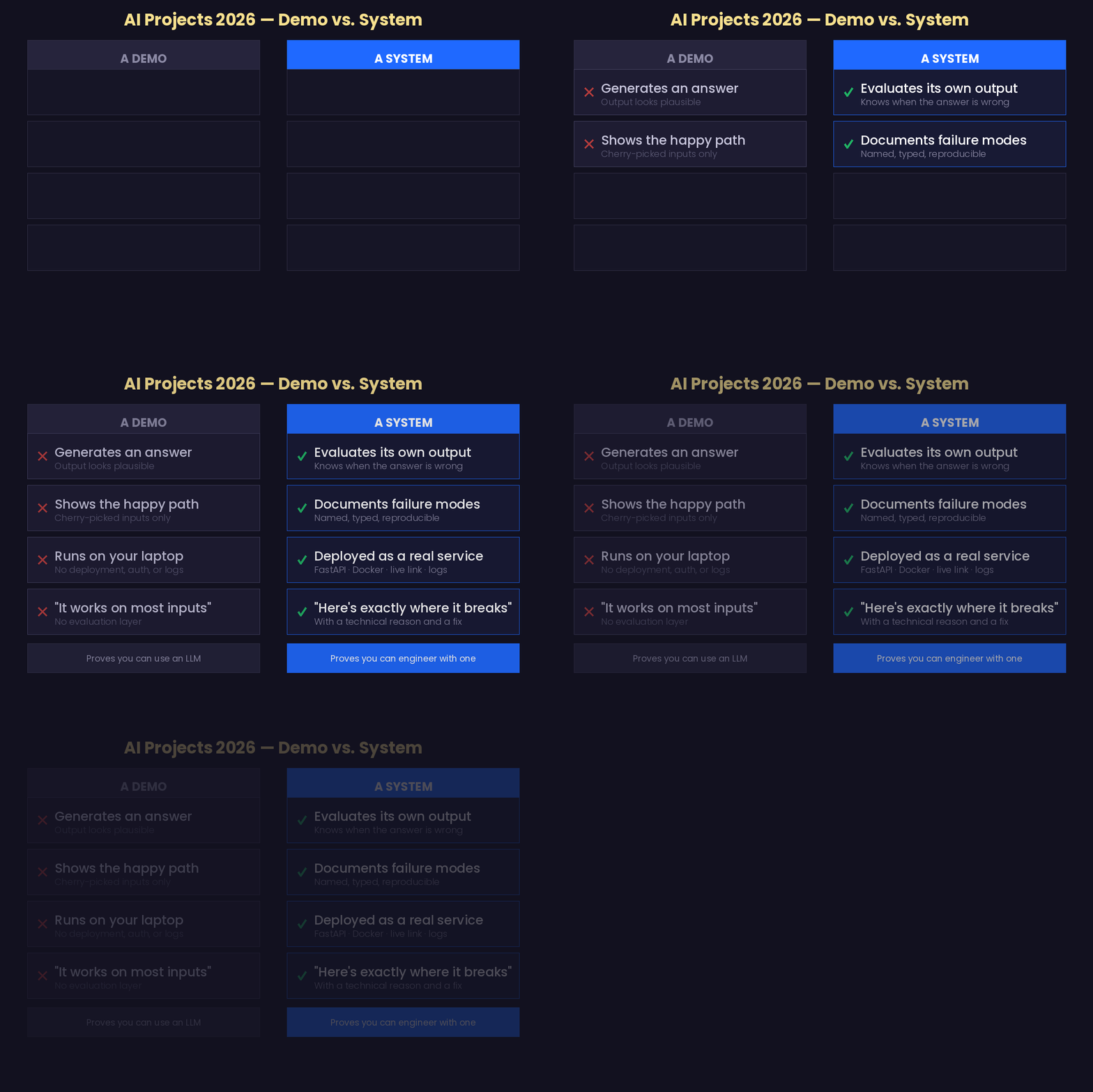
Build AI projects that prove you know where your system fails
Navigating the landscape of AI projects for 2026 requires a focused approach. The most compelling projects aren't about sheer complexity; they're about demonstrating a clear understanding of system limitations and articulating those failures confidently to potential employers. Forget wading through 50 ideas – this post delivers the top 10 AI projects poised to impress. Discover how to build demonstrable skills and showcase your expertise. For deeper insights into user interface design within AI, explore "Matching AI Modality To User Intent."

Design AI interfaces around user intent, not just chat
The rush to integrate AI often defaults to chat interfaces, overlooking a fundamental principle of user experience: matching modality to intent. Simply because Large Language Models thrive on dialogue doesn’t mean every AI capability should be presented conversationally. Great UX prioritizes the user, adapting the interface to their context and cognitive load. Explore how shifting beyond conversational tunnel vision unlocks more intuitive and effective data interactions—as discussed further in "Users Don’t Need More Tools: They Need Seamless Integrations."

How Morgan Stanley sped up reconciliation by keeping humans closer to the process
Morgan Stanley dramatically accelerated a critical reconciliation process—profit and loss (P&L) reconciliation—by deploying an internal AI agentic system called FIXR. Counterintuitively, the firm achieved a 50% reduction in processing time by prioritizing human oversight and iteratively incorporating controller decisions into automated rules. This "co-worker" approach, rather than a fully autonomous model, unlocks complex organizational workflows and exemplifies a shift toward process-first AI implementation, as highlighted by Morgan Stanley’s Managing Director, Todd Johnson.

Turn video production into a conversation your team can actually finish
Google’s Gemini Omni Flash API is poised to fundamentally reshape enterprise video production, transforming a complex, multi-stage process into a streamlined conversation. Previously limited to consumer use, this new API empowers marketing and learning-and-development teams to edit finished video clips conversationally, collapsing a five-tool pipeline into a single interaction. Priced aggressively at $0.10 per second for 720p output, Omni Flash currently leads the Text-to-Video Arena leaderboard, offering a compelling solution for internal training and social video—though higher resolutions remain a consideration.

Choosing the Right Data Skills Platform for Your Growth in 2026
Navigating the world of data skills requires choosing the right learning platform. DataCamp and Coursera are both popular options, but cater to different needs. DataCamp focuses exclusively on data science and analytics, while Coursera offers a vast marketplace of courses across numerous disciplines. This comparison weighs pricing, course catalogs, and more to determine which platform delivers the most value in 2026. For deeper insights into related AI challenges, explore "Your RAG Pipeline Is Probably Useless. Here’s a Better Alternative."

Explore how DeepSeek's DSpark framework accelerates AI inference by 85 percent.
DeepSeek has open-sourced DSpark, a new framework poised to significantly accelerate large language model (LLM) inference by up to 85%. This MIT-licensed system optimizes speed by employing a "scout" that anticipates likely text paths, allowing the LLM to quickly verify and proceed. The release, including technical papers and codebases, aims to address a key challenge in AI deployment – efficiently serving large models for real-time user experiences.
Empowering small-scale farmers with AI and NASA data for smarter planning.
AgroVision DEMO offers a future-focused solution for small-scale farmers in Nicaragua, addressing the challenges of crop loss due to climate uncertainty. This free demo, built using NASA data and machine learning, empowers producers to decide what to plant and when, simulating future climate conditions to optimize planting strategies. The system assesses potential losses and gains, providing insights in real córdobas, and features an AI advisor, ARI, to guide decision-making. Explore the possibilities at [https://agrovision10.vercel.app/](https://agrovision10.vercel.

Explore how OpenAI's Sol, Terra, and Luna models could reshape your workflows.
OpenAI today initiates a limited preview of its next-generation GPT-5.6 model series—Sol, Terra, and Luna—designed to transform developer and enterprise workflows. Following coordination with the U.S. government, access is currently restricted to approximately 20 organizations. Sol, the top-tier model, excels in complex reasoning and security applications, while Terra balances performance and efficiency, and Luna prioritizes speed and cost-effectiveness. This phased release reflects a novel landscape of safety interventions and compliance parameters for enterprise buyers. "It’s not about Anthropic vs.

Your software factory is producing bugs faster: let's build smarter.
Many organizations mistakenly believe they're building a software factory, when in reality, they're simply accelerating the release of bugs. Just as industrialized factories revolutionized physical production, a similar shift is now underway in software development, fueled by LLMs. However, traditional development lifecycles are ill-equipped for this new speed. A true software factory demands more than just velocity—it requires a platform with standardized processes, rigorous quality control, and inherent traceability. Otherwise, you risk generating "AI slop" faster than ever.

Explore how GPT-5.5 Instant adapts to your intent with sharper, more natural responses.
OpenAI has significantly updated GPT-5.5 Instant, the default language model powering the free version of ChatGPT, delivering tangible improvements in shopping, complex instruction handling, and user intent understanding. This upgrade, now available to paid subscribers and rolling out to free users, represents a move toward a more intuitive and responsive AI experience. Developers can access these enhancements via the updated chat-latest API alias, though OpenAI still recommends the separate gpt-5.5 model for production environments.
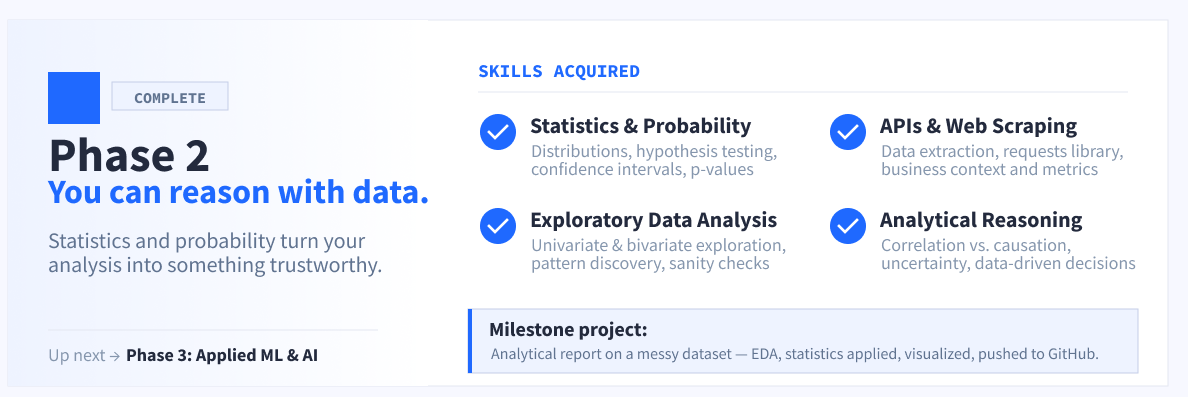
Your Practical Roadmap to Becoming a Data Scientist by 2027
## Data Scientist Roadmap for Beginners (2026–2027) Navigating the path to becoming a data scientist can feel overwhelming. This roadmap clarifies exactly what to learn, in what order, and how long it realistically takes to achieve job readiness by 2027 – whether you’re starting from zero or transitioning from data analysis, engineering, or research. We cut through the noise surrounding Python vs. R, degree requirements, and the rise of Generative AI to provide a focused, actionable plan.

Mistral OCR 4 brings structured document intelligence to enterprise workflows
Mistral AI has launched OCR 4, transforming document extraction into a full enterprise AI solution. This fourth-generation model delivers structured document representations, including bounding boxes, block classification, and confidence scores, moving beyond simple text extraction. Supporting 170 languages and deployable on-premise, OCR 4 addresses critical data sovereignty concerns, particularly relevant following recent U.S. export control actions. Early enterprise feedback highlights significant cost and latency reductions, positioning Mistral as a compelling alternative for document-intensive workflows.

Stanford's agentic scientists could reshape drug discovery's broken pipeline
Drug discovery faces systemic inefficiencies, with staggering failure rates and lengthy, costly timelines. Stanford researchers are pioneering a transformative solution: deploying thousands of autonomous AI “scientist” agents within a virtual biotech to streamline the entire drug development lifecycle. Led by James Zou, this innovative system maintains crucial context and continuity, unlike traditional, siloed workflows. Learn how this hierarchical agentic AI, leveraging models like Claude, is poised to revolutionize medical research and discover strategies for managing complex workflows at VB Transform 2026.
Enterprise AI imagery finds its own voice with faster, open-weight generation
Enterprise-grade AI image generation in just 2 seconds is now a reality with Krea 2 Raw and Turbo, available as open weights under a custom license. Addressing concerns that AI imagery often lacks originality, Krea’s new models offer greater visual variety, prompt accuracy, and crucial customization capabilities for brands. Krea 2 Turbo’s remarkable 2-second generation speed surpasses competitors, while Krea 2 Raw provides a flexible foundation for training custom models.

Alibaba Cloud's HappyHorse 1.1 makes production-ready AI video accessible to enterprises
Alibaba's HappyHorse 1.1 AI video model has surged to the No. 2 spot in global rankings, capitalizing on a dramatic shift in the generative video landscape. Following OpenAI’s Sora discontinuation and ByteDance's Seedance freeze, enterprise buyers now face limited options. HappyHorse, built for integration into business workflows and backed by Alibaba's substantial $52.7 billion infrastructure investment, offers production-ready video synthesis with features like multi-image reference capabilities and improved motion quality.

Sakana's new Fugu system delivers frontier AI through multi-model orchestration
Following Anthropic’s recent move to restrict access to its powerful Claude Fable 5 and Claude Mythos 5 models, Sakana AI has launched Fugu, a novel multi-model orchestration system designed to deliver frontier-level AI performance via a familiar OpenAI-compatible API. This innovative system dynamically routes queries across a pool of specialized AI agents, providing resilience against vendor lock-in and geopolitical export controls.
Trust Your GPU Code with Verified Memory Safety from Rust
Introducing “Fearless Concurrency on the GPU,” a new paper exploring safe GPU inference in Rust, now available on arXiv. Addressing the growing challenge of trusting AI-generated GPU code, cuTile Rust leverages Rust’s ownership model to guarantee memory safety and data-race freedom—by construction. Our resulting Grout inference engine, built with Hugging Face, achieves competitive performance against vLLM and SGLang, reaching up to 171 tok/s on an RTX 5090. For those interested in related model optimization techniques, see our recent article on "How torch.compile() achieves massive speedups."
Embrace Uncertainty to Make Smarter Design Decisions with AI
In an increasingly AI-driven design landscape, it's crucial to move beyond treating predictions as definitive truths. Probabilistic Design is a future-focused mindset empowering UX and product teams to embrace uncertainty and intelligently interpret AI outputs. Learn how to make adaptive decisions, transforming potential pitfalls into opportunities. Discover a framework for navigating complexity and building more resilient solutions. For deeper insights into the evolving AI landscape, explore "Probably raises $9M to build a more reliable kind of AI."