The inefficiencies plaguing drug discovery are well-documented, a frustrating reality for researchers and a significant barrier to medical advancement. The staggering failure rate – reportedly 90% to 95% – and the exorbitant costs associated with bringing a single drug to market underscore a systemic problem. This isn't simply about bad luck; it's about fractured workflows and the inevitable loss of context as projects are handed between specialized teams. Recent advancements in generative AI have offered glimpses of potential solutions, but Stanford’s work with agentic AI represents a truly transformative shift, building upon the foundational work seen in articles like Xiaomi's HarnessX rewrites its own AI scaffolding mid-task — and smaller models gain the most and mirroring the strategies explored in Alibaba's model never trained as an agent — and improved agent performance across seven benchmarks, where the focus is on enabling AI to handle increasingly complex, long-horizon tasks. Professor Zou’s team’s approach, deploying thousands of autonomous AI "scientist" agents within a virtual biotech, promises to address these shortcomings head-on by maintaining continuity and context throughout the entire drug development lifecycle.
The hierarchical orchestration framework is particularly compelling. Rather than a monolithic AI attempting to manage every aspect of drug discovery, the system leverages a team of specialized agents, each focused on a specific task—discovery, safety, analysis—all guided by a central “chief scientist officer.” This structure mirrors the way human research teams operate, but with the added benefit of constant communication and data sharing within the AI ecosystem. The emphasis on "agent-native" data, ensuring the AI has access to and can effectively synthesize vast datasets, further strengthens the approach. The use of a mixed-model architecture, drawing on tools like Claude for coding and data analysis while incorporating fine-tuned models for specialized use cases, demonstrates a pragmatic and adaptable approach to leveraging the power of AI. It’s a move away from the hype around singular, all-powerful models towards a more modular and robust system – a strategy that aligns with the growing understanding of how to best deploy AI in complex environments.
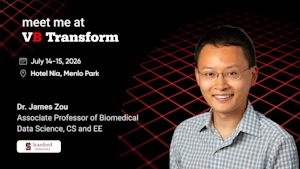
The potential impact of this technology extends far beyond simply accelerating drug discovery. By streamlining workflows and reducing failure rates, it could dramatically lower the cost of bringing new treatments to patients, expanding access to life-saving medications. The Human Intelligence startup, currently valued at roughly $1 billion, is clearly banking on this transformative potential, and the insights Zou will share at VB Transform promise to offer a glimpse into the practical considerations of building and managing such a system. The challenges of context management, data transformation, and ensuring agent trustworthiness, as highlighted in Zou’s session and echoed by the work of companies like Zillow, discussed in Mistral launches OCR 4, turning document extraction into a full enterprise AI play, are critical to successful implementation.
The emergence of agentic AI in drug discovery signals a fundamental shift in how we approach scientific research. While the technology is still in its early stages, the potential to automate and accelerate the process, while simultaneously improving success rates, is undeniable. The question now is not *if* AI will reshape drug discovery, but *how quickly* and what new ethical and regulatory considerations will arise as these increasingly autonomous systems take on greater responsibility for human health. The ability to effectively manage context and ensure the integrity of agent actions will be paramount to realizing the full potential of this transformative technology, and the lessons learned from Stanford's virtual biotech will be invaluable to anyone seeking to build the future of medical research.