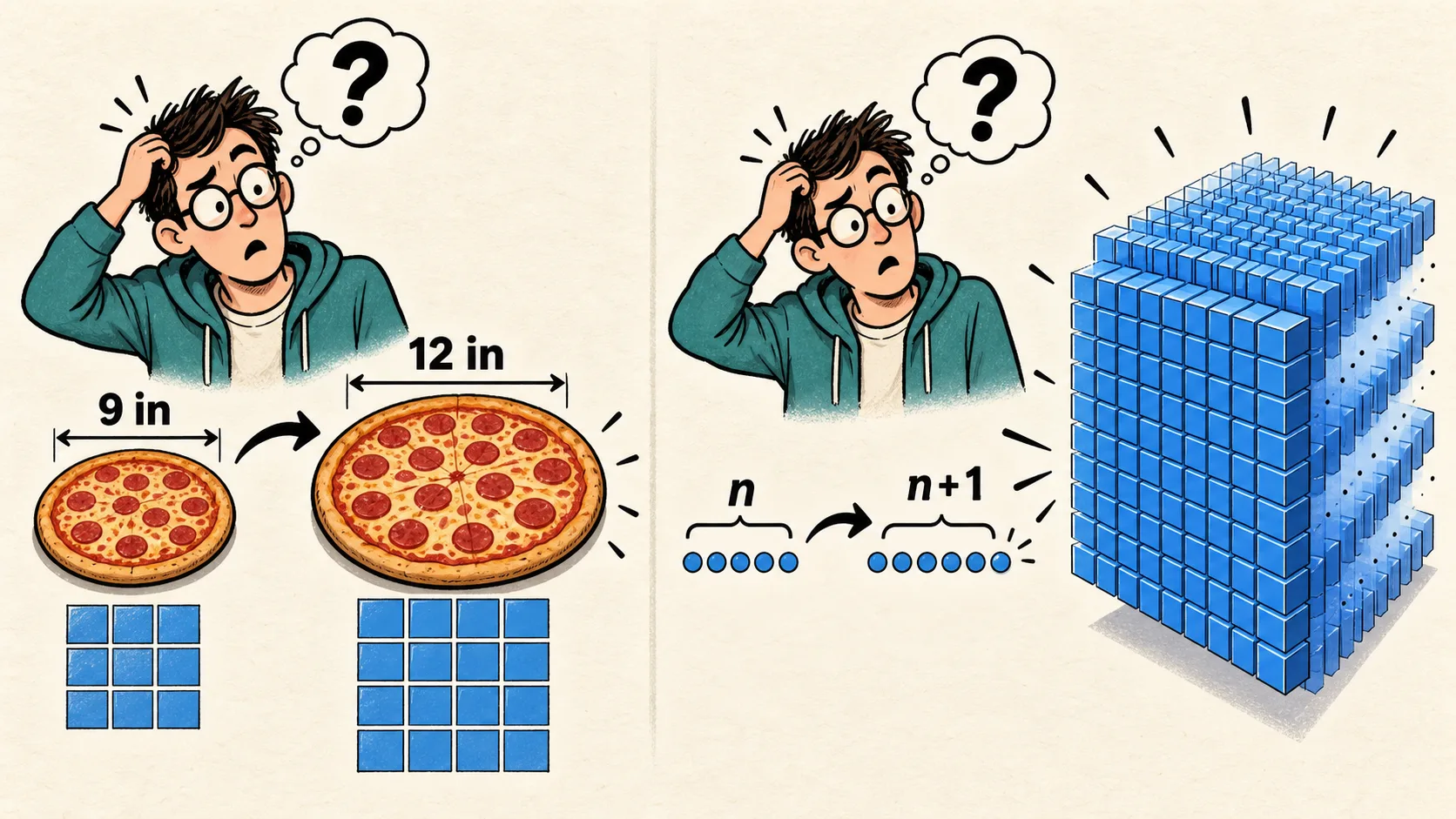
There is a particular kind of clarity that comes from a well-chosen analogy, and the image of ordering a large pizza and not eating it captures something essential about how we often approach machine learning memory. The piece frames this as the "N Squared Pizza Problem," a nod to the quadratic growth that plagues attention mechanisms and certain memory architectures. It is a simple observation, but it carries a weighty lesson: we frequently allocate resources for a feast, only to realize the true cost arrives when it is time to process, not consume. For anyone who has watched a training run stall or a model silently double its memory footprint, this is not a theoretical quirk. It is the difference between a smooth iteration loop and a hard stop.
The comparison to a leftover pizza is apt because it grounds an abstract technical constraint in a familiar, human experience. You do not need a computer science degree to understand that ordering for eight people when you are feeding two leads to waste. In the same way, your model might request memory for a sequence that grows quadratically with input length, and you feel that pinch in your infrastructure bill or your latency. This is where we connect the story to a broader thread we have been following, particularly in how we think about Exploring Paragraph Structure: How LLMs Navigate Token Space. That piece looks at how token indices act as coordinates, and how structure turns them into a metric. The pizza problem is a stark reminder that the metric is not always your friend when the coordinate space expands faster than your ability to manage it.
Our take is that this framing should push you toward a more deliberate memory strategy, not a more aggressive one. The instinct when faced with a large, uneaten pizza might be to order a smaller one next time, but the real insight is to ask whether you needed the pizza at all. In ML terms, that means questioning whether your architecture truly requires full quadratic attention, or whether a sparse or linear approximation could serve your task without the indigestion. We have touched on similar themes when exploring Unlock LLM Training: A Practical Guide to Distributed Algorithms, where the focus is on how systems handle load across nodes. The same principle applies here: memory is a shared resource, and understanding its behavior under pressure is not a niche concern. It is core to building models that scale without collapsing.
If a reader came to us and asked what to take from this, we would say this: treat memory like a budget, not a given. The pizza analogy is useful because it forces you to confront the difference between what you request and what you actually use. The most practical step is to profile your model's memory allocation as rigorously as you profile its accuracy. Measure the peak, but also measure the waste. The open question that remains, and the one we will be watching, is how the next generation of architectures will sidestep the N squared trap entirely. Will we see more dynamic memory systems that release unused capacity on the fly, or will we simply accept the cost as the price of admission? That is the detail to keep an eye on, because the solution is not a smaller pizza, but a smarter kitchen.