An Introductory Guide to Practical Constraint Decoding
Our take
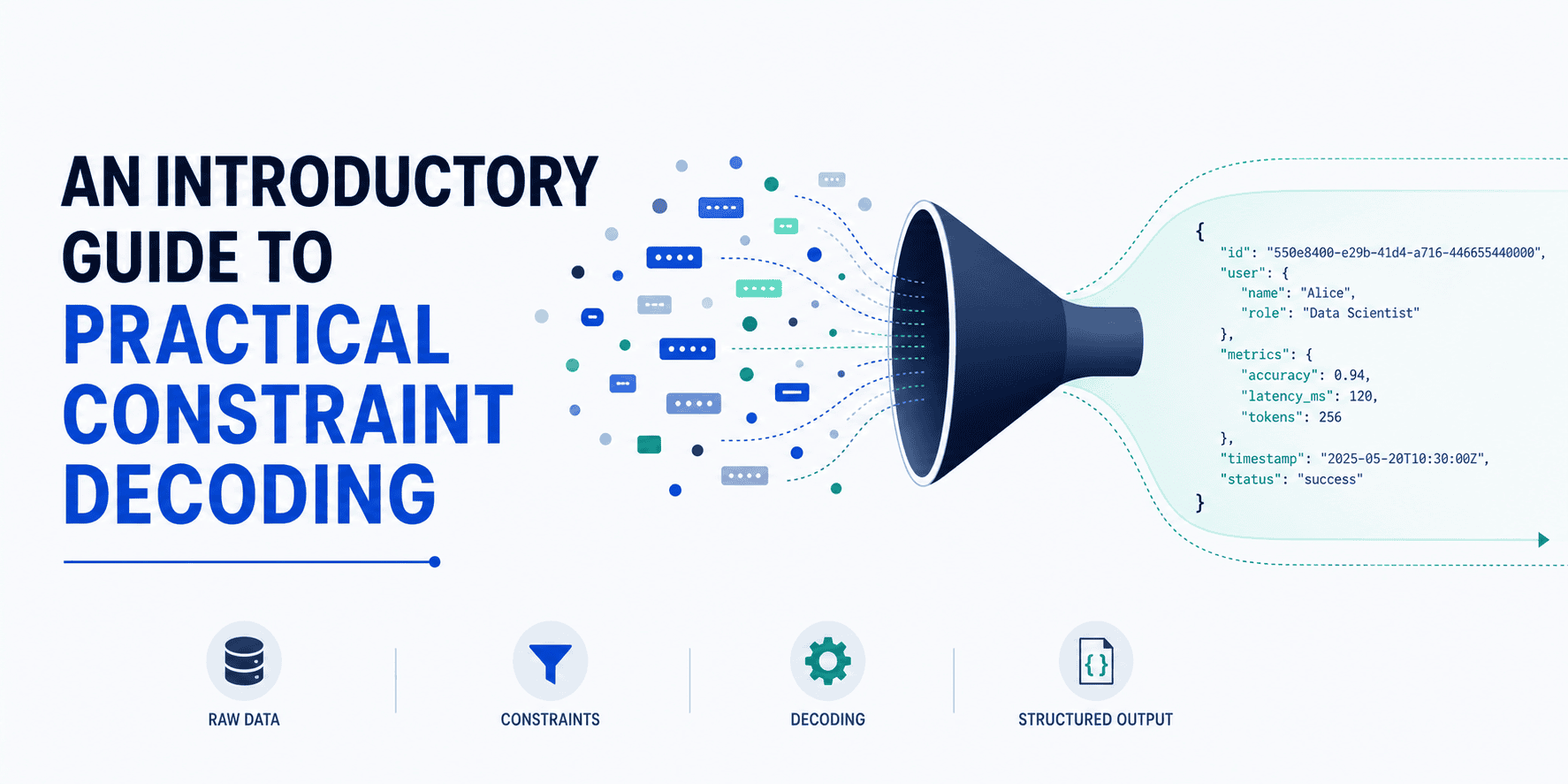
The persistent frustration of coaxing Large Language Models (LLMs) to consistently produce outputs in a desired format – be it valid JSON, clean markdown, or structured data – is a familiar one to anyone working with them. The common workaround, essentially pleading with the model to avoid unwanted elements, feels distinctly…inelegant. This new guide on practical constraint decoding offers a much-needed shift towards a more reliable and deterministic approach. It’s a welcome move away from the iterative prompting and finetuning often required, and speaks to a growing sophistication in how we interact with these powerful tools. The focus on practical application, rather than purely theoretical exploration, is particularly valuable. This resonates with the current challenges – many data professionals are already wrestling with deploying LLMs in real-world scenarios, and needing to guarantee output consistency is paramount. Consider the complexities of presenting results effectively, as discussed in [Link plots/figures in NeurIPS rebuttal [R]], where clear visualization is essential for conveying complex findings to reviewers.
Constraint decoding, at its core, allows us to impose stricter rules on the model’s output generation process, guiding it towards the desired structure without relying on vague instructions. This moves beyond simple prompt engineering and delves into techniques that directly influence the decoding process itself. The significance of this development lies in its potential to dramatically improve the reliability of LLMs for tasks requiring structured outputs, like data extraction, API integration, and report generation. Imagine a future where building a data pipeline powered by an LLM isn't a constant exercise in error handling and post-processing, but a streamlined, predictable process. It's a crucial step in bridging the gap between the impressive capabilities of LLMs and their practical usability. The ability to reliably control output format also has implications for collaborative workflows; as demonstrated by the call for meetups at KDD in Jeju [Anyone heading to Jeju for KDD? Let’s meet up! 🙋[D]], the need for shared understanding and consistent results is vital when working with these technologies across teams.
The shift towards constraint decoding also highlights a broader trend in the AI space: a move away from purely black-box approaches and towards greater control and interpretability. While visualizations like those exploring GPT-2’s embedding geometry [GPT-2 Small’s embedding geometry around “Trump”: discretized vs. continuous nearest neighbours [P]] offer fascinating insights into model behavior, practical constraint decoding provides a more direct means of influencing that behavior. It's about understanding *how* these models generate text, not just observing the *results*. This emphasis on control aligns with the increasing demand for responsible AI practices and the need to ensure that LLMs are aligned with specific objectives and constraints. The ability to enforce data integrity and output consistency is a fundamental requirement for many applications, particularly those involving sensitive data or critical decision-making processes.
Looking ahead, the evolution of constraint decoding techniques will be a key area to watch. As LLMs continue to grow in complexity, the need for precise control over their output will only become more pronounced. We can anticipate further innovations in this space, including more sophisticated constraint languages, automated constraint generation, and seamless integration with existing data pipelines. The question becomes: how can we democratize access to these powerful constraint decoding tools, making them accessible to a wider range of users, and ensuring that the benefits of this technology are widely realized? The move toward greater control and predictability in LLM outputs promises a more robust and reliable future for AI-powered applications across numerous industries.
Read on the original site
Open the publisher's page for the full experience