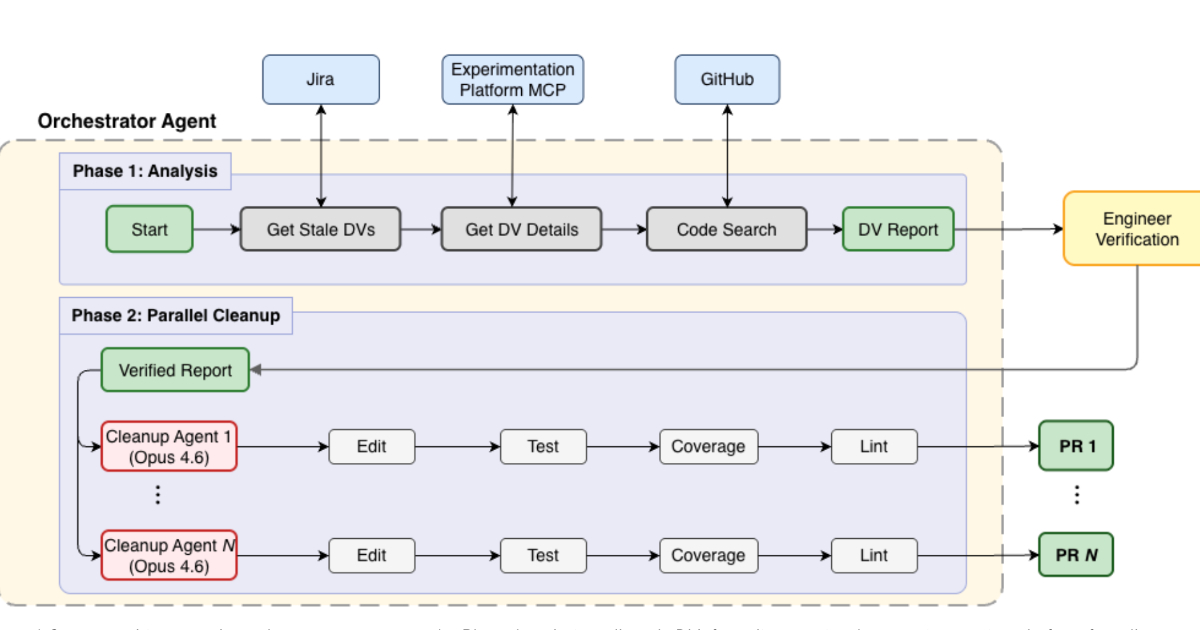
DoorDash's new multi-agent system for cleaning up stale feature flags is the kind of quiet, unglamorous win that actually moves the needle in software delivery. With more than 60,000 flags across 623 repositories, the company faced a familiar problem: technical debt that accumulates one small toggle at a time. Their solution pairs live experimentation data with an LLM-driven workflow, where agents propose pull requests, engineers approve them, and isolated Git worktrees keep the process safe. In a 50-flag evaluation, 45 produced usable PRs at an average of 13.8 minutes and $4.79 per cleanup. That is not just a neat experiment; it is a working template for turning operational hygiene into an automated, measurable process.
What stands out here is the deliberate human oversight built into the loop. DoorDash did not try to remove engineers from the equation; they made their time count more. The agents handle the tedious parts, like gathering context and drafting changes, while a person stays responsible for judgment calls. That aligns with a broader trend we have been watching across the industry. For example, Morgan Stanley's work on Scale AI Workflows: Modernizing APIs with Architecture as Code shows how structured, code-defined approaches can bring order to complex systems. And the idea that interfaces are shifting toward intent-driven design, as explored in The Death Of The Button: Why The Best Interface Is No Interface, reinforces that the most effective tools are the ones that fade into the background. DoorDash's flag cleanup is not about building a flashy new interface; it is about letting the system do the unglamorous work so people do not have to.
For teams considering something similar, the practical takeaway is not the specific LLM setup or the MCP integration, though those matter. It is the validation loop. DoorDash tested the system on 50 flags before scaling it, and that discipline is worth copying. Too many AI initiatives skip the evaluation phase and then struggle to prove value. Here, the numbers are clear: a 90% success rate, a predictable cost per task, and a meaningful reduction in manual effort. If you are drowning in deprecated toggles or similar low-stakes but high-volume chores, this approach gives you a concrete starting point. Start small, measure the output, and keep a human in the loop for anything that touches production behavior.
The open question is how far this pattern extends. DoorDash applied it to feature flags, but the same logic could hold for dependency upgrades, config migrations, or even documentation updates. The hard part is not building the agent; it is defining the acceptance criteria and knowing when to say no. The teams that figure that out will turn AI from a novelty into a reliable engineering teammate. Watch for how DoorDash handles the edge cases, like flags that fail validation or require deeper code changes. That is where the real lessons will surface.