Beyond Bots: Rethinking AI Support with a Hybrid AI Architecture
Our take
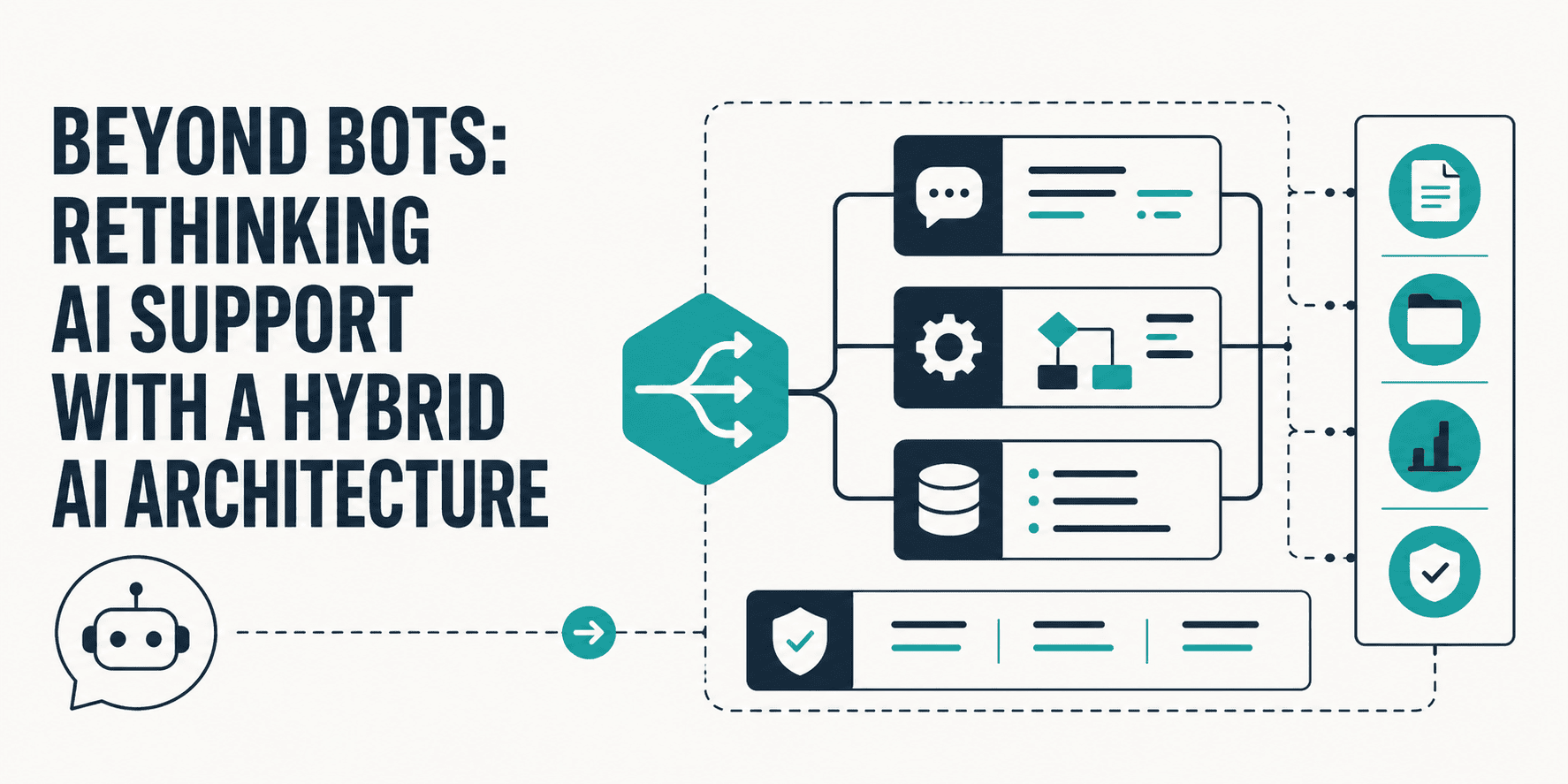
The conversation around AI support has largely centered on large language models (LLMs) as standalone solutions, often touted as replacements for human agents. However, the article "Beyond Bots: Rethinking AI Support with a Hybrid AI Architecture" rightly highlights a more nuanced and ultimately more effective approach: blending Retrieval-Augmented Generation (RAG) with fine-tuning. This isn't just about layering technologies; it's a recognition that the inherent strengths of each—RAG's ability to access and synthesize vast knowledge bases and fine-tuning's capacity to imbue models with specific conversational styles and domain expertise—are amplified when combined. The recent departure of figures like Jeff Dean and other top AI researchers from Google to launch their own startup Jeff Dean and other top AI researchers are leaving Google to launch their own startup underscores the ongoing exploration of alternative AI architectures, moving beyond the singular focus on ever-larger LLMs. This shift signals a broader understanding that specialized approaches, tailored to specific tasks, can often outperform generalized models, particularly in complex applications like customer support.
The core of the hybrid approach lies in addressing the limitations of both individual techniques. RAG, while powerful for knowledge retrieval, can sometimes struggle with generating coherent and contextually appropriate responses without further refinement. Fine-tuning, conversely, can lead to overfitting if not carefully managed, and may not inherently possess the ability to access and integrate external information. By strategically combining these two, organizations can build AI support systems that are both knowledgeable and conversational. This resonates with the increasing emphasis on enterprise document intelligence, as demonstrated in articles like "Building Document Structure with Loop Engineering: Recovering a PDF’s Outline from Body Typography for RAG" Building Document Structure with Loop Engineering: Recovering a PDF’s Outline from Body Typography for RAG, which highlights the importance of effectively structuring and accessing information for RAG systems. Ultimately, this hybrid architecture promises to deliver more accurate, relevant, and human-like support interactions.
What makes this development particularly significant is its potential to democratize access to high-quality AI support. Building and maintaining a fully fine-tuned LLM is a resource-intensive undertaking, often beyond the reach of smaller organizations. A hybrid approach, leveraging existing LLMs with RAG and targeted fine-tuning, significantly lowers the barrier to entry. This is especially relevant given the accelerating pace of AI integration across various industries, exemplified by the displays of robots and automated factories showcased at TechCrunch Disrupt 2026’s Real World AI stage TechCrunch Disrupt 2026’s Real World AI Stage features robots, automated factories, and extinct animals. The ability to rapidly deploy and customize AI support systems will be a critical differentiator for businesses seeking to enhance customer experience and operational efficiency. The future of AI support isn’t about replacing human agents entirely; it’s about augmenting their capabilities and providing users with seamless, efficient, and personalized assistance.
Looking ahead, the challenge will be in developing robust frameworks for managing and optimizing these hybrid architectures. How can organizations effectively balance the trade-offs between RAG and fine-tuning, ensuring that the system remains both knowledgeable and adaptable? Furthermore, as LLMs continue to evolve, how will these hybrid approaches need to be re-evaluated and refined? The integration of real-time feedback loops to continuously improve both the retrieval and generation components will be crucial. The ability to monitor and adjust the weighting of RAG versus fine-tuning based on specific use cases and performance metrics will be a key determinant of success. It's a space to watch closely as the industry moves beyond the initial hype and focuses on building truly practical and sustainable AI solutions.
Read on the original site
Open the publisher's page for the full experience