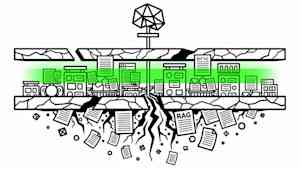
Enterprise RAG shifts focus from adding retrieval layers to rebuilding themSomething shifted in enterprise RAG in Q1 2026. VB Pulse data spanning January through March tells a consistent story: the market stopped adding retrieval layers and started fixing the ones it already has. Call it the retrieval rebuild.
The survey covered three consecutive monthly waves from organizations with 100 or more employees, with between 45 and 58 qualified respondents per month across platform adoption, buyer intent, architecture outlook and evaluation criteria. The data should be treated as directional.
Enterprise intent to adopt hybrid retrieval tripled from 10.3% to 33.3% in a single quarter — even as 22% of qualified enterprise respondents reported having no production RAG systems at all. For data engineers and enterprise architects building agentic AI infrastructure, the data reveals a market in active transition: the RAG architecture most enterprises built to scale is not the one they expect to run by year-end.
Hybrid retrieval has become the consensus enterprise strategy. Unlike single-method RAG pipelines that rely on vector similarity alone, hybrid retrieval combines dense embeddings with sparse keyword search and reranking layers, trading simplicity for the retrieval accuracy and access control that production agentic workloads require.
The standalone vector database category is under pressure. Weaviate, Milvus, Pinecone and Qdrant each lost adoption share across the quarter in the VB Pulse data. Custom stacks and provider-native retrieval are absorbing their displaced share.
A growing minority of enterprises are stepping back from RAG altogether — a signal that the market's maturity narrative has meaningful exceptions.
Organizations that went wide on RAG in 2025 are hitting the same failure point: the architecture built for document retrieval does not hold at agentic scale.
Enterprises that scaled RAG fast are now paying to rebuild it
The two largest intent movements in Q1 are directly connected — enterprises confronting retrieval quality problems at scale, and hybrid retrieval emerging as the consensus answer.
Investment priorities shifted in parallel. Evaluation and relevance testing led budget intent in January at 32.8% and fell to 15.6% by March. Retrieval optimization moved in the opposite direction, from 19.0% to 28.9% — overtaking evaluation as the top growth investment area for the first time.
Steven Dickens, vice president and practice lead at HyperFRAME Research, described the operational burden enterprise data teams are facing in a VentureBeat interview in March on Oracle's agentic AI data stack. "Data teams are exhausted by fragmentation fatigue," Dickens said. "Managing a separate vector store, graph database and relational system just to power one agent is a DevOps nightmare."
That fatigue shows directly in the platform data. The custom stack rise to 35.6% is not a rejection of managed retrieval — many organizations run both. It is a consolidation response from engineering teams that have hit the limits of assembling too many components.
Not every enterprise has made it that far. The VB Pulse data includes a signal that complicates the market's overall growth narrative: 22.2% of qualified respondents reported no production RAG by March, up from 8.6% in January. The report attributes this cohort to organizations that have "not yet committed to any retrieval infrastructure, or have paused programs" — concentrated in Healthcare, Education and Government, the same sectors showing the highest rates of flat budgets.
Standalone vector databases are losing the adoption argument but winning the reliability one
Recent reporting by VentureBeat illustrates why the dedicated retrieval layer still matters in production.
Two enterprises building on Qdrant show why purpose-built vector infrastructure still wins in production.
&AI builds patent litigation infrastructure and runs semantic search across hundreds of millions of documents. Grounding every result in a real source document is not optional — patent attorneys will not act on AI-generated text. That requirement makes the architectural choice clear.
"The agent is the interface," Herbie Turner, &AI's founder and CTO, told VentureBeat in March. "The vector database is the ground truth."
GlassDollar, a startup that helps Siemens and Mahle evaluate startups, runs an agentic retrieval pattern across a corpus approaching 10 million indexed documents. A single user prompt fans out into multiple parallel queries, each retrieving candidates from a different angle before results are combined and re-ranked. That query volume and precision requirement is what drove the choice of purpose-built vector infrastructure.
"We measure success by recall," Kamen Kanev, GlassDollar's head of product, told VentureBeat in March. "If the best companies aren't in the results, nothing else matters. The user loses trust."
The VB Pulse data shows that framing — retrieval as ground truth rather than feature — is gaining traction across the broader enterprise market, even as standalone vector database adoption declines.
Why enterprises say they need a dedicated vector layer shifted significantly across Q1. In January the top reasons were access control complexity (20.7%) and retrieval precision (19.0%). By March, operational reliability at scale had surged to 31.1% — more than doubling and overtaking everything else. Enterprises are no longer keeping vector infrastructure primarily for precision. They are keeping it because it is the part of the stack they can rely on when query volumes scale.
How enterprises are redefining what good retrieval means
How enterprises judge their retrieval systems shifted notably across Q1 — and the direction of that shift points to a market getting more sophisticated about what good retrieval actually means.
In January, response correctness dominated evaluation criteria at 67.2% — far above anything else. By March, response correctness (53.3%), retrieval accuracy (53.3%) and answer relevance (53.3%) had converged exactly. Getting the right answer is no longer enough if it came from the wrong document or missed the context of the question.
Answer relevance was the only criterion that rose across the quarter, gaining five percentage points. It is also the hardest to measure — whether the retrieved context is actually the right context for that specific question requires purpose-built evaluation infrastructure, not just pass-or-fail correctness checks. Its rise signals that a meaningful share of enterprise buyers have moved past basic RAG testing entirely.
The market's verdict: RAG isn't dead. The original architecture is
The "RAG is dead" narrative had real momentum heading into 2026. It rested on two claims. The first: that long-context windows — models capable of processing hundreds of thousands of tokens in a single prompt — would make dedicated retrieval unnecessary. The second: that agentic memory systems, which store what an agent learns across sessions rather than retrieving it fresh each time, would absorb the knowledge access problem entirely.
The VB Pulse data is the enterprise market's answer to the first claim. The long-context-as-dominant-architecture position collapsed from 15.5% in January to 3.5% in February before partially recovering to 6.7% in March. January's sample was heavily weighted toward Technology and Software respondents — the segment most exposed to long-context model announcements in late 2025. As the sample diversified, the position evaporated.
On the memory question, Jonathan Frankle, chief AI scientist at Databricks, framed the architecture clearly in a March interview with VentureBeat: a vector database with millions of entries sits at the base of the agentic memory stack, too large to fit in context. The LLM context window sits at the top. Between them, new caching and compression layers are emerging — but none of them replace the retrieval layer at the base. New agentic memory systems like Hindsight, developed by Vectorize, and observational memory approaches like those in the Mastra framework address session continuity and agent context over time — a different problem than high-recall search across millions of changing enterprise documents.
The most consequential signal: the share of respondents not expecting large-scale RAG deployments by year-end grew from 3.4% to 15.6% — nearly 5x. That is not a verdict against retrieval. It is a verdict against the retrieval architecture most enterprises built first.
The retrieval rebuild is not optional
The retrieval rebuild is the cost of scaling RAG without first deciding what architecture could actually support it.
If your organization is among the 43.1% that entered Q1 planning to expand RAG into more workflows, the VB Pulse data suggests that plan has already changed for many of your peers — and may need to change for you. Hybrid retrieval is the consensus destination. Custom stack growth to 35.6% reflects teams building retrieval infrastructure around requirements that off-the-shelf products do not fully address.
RAG is not dead. The architecture most enterprises used to implement it is. The data suggests the rebuild is not a future decision. For 33% of enterprises, the rebuild is already the stated priority.
Your data agents are only as smart as their freshest context.Enterprise data teams moving agentic AI into production are hitting a consistent failure point at the data tier. Agents built across a vector store, a relational database, a graph store and a lakehouse require sync pipelines to keep context current. Under production load, that context goes stale.
Oracle, whose database infrastructure runs the transaction systems of 97% of Fortune Global 100 companies by the company's own count, is now making a direct architectural argument that the database is the right place to fix that problem.
Oracle this week announced a set of agentic AI capabilities for Oracle AI Database, built around a direct architectural counter-argument to that pattern.
The core of the release is the Unified Memory Core, a single ACID (Atomicity, Consistency, Isolation, and Durability)-transactional engine that processes vector, JSON, graph, relational, spatial and columnar data without a sync layer. Alongside that, Oracle announced Vectors on Ice for native vector indexing on Apache Iceberg tables, a standalone Autonomous AI Vector Database service and an Autonomous AI Database MCP Server for direct agent access without custom integration code.
The news isn't just that Oracle is adding new features, it's about the world's largest database vendor realizing that things have changed in the AI world that go beyond what its namesake database was providing.
"As much as I'd love to tell you that everybody stores all their data in an Oracle database today — you and I live in the real world," Maria Colgan, Vice President, Product Management for Mission-Critical Data and AI Engines, at Oracle told VentureBeat. "We know that that's not true."
Four capabilities, one architectural bet against the fragmented agent stack
Oracle's release spans four interconnected capabilities. Together they form the architectural argument that a converged database engine is a better foundation for production agentic AI than a stack of specialized tools.
Unified Memory Core. Agents reasoning across multiple data formats simultaneously — vector, JSON, graph, relational, spatial — require sync pipelines when those formats live in separate systems. The Unified Memory Core puts all of them in a single ACID-transactional engine. Under the hood it is an API layer over the Oracle database engine, meaning ACID consistency applies across every data type without a separate consistency mechanism.
"By having the memory live in the same place that the data does, we can control what it has access to the same way we would control the data inside the database," Colgan explained.
Vectors on Ice. For teams running data lakehouse architectures on the open-source Apache Iceberg table format, Oracle now creates a vector index inside the database that references the Iceberg table directly. The index updates automatically as the underlying data changes and works with Iceberg tables that are managed by Databricks and Snowflake. Teams can combine Iceberg vector search with relational, JSON, spatial or graph data stored inside Oracle in a single query.
Autonomous AI Vector Database. A fully managed, free-to-start vector database service built on the Oracle 26ai engine. The service is designed as a developer entry point with a one-click upgrade path to full Autonomous AI Database when workload requirements grow.
Autonomous AI Database MCP Server. Lets external agents and MCP clients connect to Autonomous AI Database without custom integration code. Oracle's row-level and column-level access controls apply automatically when an agent connects, regardless of what the agent requests.
"Even though you are making the same standard API call you would make with other platforms, the privileges that user has continued to kick in when the LLM is asking those questions," Colgan said.
Standalone vector databases are a starting point, not a destination
Oracle's Autonomous AI Vector Database enters a market occupied by purpose-built vector services including Pinecone, Qdrant and Weaviate. The distinction Oracle is drawing is about what happens when vector alone is not enough.
"Once you are done with vectors, you do not really have an option," Steve Zivanic, Global Vice President, Database and Autonomous Services, Product Marketing at Oracle, told VentureBeat. "With this, you can get graph, spatial, time series — whatever you may need. It is not a dead end."
Holger Mueller, principal analyst at Constellation Research, said that the architectural argument is credible precisely because other vendors cannot make it without moving data first. Other database vendors require transactional data to move to a data lake before agents can reason across it. Oracle's converged legacy, in his view, gives it a structural advantage that is difficult to replicate without a ground-up rebuild.
Not everyone sees the feature set as differentiated. Steven Dickens, CEO and principal analyst at HyperFRAME Research, told VentureBeat that vector search, RAG integration and Apache Iceberg support are now standard requirements across enterprise databases — Postgres, Snowflake and Databricks all offer comparable capabilities.
"Oracle's move to label the database itself as an AI Database is primarily a rebranding of its converged database strategy to match the current hype cycle," Dickens said. In his view the real differentiation Oracle is claiming is not at the feature level but at the architectural level — and the Unified Memory Core is where that argument either holds or falls apart.
Where enterprise agent deployments actually break down
The four capabilities Oracle shipped this week are a response to a specific and well-documented production failure mode. Enterprise agent deployments are not breaking down at the model layer. They are breaking down at the data layer, where agents built across fragmented systems hit sync latency, stale context and inconsistent access controls the moment workloads scale.
Matt Kimball, vice president and principal analyst at Moor Insights and Strategy, told VentureBeat the data layer is where production constraints surface first.
"The struggle is running them in production," Kimball said. "The gap is seen almost immediately at the data layer — access, governance, latency and consistency. These all become constraints."
Dickens frames the core mismatch as a stateless-versus-stateful problem. Most enterprise agent frameworks store memory as a flat list of past interactions, which means agents are effectively stateless while the databases they query are stateful. The lag between the two is where decisions go wrong.
"Data teams are exhausted by fragmentation fatigue," Dickens said. "Managing a separate vector store, graph database and relational system just to power one agent is a DevOps nightmare."
That fragmentation is precisely what Oracle's Unified Memory Core is designed to eliminate. The control plane question follows directly.
"In a traditional application model, control lives in the app layer," Kimball said. "With agentic systems, access control breaks down pretty quickly because agents generate actions dynamically and need consistent enforcement of policy. By pushing all that control into the database, it can all be applied in a more uniform way."
What this means for enterprise data teams
The question of where control lives in an enterprise agentic AI stack is not settled.
Most organizations are still building across fragmented systems, and the architectural decisions being made now — which engine anchors agent memory, where access controls are enforced, how lakehouse data gets pulled into agent context — will be difficult to undo at scale.
The distributed data challenge is still the real test.
"Data is increasingly distributed across SaaS platforms, lakehouses and event-driven systems, each with its own control plane and governance model," Kimball said. "The opportunity now is extending that model across the broader, more distributed data estates that define most enterprise environments today."