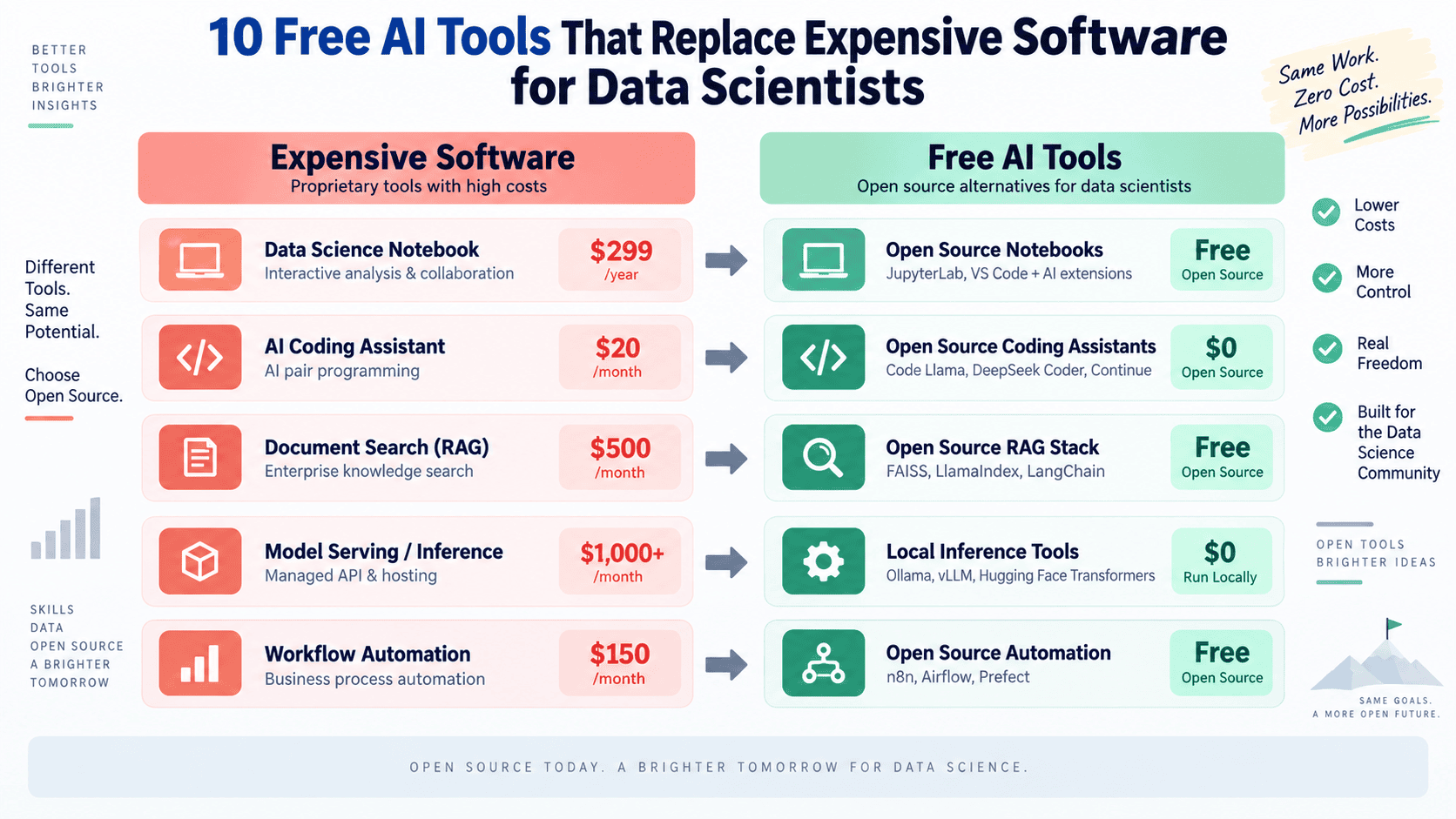
The idea that a production-grade data science stack costs nothing to assemble should surprise no one who has been paying attention, yet it still does. We have been conditioned to equate quality with a price tag, especially in AI, where the commercial vendors market their platforms as indispensable. The reality is that open-source tools have quietly closed the gap, and in some cases, they have pulled ahead. This is not a fringe position; it is the practical experience of teams who have realized that their most significant constraint was never the software budget but their own assumptions about what "enterprise-ready" means.
This matters because the barrier to entry for serious data work just collapsed. If you are an individual practitioner or a small team, you no longer need to justify a line item for a proprietary suite. The same tools that power sophisticated pipelines at large organizations are available for the cost of the hardware you already own. This connects to a broader trend we have been tracking: the quiet maturation of the open-source ecosystem beyond its early reputation as a hobbyist playground. Consider how Valkey's Future Expands Beyond Caching, Say Its Lead Maintainers illustrates a project evolving into a core infrastructure piece, not a stopgap. Similarly, the growing interest in Semi-supervised learning is an underrated path to smarter AI workflows shows that the community is pushing methodological boundaries, not just repackaging old ideas. The free stack is not a consolation prize; it is where the innovation is happening.
The practical takeaway is direct: start evaluating your workflow through the lens of open-source components before you commit to another annual license. The perceived risk of "no vendor support" is often outweighed by the transparency of the code, the velocity of community fixes, and the absence of vendor lock-in. The tools have reached the point where the trade-off is no longer about capability but about your team's willingness to invest time in learning and configuration. That is a skill investment, not a cost center. The data shows that the ecosystem is healthy, and the momentum is not slowing down.
We should watch how the commercial vendors respond to this pressure. If the open-source alternatives are genuinely matching paid performance, the proprietary players will need to justify their premiums with service, integration, or specialization, not just brand recognition. The question for our readers is whether they will be the ones forcing that conversation or the ones waiting for permission to switch. The tools are free; the only remaining cost is the courage to try them.