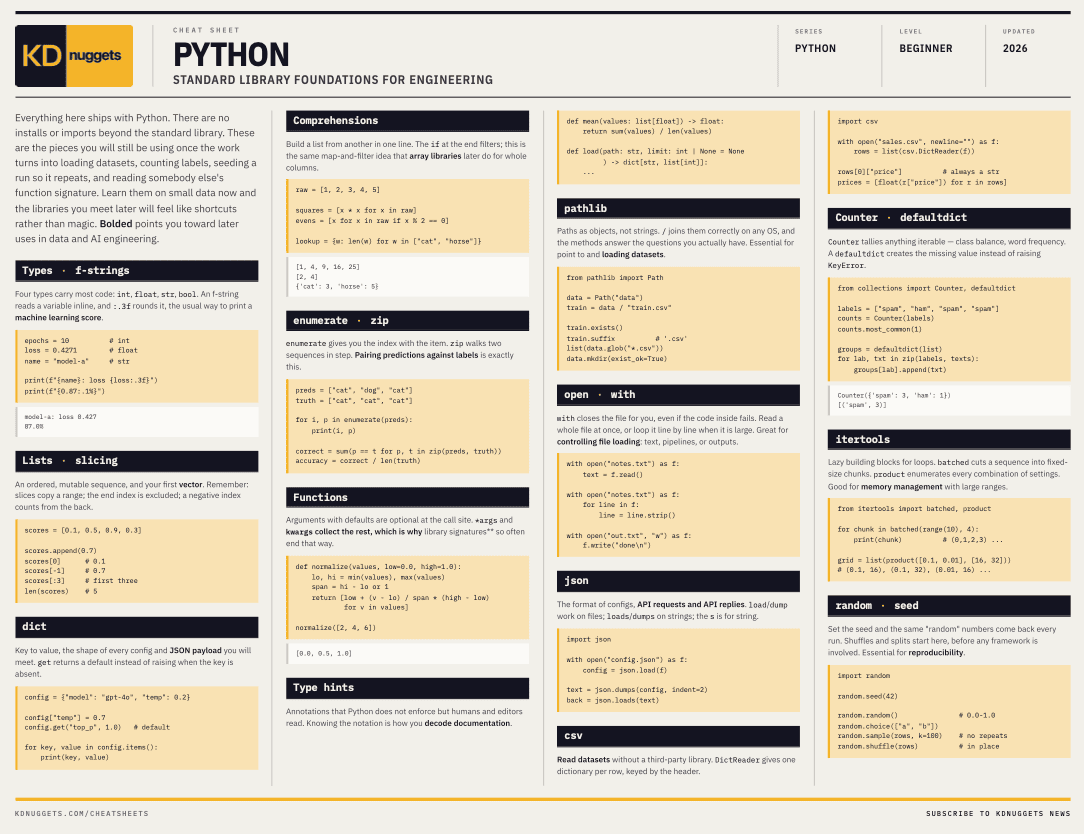
If you spend any time working with modern data tools, whether that's Build Interactive Dashboards Using Marimo's Reactive Notebooks or running AI Models Locally with Ollama's OpenAI-Compatible Endpoint, you eventually hit the same wall. The framework changes. The library gets deprecated. But the core language stays. That is exactly why the cheat sheet highlighted in this story matters. It collects the Python that does not get replaced. The structures, the idioms, the logic patterns that persist whether you are wrangling data in a reactive notebook, building a local inference server, or automating a mundane task with a single line of AI-assisted code.
Too many learners rush to Pandas or NumPy or the hot new AI wrapper before they have internalized how Python itself thinks. They can call functions but cannot explain why a generator is more memory-efficient than a list. They can import a module but freeze when asked to handle an exception without Googling the syntax. That cheat sheet targets the gap. It is not a tutorial on any framework. It is the scaffolding that every framework assumes you already possess. And that makes it more valuable than a dozen library-specific guides, because it pays off in every single project you will ever write.
The practical consequence is straightforward. When you know the material on that sheet cold, your experience with tools like Marimo or Ollama transforms. You stop fighting the language and start leveraging it. That interactive dashboard? You write cleaner transformations because you understand list comprehensions and lambdas at a reflex level. That local AI model? You debug connection errors faster because you know how Python handles sockets and context managers. Even the promise of saving seconds with AI-generated code becomes more powerful when you can read the output, spot the inefficiency, and rewrite it in half the lines. The cheat sheet is not a crutch; it is a foundation. The frameworks will keep arriving, but Python's core is the constant.
One specific detail sticks with us: the claim that 'almost none of it is replaced by a framework later.' That is an honest statement in an industry that profits from making you feel behind. Frameworks chase novelty. Core language skills chase durability. So the question worth asking yourself is not which dashboard library or model runner you should try next week. It is whether you have locked down the fundamentals well enough that those tools feel like extensions of your thinking rather than obstacles to it. If the answer is no, keep that cheat sheet close. It will serve you longer than any framework.