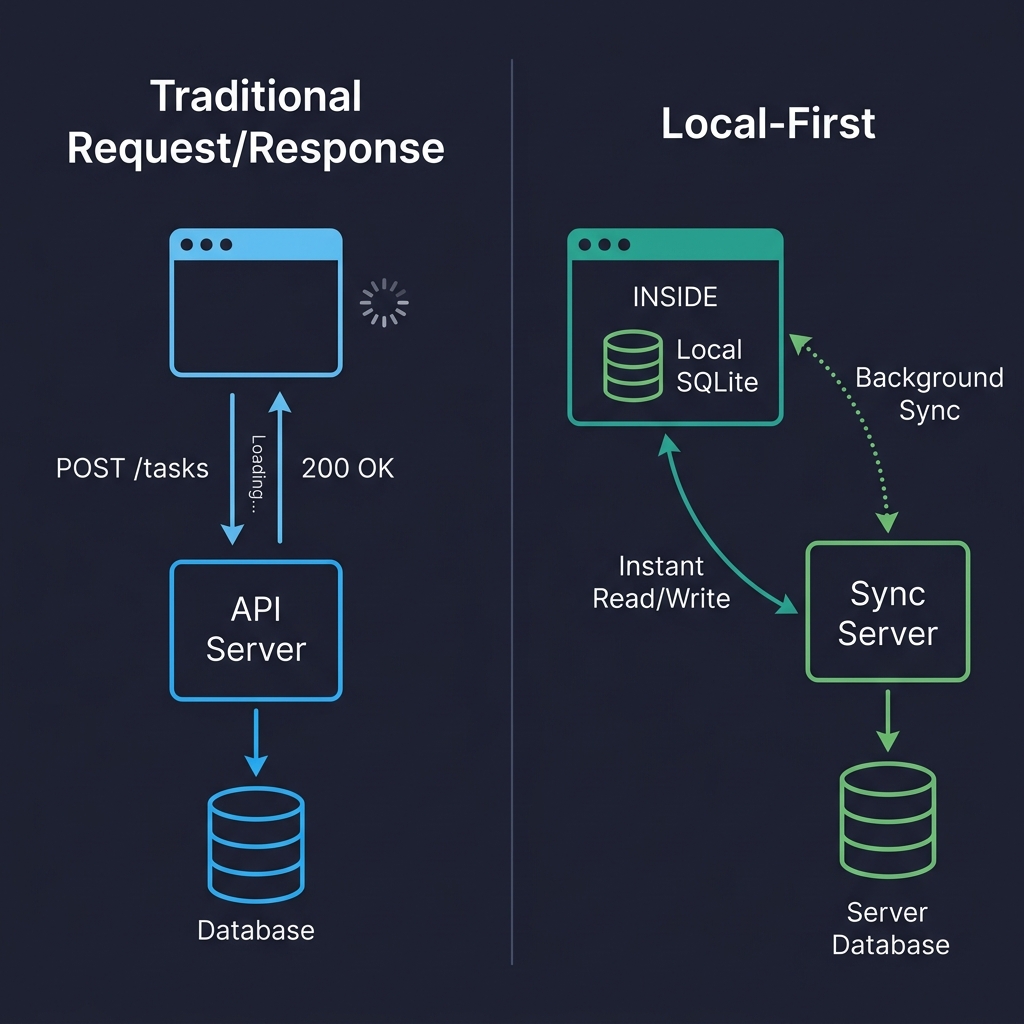
The Promise and Pitfalls of Local-First Development
The Lisbon hotel room moment captures something many developers have experienced but rarely discuss openly: the profound vulnerability of cloud-dependent applications. After four months of careful architecture work—React front end, Node back end, Postgres database, Redis cache, GraphQL API with six resolvers—the entire project management tool collapsed because of unreliable hotel Wi-Fi. This isn't a story about bad infrastructure decisions; it's a story about assumptions we make without realizing them. We built sophisticated systems that work beautifully in conference rooms with stable connections, then act surprised when they fail in the real world where connectivity is anything but guaranteed.
What resonates beyond the anecdotal frustration is an implicit critique of how modern web development has converged on a single architectural pattern. The assumption that users will always have reliable internet has become so embedded in our tooling that we rarely question it. Local-first development, sometimes called offline-first, challenges this assumption by treating the network as an optimization rather than a requirement. The philosophy isn't new—desktop applications worked this way for decades—but applying it to web-based tools requires rethinking fundamental patterns around data synchronization, conflict resolution, and user interface state management. For developers who've spent years mastering cloud-native architectures, this represents a significant mental shift that demands genuine evaluation rather than reflexive adoption.
The timing of this discussion matters because browser capabilities have finally caught up with the ambition of local-first applications. Service workers, IndexedDB, and the Cache API provide the technical foundation for sophisticated offline experiences that were impractical just a few years ago. Libraries like RxDB, Electric SQL, and similar tools are emerging to address the hard problems of syncing state across devices when connectivity fluctuates. Yet the ecosystem remains immature compared to the mature, well-documented patterns of traditional web development. Developers considering this path need to weigh the real benefits against the learning curve and the inevitable edge cases that arise when network assumptions disappear. Related discussions from our archive, such as "Presentation: Local First – How To Build Software Which Still Works After the Acquihire," explore these tradeoffs from different angles and offer practical guidance for teams evaluating this architectural approach.
The deeper question is about what we owe our users in terms of reliability. Building applications that fail gracefully when networks hiccup isn't just a technical nicety—it's increasingly an expectation as users work from coffee shops, airplanes, and remote locations where connectivity varies. This is framed as an architectural decision, but it's also a product decision that reflects priorities about who the software serves and under what conditions. For teams building internal tools, the cost of offline failures might be minimal. For products serving customers across diverse network environments, it might represent the difference between a tool that feels trustworthy and one that feels fragile. As web applications continue to replace desktop software in professional contexts, the expectation that they work reliably regardless of network conditions will only grow stronger.