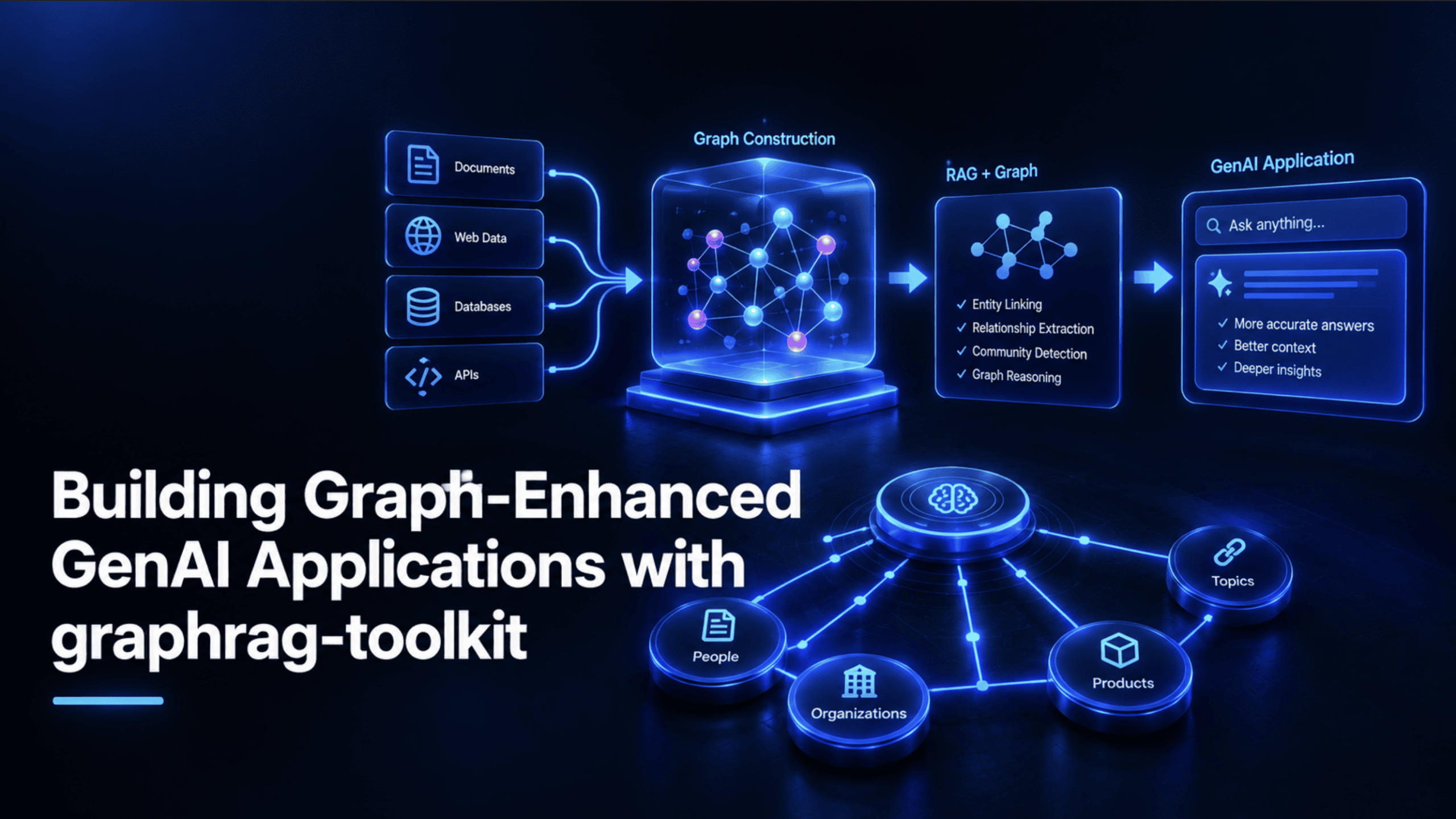
Vector search finds what you ask for. Graph-enhanced retrieval finds what you should have asked for. That distinction matters more than most data teams realize, which is why the open-source work from AWS Labs combining the graphrag-toolkit with Neo4j and pgvector deserves attention. This isn't just another RAG variant, it's a practical response to a persistent blind spot in how we connect information.
The problem with plain vector search is that it treats each query as a fresh start. It finds the nearest neighbors in embedding space, but it has no memory of how those neighbors relate to one another. If you ask about a funding round and a product launch that happened in the same quarter, vector search might return both documents, but it won't tell you that the funding enabled the launch. Graph-enhanced RAG solves that by explicitly modeling the relationships between entities. It turns a flat retrieval problem into a multi-hop reasoning task, and that shift changes what you can build.
Consider what this means for a research assistant. A single query like "What regulatory changes affected our supply chain partners last quarter?" demands that the system connect companies, regulations, dates, and geographic regions. Vector search alone would return fragments; graph-enhanced retrieval walks the connections. AWS Labs' toolkit, combined with Neo4j's graph database and pgvector's hybrid capabilities, makes this pattern accessible without requiring a dedicated research team. This aligns with the direction we've seen in other open-source projects, such as how Explore how DiffusionEngine unifies diffusion research in one extensible PyTorch framework brings scattered research into a single extensible framework. Both projects recognize that the hard part isn't the algorithm, it's the integration.
The practical takeaway is straightforward: if your retrieval system cannot answer questions that require two or more hops between facts, you are leaving value on the table. The graphrag-toolkit provides a concrete way to close that gap today, using tools many teams already have in their stack. It doesn't require a graph database specialist or months of pipeline work. The open-source nature means you can inspect, adapt, and extend it without vendor lock-in. For teams already experimenting with vector search, this is the natural next step, not a replacement, but an augmentation.
One detail worth watching is how this approach handles scale. Graph traversal costs grow with the density of connections, and not all datasets benefit equally from graph modeling. The toolkit's performance characteristics at production scale remain an open question. But the architectural choice to support both Neo4j and pgvector suggests a pragmatic path: use vectors for broad recall and graphs for precise multi-hop reasoning. That hybrid design is the pattern to watch, because it mirrors how human analysts actually work, starting broad, then following threads.