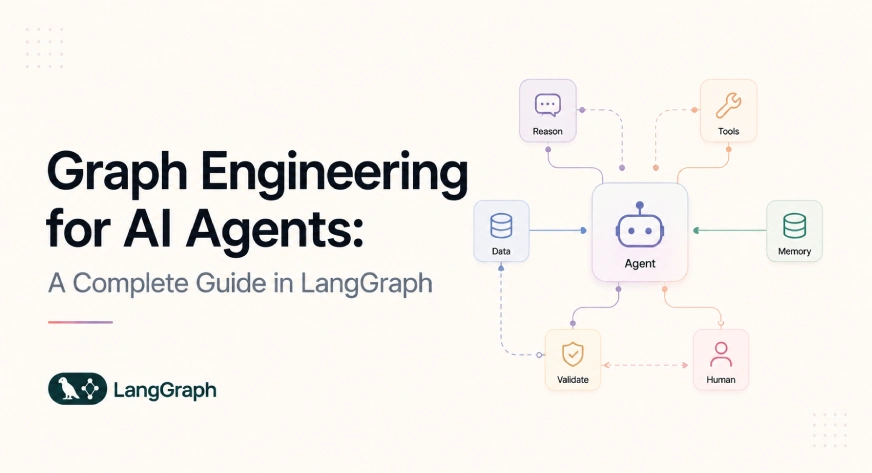
The shift from prompt engineering to graph engineering is more than a technical footnote; it is a fundamental change in how we should think about AI's role in our work. For anyone who has felt the frustration of a single-agent loop that drifts off-task or fails to incorporate basic validation, the move toward explicitly designed workflows is a relief. It signals a maturation of the field, moving away from the magic trick of a single autonomous loop and toward something more reliable: a structured system where agents, deterministic functions, and validators each play a defined part. This is not about making AI smarter in a vacuum; it is about making it more useful within the messy, human-driven processes we already use. We have long said that context is everything, and the *structure* of that context is just as critical as its content. As we explored in Explore how AI agents learn by editing context, not model weights, the ability to edit and control context is becoming a core competency, and graph engineering is the natural next step in that progression.
Our take is that this perspective finally addresses the trust gap that has been nagging at AI adoption. When you rely on a single autonomous agent, you are essentially betting on a black box. Graph engineering, by contrast, makes the decision-making process visible and auditable. It allows for human-in-the-loop checkpoints, which is not a step backward but a pragmatic acknowledgment that some decisions require human judgment. This is a point we touched on when we discussed the unease of interacting with an AI clone in Talking to My AI Clone Taught Me to Question the Tech; the technology is impressive, but the lack of transparency in its reasoning can be disorienting. Graph engineering offers a path to reclaim some of that oversight, giving us a way to verify not just the output, but the journey to get there. It moves the conversation from "what can the AI do?" to "how can we build a reliable system around what the AI does?"
For our readers, the practical implication is immediate. You do not need to wait for a new platform or a major vendor update to start thinking this way. You can begin by mapping out a single workflow in your own spreadsheets or scripts. Identify where a deterministic function is more reliable than a model guess. Mark a step where a human has to approve a final output before it goes out. That is graph engineering in its most accessible form. It is a mindset that says the value is not in the single, clever prompt, but in the orchestration of simple, reliable steps. This approach also aligns with the need for verification, a theme we have seen resonate in pieces like Verify Your AI's Understanding: A Simple Check for Tax Season, where a simple check is the difference between a useful tool and a costly error.
The open question we are left with is about tooling. Who will build the interfaces that make graph engineering as accessible as writing a prompt? The concepts are sound, but the execution will determine whether this remains a practice for specialists or becomes a standard feature in the next generation of productivity tools. Watch for the first spreadsheet add-on that lets you visually connect a data source to a validator and then to an agent. That is the moment this idea goes from a thoughtful article to a daily utility. We would tell any reader to start small, but start now, because the single-agent loop is no longer the only game in town.