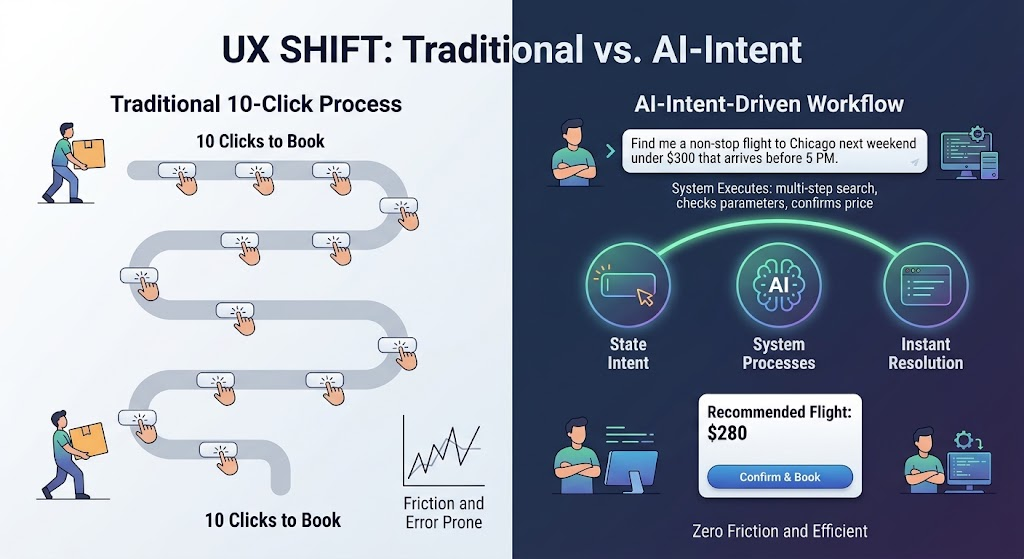
The shift away from buttons and menus is not a prediction; it is already happening in the tools we use daily. When you ask a spreadsheet to generate a chart by typing a plain-language prompt, or when a customer service portal anticipates your issue before you finish typing, you are experiencing the early stages of an interface that reads intent rather than clicks. The argument about the death of the button is really about the death of the intermediary. For decades, we learned to translate our goals into the machine's language: navigate, select, submit. Now, the machine is learning ours. That is a profound change, and it redefines the role of anyone who builds software, not just the person holding the mouse.
This is where the conversation gets practical for our readers. If you are a UX designer, your job is no longer to craft the perfect dropdown menu. It is to decide what the AI should do when it is uncertain, and how much control the human should keep. Transparency becomes the new design constraint. We saw this exact tension play out in Transparency in AI Voice: ElevenLabs CEO on Disclosure and the Future, where the core question was not whether the AI could speak, but whether it should tell you it is speaking. That is the same principle here. An invisible interface that guesses wrong is worse than a clunky button that lets you correct it. The interface does not disappear; it moves behind the scenes, and that makes trust the primary feature.
For the spreadsheet user, this evolution is not abstract. Consider the related journey in Exploring a Career Shift: An MD, a PhD, and a Data-Driven Future, where a highly trained professional is weighing a major pivot based on data and outcomes. That person does not want to learn a new dashboard. They want to ask a question and get an answer they can act on. The underlying mechanics of data analysis, the vector spaces and classifications that make AI useful, are already becoming accessible through natural language, as noted in Unlocking Text's Potential: Exploring Vector Spaces and Classification. So when we say the interface is disappearing, we mean the user is finally free to focus on the problem, not the tool. That is a meaningful productivity gain, but it comes with a warning.
Our take is this: do not mourn the button, but do not hand over the keys blindly. The best interface is the one you do not notice, but only because it is doing what you intended. That requires the AI to be modest, to ask for confirmation when it is wrong, and to show its reasoning when asked. Pushing designers toward this new discipline is right, but we would push further. The real test is not whether the interface is invisible; it is whether the user feels in control. Watch for the products that let you see why a decision was made, because those are the ones that will earn lasting trust. The button dies, but the human intent behind it should remain the only thing that matters.