Making LLM chat experiences accessible isn't a feature request; it's a design requirement that most teams are failing. Eric Bailey's practical guide on building chat-based interfaces that work for assistive technology should be required reading for every product team shipping an AI chatbot today. The core insight is both refreshing and sobering: there is nothing technically novel about the accessibility barriers in these tools. They are the same interaction patterns, input text, submit, read output, that the web has handled for decades. What is new is how quickly teams are deploying these experiences without applying what we already know. For those building smarter text pipelines or tracking how AI tools reshape workflows, as we've explored in Build smarter text pipelines by merging AI summarization with classic scikit-learn tools and Track milestone shifts across updates to see the real forecast story, the lesson is the same: the fundamentals still apply. Bailey's reframing is the most important move here. He strips away the hype and places immersive LLM chat experiences squarely under the Web Content Accessibility Guidelines. The social model of disability applies directly: when a screen reader user sends a prompt and cannot tell whether the AI is thinking, stalled, or done, that is a barrier created by the built environment of the interface. The fix is not exotic. Bailey walks through using live region announcements to signal new content, waiting for the full message before announcing it, and communicating loading states rather than leaving users in silence. These are well-documented patterns applied with care. What stands out is the attention to the user's mental state. A five-second delay before announcing "Loading" prevents premature announcements, and varying the phrasing avoids the feeling that the experience has frozen. That level of detail separates a compliant interface from one that actually works. The open question is whether teams will invest the effort. Bailey notes that visual bias permeates software creation, and the pressure to ship LLM features quickly amplifies that tendency. A loading spinner that works visually gets shipped; the equivalent live region announcement often does not. The consequence is predictable: knowledge, opportunity, and employability are lost for people who rely on assistive technology. Bailey also flags ariaNotify() as an upcoming simplification, but warns that evergreen browsers and native app wrappers complicate adoption. The takeaway is direct: do not wait for the new API. Implement live region announcements now, test with real users, and treat the loading state as a first-class interaction. The alternative is building tools that look impressive but quietly exclude a significant portion of your audience.
row zero
Designing LLM chat experiences that work for everyone
As LLM chat patterns become more widespread, making them accessible is essential to ensuring everyone can access the information, tools, and opportunities they offer.
3 min readArticles on Smashing Magazine — For Web Designers And Developers
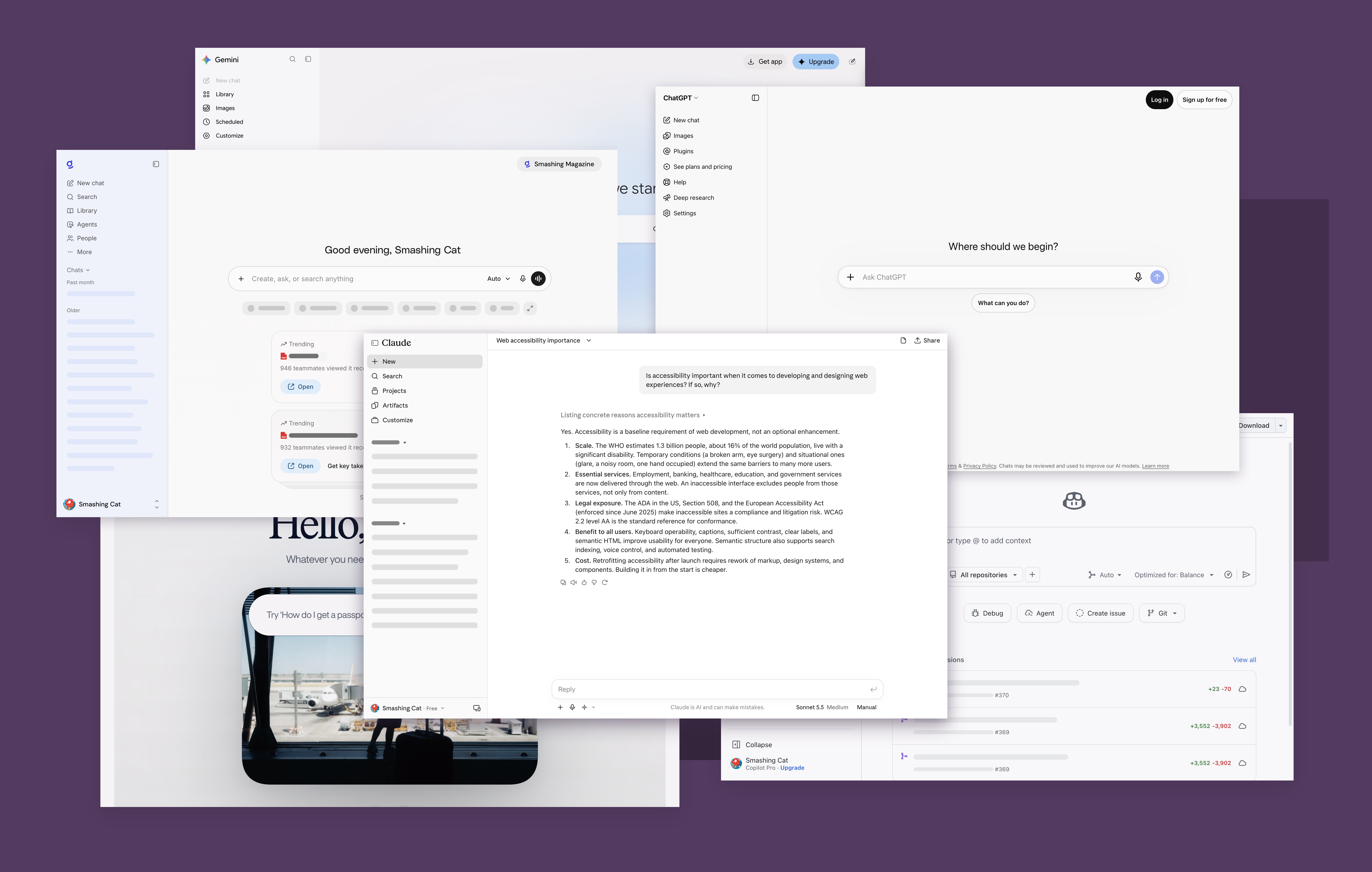
I have had the privilege of helping to improve the accessibility of multiple immersive LLM chat experiences in the course of my career. Now I want to share this knowledge with you.
Accessibility is a core part of a functional digital experience. As the LLM chat pattern continues to spread like wildfire across the web, we risk excluding people if these experiences are not built with accessibility as a core consideration.
Read the original at Articles on Smashing Magazine — For Web Designers And Developers