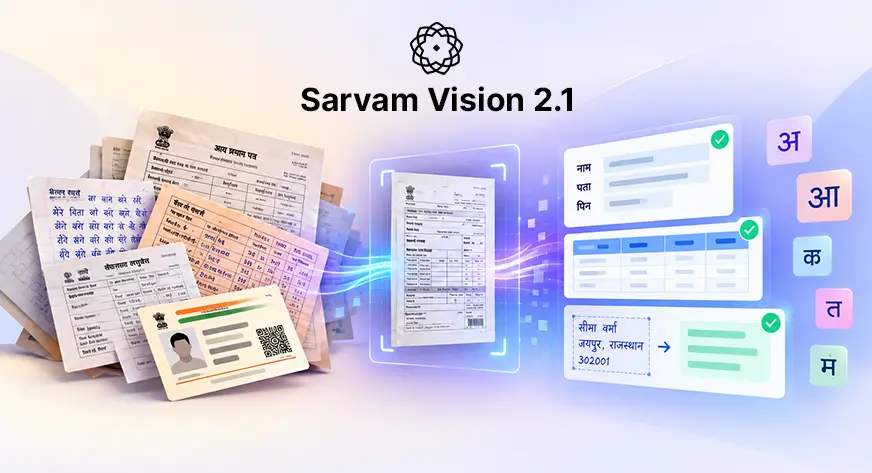
If your workflow involves documents written in Devanagari, Tamil, Bengali, or any of India's other scripts, you have likely faced a frustrating trade-off. You could either extract the text accurately from a regional language, or you could preserve the structure of the document, the table layout, the invoice line items, the claim form fields. You could not do both. Sarvam Vision 2.1 claims to break that compromise, and for Indian businesses processing real-world paperwork, that is not a minor update. It is a practical unlock. Consider how this connects to a broader shift in how we think about AI capability. We recently explored how Explore how AI agents learn by editing context, not model weights, where improvement comes from changing what the model sees rather than retraining it. Sarvam's approach mirrors that logic: instead of forcing every document into an English-first pipeline, the model adapts to the script and structure it actually encounters.
The specific pain point here is worth naming. Finance teams automating invoices in India do not just need OCR that reads Hindi or Kannada. They need OCR that reads a handwritten invoice where the header is in English, the line items are in Marathi, and the total is stamped in a box. Insurance companies processing claims from rural districts need a model that handles a handwritten name in Telugu without losing the checkbox structure beside it. Sarvam Vision 2.1 targets exactly that intersection. By treating script recognition and structural parsing as one problem rather than two, it removes a manual step that many teams have simply accepted: the need to route documents through separate tools or to re-enter data by hand. This is the kind of incremental but real progress that matters more than a flashy benchmark. It is worth contrasting this with another recent development we covered: Showcase Your AI Skills: 10 Projects to Build Your Portfolio. While those projects help individuals demonstrate capability, tools like Sarvam's model are what let those same individuals automate work that previously required human judgment.
Here is our honest take. This model does not need to be perfect to be useful. If it reduces the error rate on mixed-script invoices by even twenty percent, that is a week of manual review saved per month for a mid-sized finance team. The more interesting question is what happens when this kind of OCR becomes an input for an AI agent that can act on the extracted data. Imagine an agent that reads a regional-language purchase order, checks inventory, and generates a response, all without a human touching the document. That workflow is now one model closer to reality. The specific detail to watch is how Sarvam handles handwritten text in low-resource scripts like Santali or Konkani, because that is where most OCR models still fail silently. If Vision 2.1 performs there, it is not just a better OCR tool. It is the missing piece for digitizing the documents India actually has, not the ones Silicon Valley assumed it would.