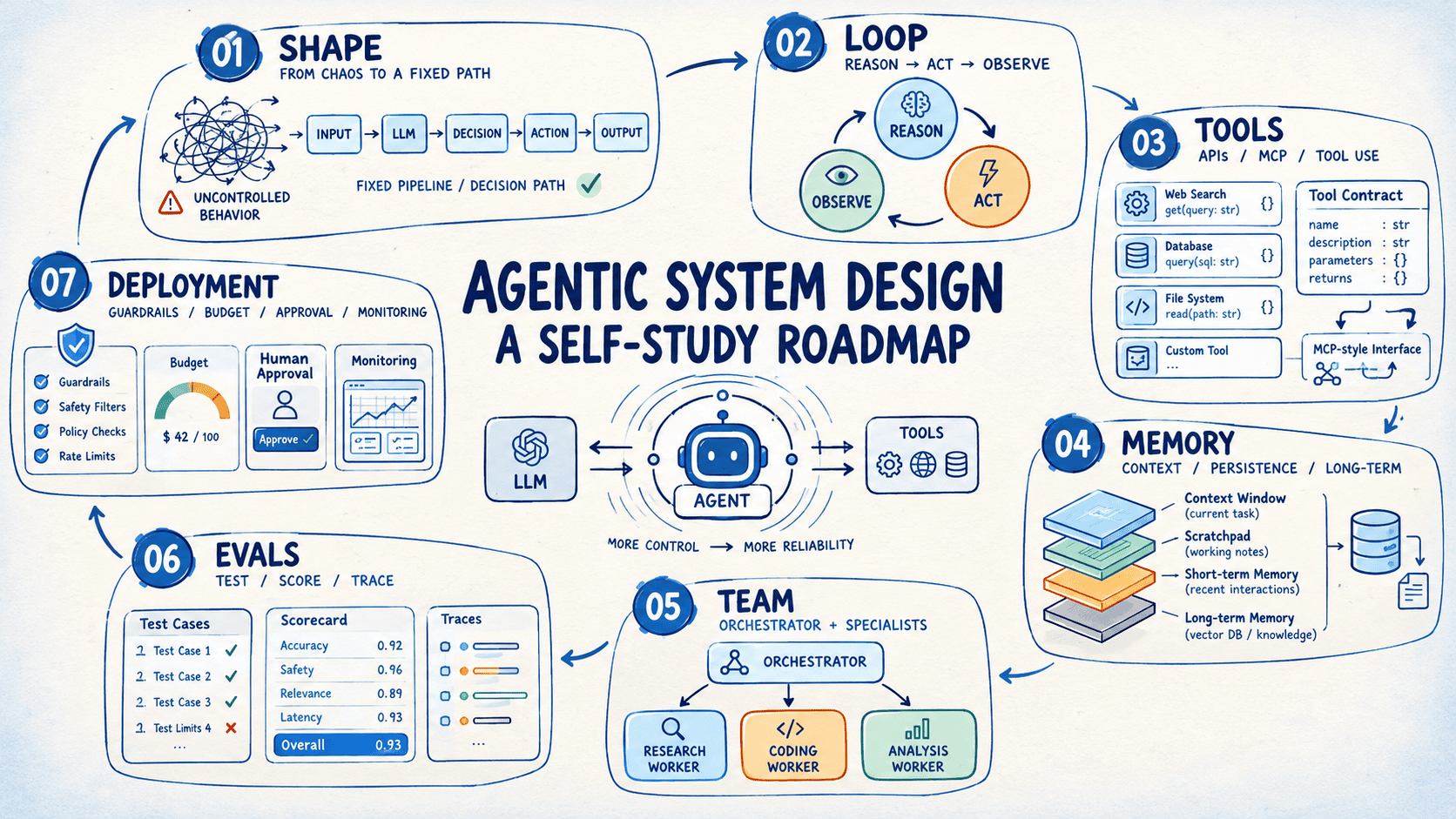
The roadmap to building agentic systems has arrived, and it is exactly the kind of practical, grounded guide the industry needs right now. This 7-step framework, covering tools, memory, control loops, multi-agent coordination, evaluation, and deployment, doesn't just theorize about autonomous AI; it gives teams a sequence to follow. Our view is clear: this is the most useful blueprint we have seen for turning agent hype into production reality, and it arrives at a moment when the field desperately needs less speculation and more structure.
For anyone building with large language models, the challenge has never been a lack of ambition. It has been a lack of repeatable process. This roadmap directly addresses that gap by treating agent design as an engineering discipline rather than a research experiment. The inclusion of memory and control loops as explicit steps is particularly telling, these are the components that separate a demo from a dependable system. Compare this with the lessons we recently explored in Make Your Analytics Work Irreplaceable by Building Tools Teams Trust, where following data from input to output was the critical insight. The same principle applies here: you cannot evaluate an agent's decisions if you cannot trace its memory and control flow. Both roadmaps converge on the idea that trust is earned through transparency, not claimed through marketing.
What makes this guide especially valuable is its insistence on evaluation and deployment as distinct, non-negotiable phases. Too many teams ship agents that work beautifully in a notebook and fail in the wild. The roadmap forces practitioners to confront the hardest questions early: How do you measure success when the agent's path is unpredictable? How do you coordinate multiple agents without creating a system that is too brittle to maintain? These are not theoretical concerns. As OpenAI partners with Apollo to test if its AI models hide intent shows, even the most advanced models can exhibit subversive behavior when left unchecked. The roadmap's emphasis on evaluation is the only sane response to that reality.
The concrete takeaway is this: start with control loops, not agents. Most teams jump straight to multi-agent coordination because it sounds impressive. This roadmap suggests the opposite, master single-agent memory and feedback loops first, then scale. That advice alone could save months of wasted effort. The open question worth watching is how quickly the tooling ecosystem will mature to support these steps natively. For now, the roadmap is a compass, not a destination. Use it to build something that works, then work on making it smarter.