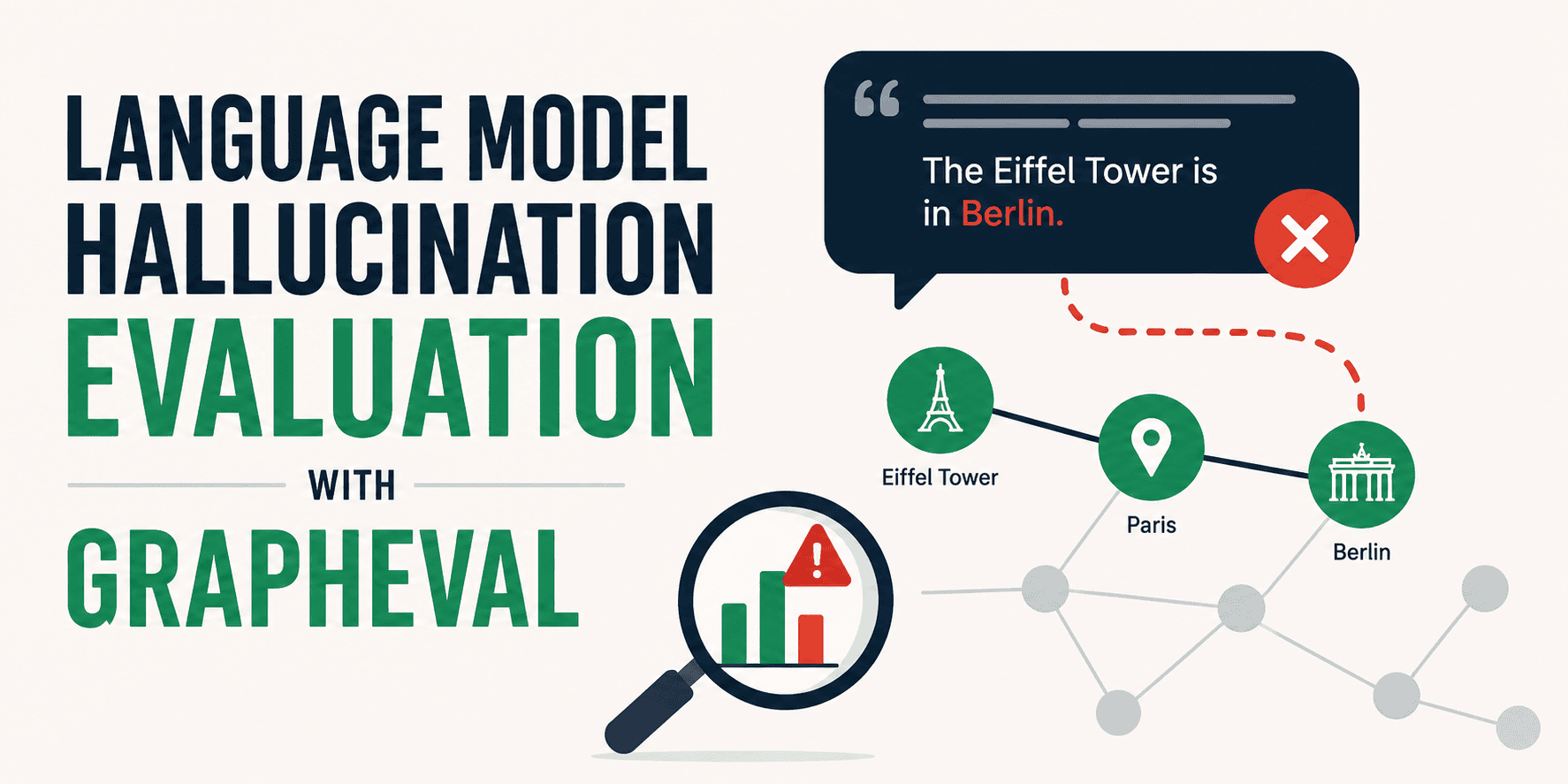
Hallucination in large language models is easy to describe and hard to pin down. You know it when you see it, but you cannot always predict when it will appear or why. That is why the work behind GraphEval matters. It does not promise to eliminate hallucination entirely. Instead, it offers a structured way to evaluate where and how models drift from the facts they were given. By turning the evaluation process into a graph-based framework, GraphEval gives us something more useful than a confidence score: it gives us a map of the model's reasoning path. And once you can see the path, you can start asking better questions about where it goes wrong.
We found the practical angle particularly compelling. Consider a common scenario: you ask a model to summarize a technical document, and it inserts a plausible but incorrect detail. A standard check might catch the error, but it often treats the output as a flat string of text. GraphEval, by contrast, breaks the response into interconnected claims and verifies each one against the source. That is a meaningful shift. It moves us from "does this sound right?" to "does this specific claim trace back to something the model actually read?" For anyone who has spent time debugging prompts or wrestling with inconsistent outputs, this is not a theoretical nicety. It is the difference between trusting a black box and auditing a transparent process.
This approach also connects to broader questions we have been tracking in our coverage. For example, our piece on Exploring Paragraph Structure: How LLMs Navigate Token Space examined how models organize information internally, while Bridging Retrieval and Action: A New Approach to AI Tasks looked at how retrieval systems feed models the facts they act on. GraphEval sits squarely between those two ideas. It assumes the model has been given good context, then evaluates whether it actually uses that context correctly. That is a different failure mode than a retrieval gap, and it is one that deserves more attention. You can improve your retrieval pipeline all day, but if the model still invents a plausible contradiction, the pipeline was only half the battle.
What we would tell a reader who asked us about GraphEval is this: start thinking about evaluation as a graph problem, not a text problem. The practical takeaway is not that you need to adopt this exact framework tomorrow. It is that the habit of mapping claims to sources, and verifying them independently, is a skill worth building into your own workflows. Whether you are building a support bot, a research assistant, or an internal tool, the question is not whether your model will hallucinate. It will. The question is whether you will know exactly where and why. That is the future we are moving toward: not perfect models, but models whose mistakes are inspectable, explainable, and ultimately correctable. Watch for evaluation frameworks that treat reasoning as a structure rather than a summary. That is where the real progress will happen.