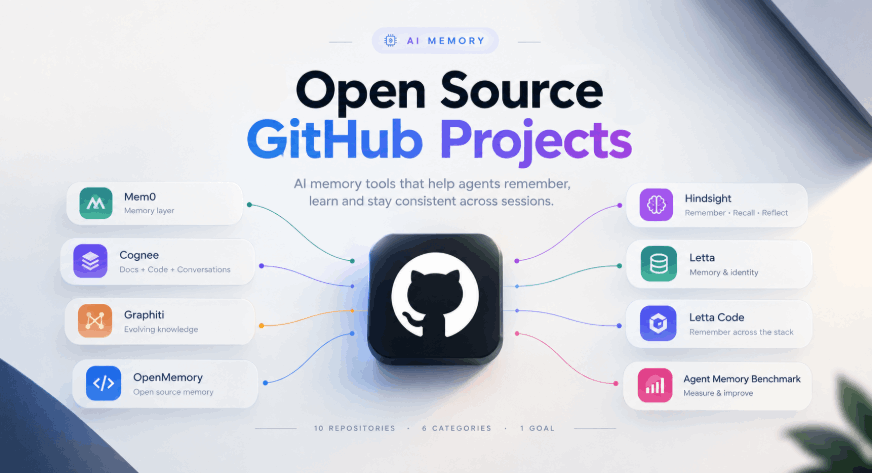
Memory is the missing layer in the agentic stack. Anyone who has watched an AI agent carry out a multi-step task, only to lose its thread the next session, knows the frustration. Context windows keep growing, Claude Sonnet 5.5, for example, delivers faster coding and smarter agentic workflows, as we noted in our coverage of Claude Sonnet 5.5 Delivers Faster Coding Smarter Agentic Workflows and Practical Cost Controls, but a long context window is still a short-term memory. When the session ends, the knowledge vanishes. That is the gap the open-source projects highlighted in this article aim to close, and it matters more than most developers realize.
The seven GitHub projects profiled approach persistence from different angles: some use APIs to expose memory stores, others build graph-based representations of relationships and facts, and a few focus on portable agent state that can travel between sessions. What unites them is a recognition that memory is not a single feature but a system. It must handle what to remember, how to organize it, and when to forget. This is not a trivial engineering problem. It is the difference between an agent that feels like a tool and one that feels like a collaborator. We have seen similar infrastructure thinking in other parts of the ecosystem. When Secure AI agents with new guardrails for safer autonomy was introduced, the focus was on constraining agent behavior at the system level. Memory is the mirror image: giving agents the freedom to act with context, not just rules.
Our take is straightforward: if you are building agents today, ignoring memory architecture is a mistake. The open-source projects covered here are not academic experiments, they are production-ready starting points. A reader who asks us which one to explore first should look at the graph-based memory systems. They map naturally to how people think about relationships and preferences, and they scale better than flat key-value stores. The concrete takeaway is this: within the next six months, the difference between a good agent and a great one will be whether it remembers who you are and what you asked last week. The projects in this article give you the blueprint.
The open question that lingers is about forgetting. Memory systems that preserve everything become brittle. They clutter the signal with noise. The smartest implementations will include decay rates or priority-based retention, and the benchmarks mentioned in the article suggest the community is already measuring that trade-off. Watch for projects that treat forgetting as a design choice, not a bug. That is where the real innovation will surface.