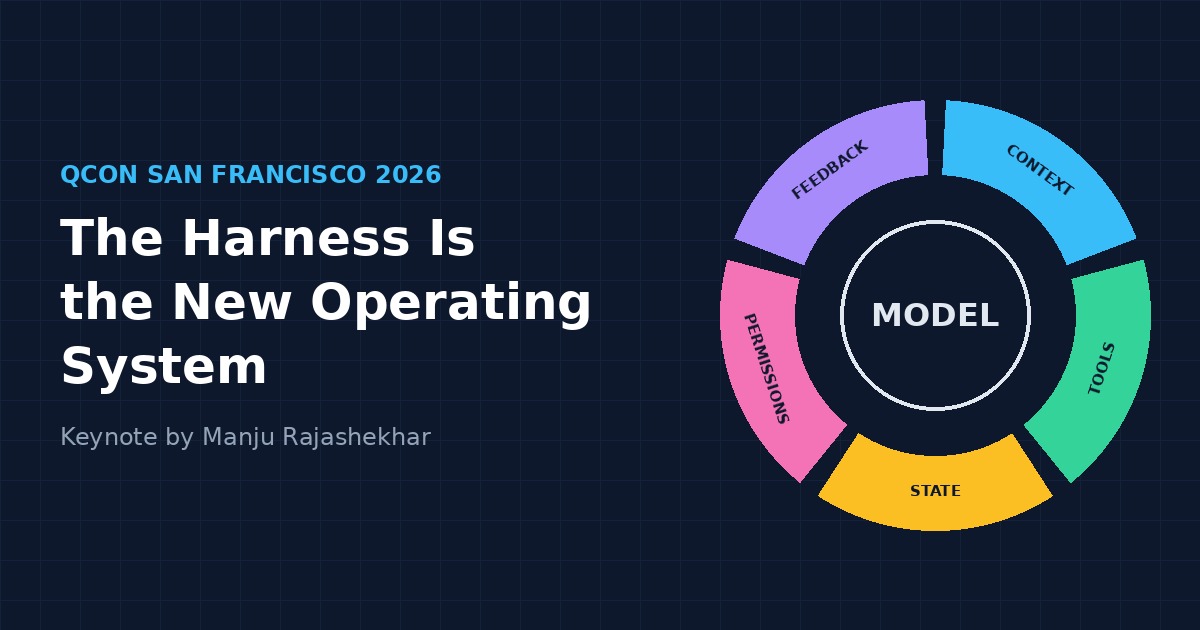
The most important part of an AI agent isn't the model at its core, it's the harness that surrounds it. That was the central argument from Mad Labs founder and CEO Manju Rajashekhar at QCon San Francisco 2026, and it's one we think reframes how the industry should talk about safety and capability. By mapping the components of an agent harness, context, tools, state, permissions, and feedback loops, onto the familiar job of an operating system, Rajashekhar gave us a practical mental model for a problem that has felt abstract until now. This isn't about better models; it's about better boundaries. And that distinction matters for anyone building or buying AI tools today.
Consider what an operating system actually does. It manages memory, controls which programs access which files, enforces permissions, and logs activity. Now imagine an AI agent without a similar layer. The model itself is a powerful engine, but without a harness, it has no way to know which database it's allowed to query, which user's data it can read, or when a loop should be stopped. Rajashekhar's insight is that these guardrails are not afterthoughts, they are the mechanism that makes an agent trustworthy. This echoes a theme we've seen elsewhere, such as in PostgreSQL 19 Reduces Admin Friction With Smarter Table Management and Query Control, where smarter defaults and permission controls reduce the cognitive load on administrators. The parallel is direct: just as a database needs structured access controls to be reliable, an AI agent needs a harness to be predictable.
For our readers who are evaluating agent frameworks or building their own, the practical takeaway is clear. Stop asking which model is safest and start asking how the harness manages permissions, context windows, and tool access. A model with a tight harness is far safer than a "safer" model with loose boundaries. This is not a theoretical point. In practice, it means that the same model can behave responsibly or recklessly depending entirely on the harness design. The feedback loop component is especially worth watching. An OS logs every system call; a harness should log every tool invocation and decision point. Without that, you cannot audit or correct agent behavior after deployment.
The open question that remains is about standardization. Operating systems became reliable because they settled on common interfaces and security models. AI agent harnesses today are fragmented, with each vendor defining permissions and state management differently. Until we see a shared understanding of what a harness must include, similar to how an OS must handle memory and processes, every agent deployment will require custom safety engineering. That is a constraint, but also an opportunity. The teams that treat harness design as a first-class engineering discipline, rather than a wrapper around a model, will build agents that earn trust. The rest will have powerful engines with no steering wheel.