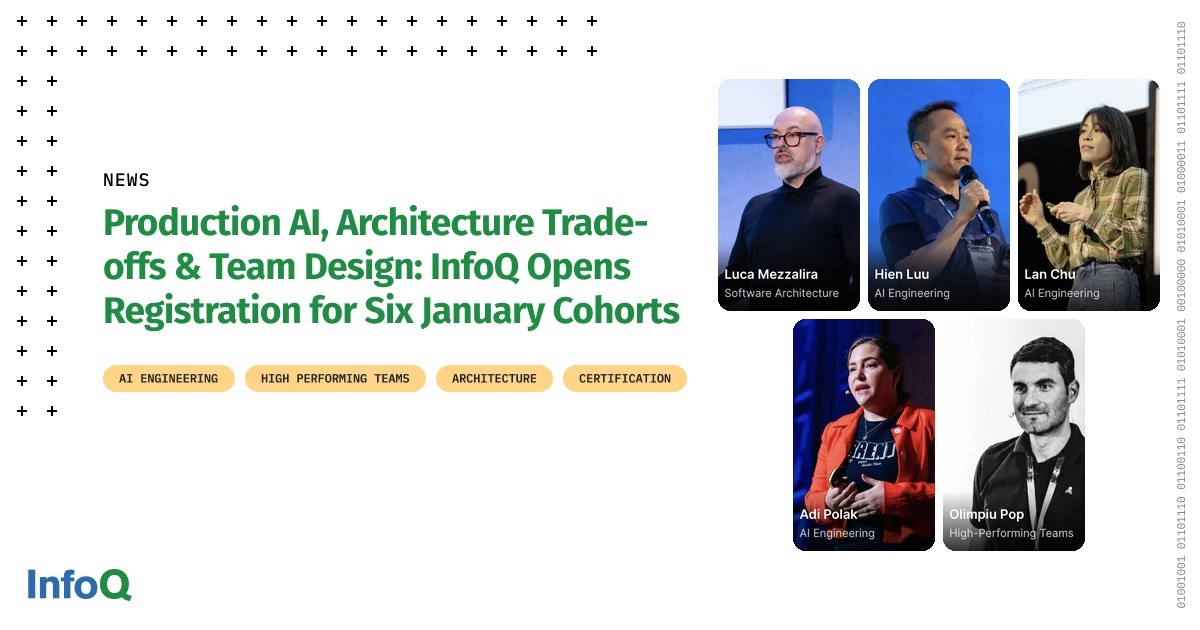
The real test of production AI isn't whether it works in a demo, it's whether it holds up under real traffic, real edge cases, and real time pressure. InfoQ's January 2027 cohorts give senior practitioners exactly that: five weeks to examine current challenges, test approaches in their own work, and compare results with peers. This isn't a conference talk or a white paper. It's a structured, peer-driven experiment designed to surface what actually happens when you push agent reliability, architecture decisions, and delivery bottlenecks into production. That kind of grounded, iterative learning is far more valuable than any vendor benchmark.
The timing matters. As teams adopt AI agents for tasks like contract review, Uber's AI Agent Saves Lawyers 20% Time on Contract Reviews, they quickly discover that reliability isn't a binary property. An agent that works 95% of the time may still fail unpredictably on the 5% that matters most. The cohort format lets participants surface those failure modes together, compare mitigation strategies, and walk away with tactics that have been battle-tested by peers facing similar constraints. It's a direct response to the gap between what vendors promise and what engineers actually ship.
Architecture trade-offs are the other critical focus. Every team building AI features eventually faces the same question: should we route through a single large model, or compose smaller, specialized ones? Should we cache aggressively or accept latency for freshness? These decisions compound quickly, and the wrong choice early can lock you into months of rework. The cohort approach lets participants test their assumptions against real workloads and real data, not synthetic benchmarks. That's especially relevant as platforms like the Uno Platform 7.0 Unifies Rendering and Welcomes Apple TV to Its Ecosystem demonstrate how architecture unification reduces complexity across targets, a lesson that applies directly to AI pipelines managing multiple model endpoints and inference backends.
The specific takeaway here is simple: the most honest feedback you can get about your production AI system comes from peers who are running the same experiments under similar constraints. Five weeks is long enough to surface real problems but short enough to act on them. If you're still relying on vendor documentation or internal benchmarks alone, you're missing the signal that matters most. Join a cohort, bring your hardest architectural question, and see whether your assumptions survive contact with someone else's production data.