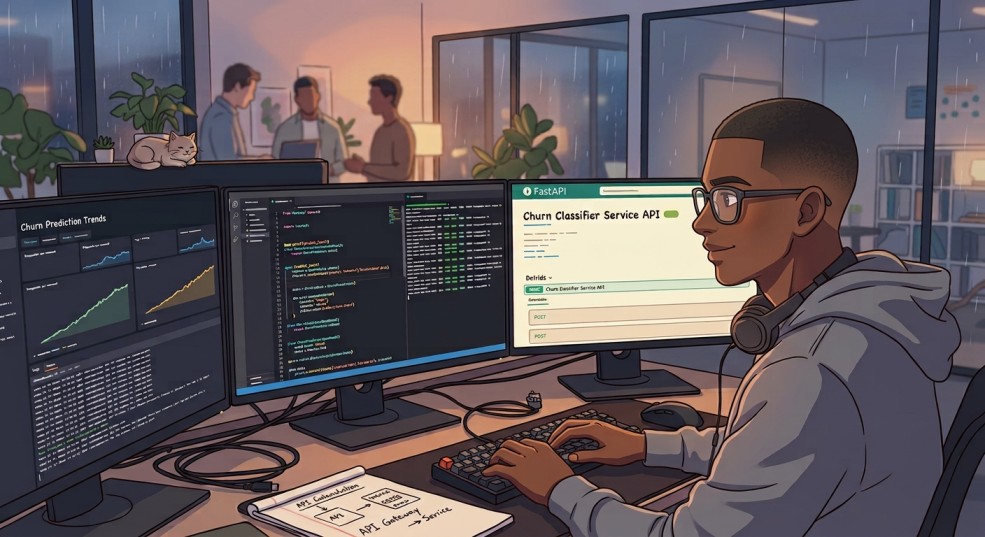
There's a moment every data scientist knows well. The model trains, the metrics look great, and you feel that surge of accomplishment. Then someone asks the question that changes everything: "How do we actually use this?" That's exactly where the story 'My Model Worked Perfectly.' drops us. Then I Tried to Make It Useful." drops us. It's not a story about algorithms or tuning. It's about the unglamorous, essential work of taking a churn classifier from a notebook and turning it into a FastAPI service that other software can genuinely call. That's where the real skill lives, and it's a lesson we could all stand to revisit.
This piece resonates because it exposes the gap between what we celebrate and what actually matters. We obsess over accuracy, but accuracy without accessibility is just a number. This experience mirrors what we see across the industry, from Exploring Real-World Computer Vision: Deployments, Edge Models, and Current Challenges to the shifting expectations in Navigating AI/ML Job Requirements: A Shift in Expected Skills. The latter article points out that job postings now demand software engineering chops alongside ML knowledge, and this story is the clearest proof yet of why that's true. Your model is only as good as its ability to be consumed by another system, and if you can't expose it cleanly, you've built a beautiful paperweight. The same principle applies when you explore tools like the Forrester function in Explore the Forrester Function: Beyond Mathematics, a Tool for Machine Learning; mathematical elegance is fine, but utility is what turns a curiosity into a solution.
What we appreciate most is its honesty about the mundane friction. No one talks about the hours spent wrestling with CORS headers, request schemas, or error handling. But that's the job. The takeaway here isn't that FastAPI is the answer to every problem, it's that thinking in terms of "how will this be integrated?" changes how you build from day one. If you're a data scientist who's never had to ship an API, this is your nudge to start. If you're hiring, this is your reminder that model accuracy is table stakes; deployment pragmatism is the differentiator.
So what would we tell a reader who asks about this? Simple: stop treating deployment as an afterthought. The next time you train a model, ask yourself what it would take to serve it. Build the wrapper, write the endpoint, and test the call. It won't be glamorous, but it will make you dangerous in the best way. The specific consequence to watch for? As more tools and frameworks simplify this process, the ones who thrive won't be those with fancier models, but those who can make their work accessible, testable, and boringly reliable. That's the future of data work, and it starts with a simple POST request.