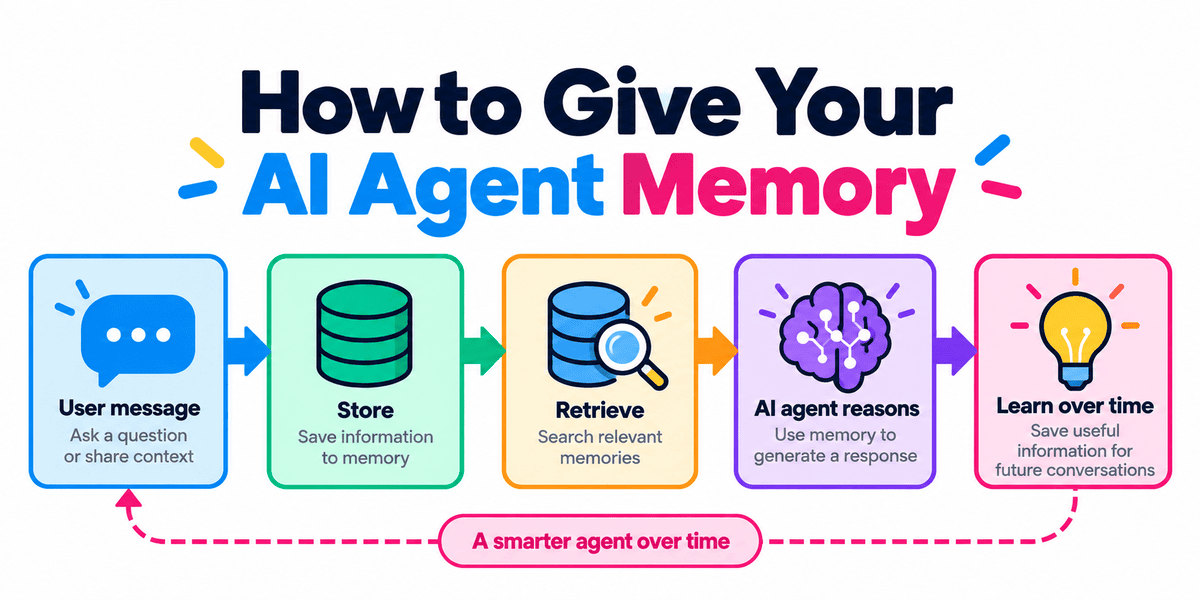
Persistent memory is the missing piece that separates a useful AI agent from a genuinely helpful one, and the integration of the OpenAI Agents SDK with Mem0 and MCP finally delivers it. This isn't about storing more data; it's about creating continuity. Without memory, every conversation with an agent starts from zero, forcing users to re-explain preferences, context, and project history. That friction is why many early agent experiments feel clever but not productive. What this combination of tools offers is a pragmatic path to agents that actually learn from each interaction, remembering what matters and discarding what doesn't.
We have seen adjacent efforts in this space. For example, Build Persistent Memory for Your AI Agent with a Single JSON File demonstrated that a lightweight approach using just three Python classes and a JSON file could give an agent working memory for conversations. That was a proof of concept, elegant in its simplicity but limited in scope. The current story scales that idea dramatically by layering in Mem0's dedicated memory management and MCP's protocol for context sharing, creating a system that feels less like a hack and more like infrastructure. Meanwhile, Explore How GitLab 19.5 Brings Governed AI Agents Into Your Workflow reminds us that governance is the other side of this coin; memory without control is a liability, and GitLab's focus on agent governance shows that the industry knows it.
The practical consequence for readers is straightforward. If you are building agents for internal tools, customer support, or personal productivity, the barrier to adding persistent memory just dropped significantly. You no longer need a custom vector database or a complex RAG pipeline to give an agent the ability to remember that a user prefers concise answers, avoids certain topics, or has a specific workflow pattern. The OpenAI Agents SDK handles the orchestration, Mem0 manages the memory storage and retrieval, and MCP standardizes how that memory is shared across sessions and even across different agent instances. That is a concrete stack that teams can adopt today, not a vision for next year.
The open question that lingers is about privacy boundaries. When an agent remembers preferences across sessions, where does that memory live, and who controls its deletion? The related piece on A new open model detects personal data with a purpose-built benchmark hints at the direction detection tools are taking, but the integration of memory and detection is still immature. Watch for how Mem0 handles memory expiration and user consent in practice. The technical path is clear, but the responsible deployment of persistent memory will determine whether these agents become trusted assistants or just another data silo.