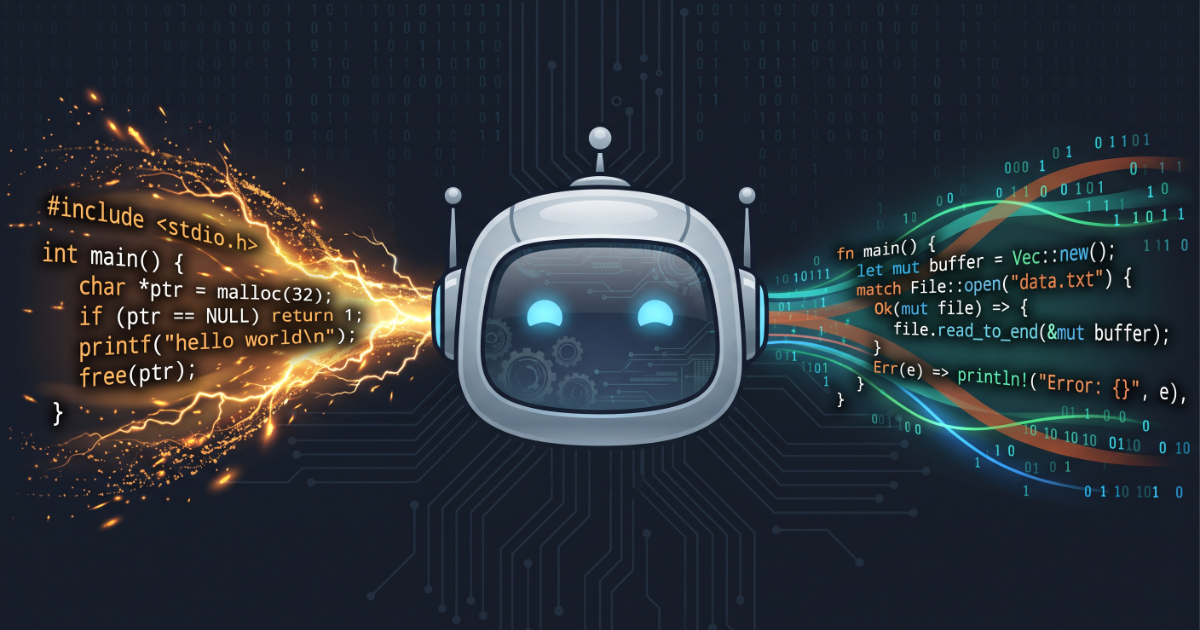
Google's security team just did something quietly remarkable: they took giflib, a decades-old C library responsible for processing GIF images, and moved its legacy code to Rust using an automated, AI-driven process. The goal wasn't to make headlines, but to eliminate the memory vulnerabilities that have plagued C for decades. And they pulled it off without sacrificing runtime performance. That's worth pausing over, because it points to a future where we don't have to choose between security and speed, and where AI isn't just generating code, but helping us safely retire the brittle foundations we've been building on.
The practical lesson here is about trust, but not the kind you might expect. The team didn't just hand the keys to an AI and hope for the best. They used AI translation, but with continuous human oversight, catching the subtle behavioral differences that automated tools miss. That's the honest version of progress: machines doing the heavy lifting, humans steering the details. It's the same spirit we're seeing elsewhere, like how Perplexity Transforms Search with CobbleDB, Achieving 5x Faster Queries by rebuilding infrastructure from the ground up rather than patching around old limitations. And it echoes the way Explore how Gemini simplifies shopping with Flipkart in India is about making complex systems feel effortless to the end user, even when the underlying engineering is anything but simple.
For developers, this should feel like a door opening. For years, the conventional wisdom was that rewriting legacy C in Rust was too risky, too expensive, or simply not worth the effort. Google's approach flips that assumption. By automating the migration and focusing on zero-day vulnerability mitigation, they've shown that modernizing critical libraries is not just possible, but practical. The catch is that the human oversight isn't a safety net; it's the core requirement. AI can map syntax and spot patterns, but it still struggles with intent, context, and the messy reality of how code behaves in production. That's not a limitation to apologize for. It's a reminder that the best tools amplify human judgment rather than replace it.
What we'd tell a reader who's wondering whether this applies to their own work is simple: start paying attention to where your dependencies come from. If you're still relying on C libraries for image processing, network protocols, or anything that touches untrusted input, this project is a blueprint, not a curiosity. It's also a signal that the bar for "good enough" security is rising. The teams that embrace this kind of incremental, AI-assisted migration now will be the ones that avoid the next big vulnerability disclosure later. The question isn't whether you'll need to modernize, but whether you'll do it deliberately or reactively. Google chose the former, and they did it without losing performance or breaking compatibility. The detail to watch now is how quickly this approach spreads beyond Google's internal tooling, because if it becomes a standard practice, the era of memory-safe code might finally be within reach.