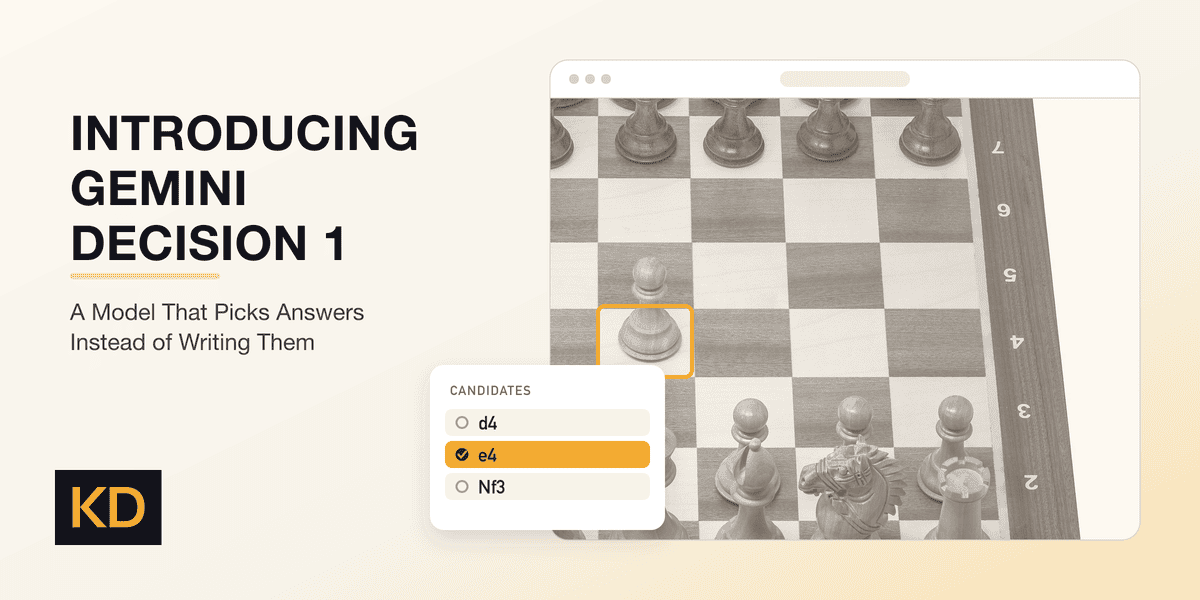
Google's new model, Decision 1, does something unusual in the AI landscape: it reads everything and says nothing. The model processes text, images, video, audio, and PDFs in a single forward pass, handling up to 262,144 input tokens per request, yet it never generates a single word of output. Its only job is to pick the right answer. That is a fascinating constraint, and one that signals a deeper shift in how we should think about AI tools.
We have grown accustomed to models that produce endless streams of text, often requiring us to sift through verbose explanations to find the answer we need. Decision 1 flips that expectation. By refusing to write, it forces the technology to prove its value through accuracy and efficiency alone. This is not about generating content; it is about making sense of the content you already have. For anyone who has felt overwhelmed by the sheer volume of information in a modern spreadsheet or document, this approach feels like a direct response to the problem of data fatigue. It aligns with the growing interest in more private, focused AI interactions, as seen in Google's recent introduction of temporary threads that let users Explore AI Mode privately without leaving a trace in your search history. The thread feature and Decision 1 share a philosophy: AI should work quietly in the background, not demand attention.
The practical implications for spreadsheet users are worth examining directly. Traditional formulas and lookup functions require you to know exactly what you are searching for and how to structure the query. Decision 1 suggests a future where you can feed a model an entire dataset, including images and audio files embedded in your workflow, and ask it a single question, receiving a precise answer without any intermediate text generation. That is a significant reduction in friction. It also raises an interesting question about where this model fits alongside other major investments. Google, alongside Amazon, holds a Amazon and Google combine for nearly 30% stake in Anthropic after IPO, signaling a long-term bet on generative AI. Decision 1 represents the other side of that coin: an investment in lean, purpose-built reasoning rather than expansive generation.
The specific detail to watch is the token limit. 262,144 input tokens is enough to process entire research papers, lengthy legal contracts, or complex financial models in one pass. That capacity, combined with a model that never writes a word, means the output is binary in the best sense: either it finds the correct answer or it does not. There is no room for hallucinated filler or polite hedging. That is a standard many generative models still struggle to meet. For users who rely on spreadsheets for critical decisions, the open question is whether Decision 1 can deliver that precision consistently enough to replace the manual verification we currently trust. The answer will determine whether silent models become the new default or remain a clever experiment.