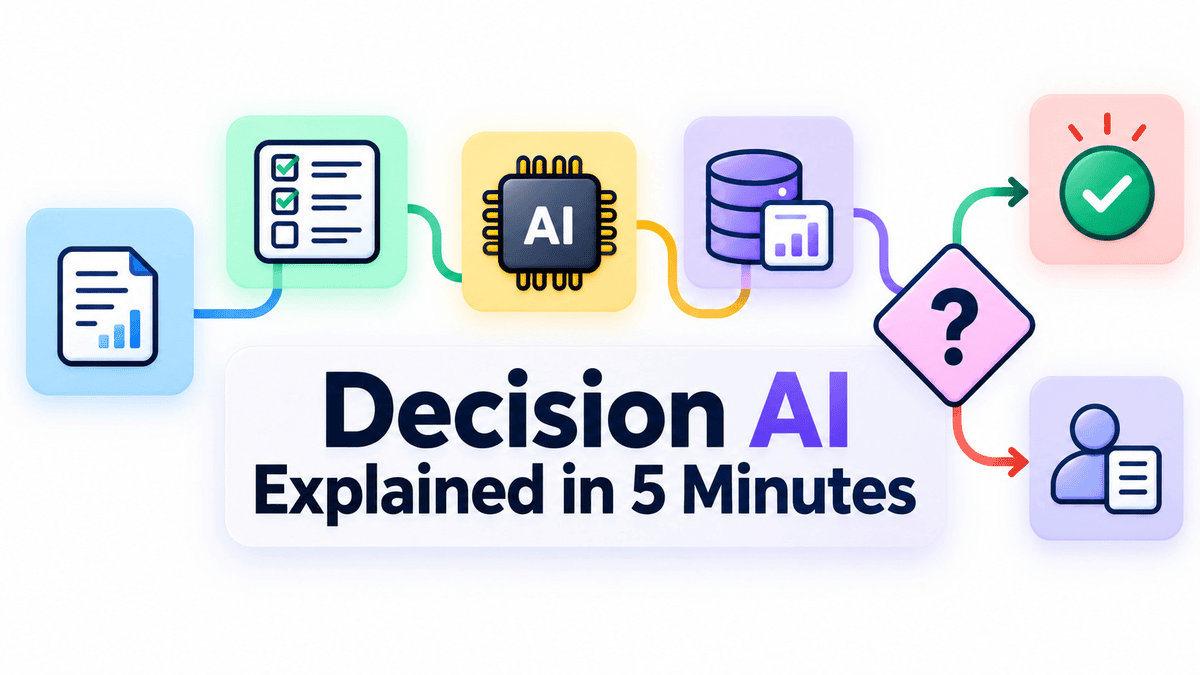
Decision models are the missing link between a chatty LLM and a system that actually makes calls. The story here is about turning large language models into faster decision engines, and the practical path runs through open-source alternatives you can run locally. This matters because the difference between a model that suggests answers and one that decides on them is the difference between a tool you consult and a tool you trust to act.
We have argued for months that the real LLM question is not which model has the highest benchmark score, but which one fits your workflow. In Four Questions to Find Your LLM Fit in 2026, we laid out a framework built on latency, cost, control, and compliance. Decision models are the natural next step: they take that fit question and make it operational. Instead of asking an LLM to generate prose and then parsing it for a decision, you build a model that outputs a structured decision directly. The speed gain is not incremental, it is structural. You skip the generation step entirely and go straight to the action.
Running these models locally is where the promise meets reality. If you have been following Google Donates AI Agent Tools to Open-Source Foundation for Secure Scaling, you already know that the infrastructure for secure, local agent execution is maturing fast. Decision models fit neatly into that stack: they are smaller, faster, and less resource-hungry than general-purpose LLMs, which makes them ideal for local deployment behind your own firewall. The open-source options mentioned in the story are not academic experiments, they are production-ready tools that let you bypass API latency, avoid per-token costs, and keep your data off someone else's server.
The concrete takeaway is this: if your team has been frustrated by the latency or cost of calling an LLM API for every decision, you should prototype a decision model this quarter. Start with a small open-weight model, define your output schema, and measure the response time against your current pipeline. The gap will surprise you. And if you are building for production reliability, the intersection of decision models with Rust-based guardrails, as explored in Why Rust with AI guardrails is the future of production systems, suggests a stack where speed and safety are not traded off but designed in together. The open question is whether the ecosystem for decision models will standardize around a single schema format or fragment into domain-specific tools. Watch for that split in the next six months: it will tell you whether this is a niche or the new default.