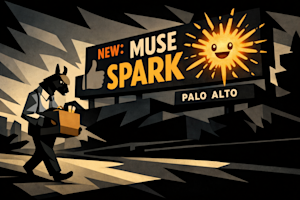
Meta just changed the rules, and it's about time. After a year of watching competitors sprint ahead while Llama 4 stumbled, Meta has finally answered with Muse Spark, a model that doesn't just catch up to the frontier; it redefines what Meta is willing to build and, just as importantly, what it's willing to keep for itself. For the millions of developers and enterprises who built their stacks on open-weight Llama, this is a wake-up call wrapped in a triumph.
Let's be direct about what this means for you. If you've been running Llama models to cut costs or maintain data sovereignty, Muse Spark's proprietary status is a genuine fork in the road. Meta is telling you, in no uncertain terms, that the era of free access to their best thinking is on hold. They're framing it as a necessary evolution, Wang promises open-sourcing future versions, but the immediate message is clear: the most capable model Meta has ever produced lives behind their API and app ecosystem. Your next project can't assume the open-weight gravy train keeps rolling. That's not a reason to panic, but it is a reason to reassess your dependency on any single vendor's roadmap, especially when Meta's own priorities have shifted from community infrastructure to personal superintelligence.
The practical upside is harder to ignore. Muse Spark isn't just smarter; it's dramatically more efficient, using less than half the compute of its peers to reach near-top scores on reasoning and vision benchmarks. For businesses, that translates to lower operational costs and faster inference times, if you're willing to build on Meta's cloud. And the model's strengths are genuinely useful: it crushes visual reasoning tasks, from analyzing food photos for health scores to generating interactive tutorials on the fly. Meta has also invested heavily in making it a capable agent, even if its real-world software skills still trail leaders like GPT-5.4 and Claude Opus. The takeaway? Muse Spark is a tool that can transform your workflow today, but only if you accept the new terms of engagement.
Here's where we land: Meta has traded its open-source crown for a shot at the superintelligence throne. That's a strategic choice, not a betrayal. The Llama family isn't dead, but it's clearly no longer the center of gravity. For you, the smartest move is to treat Muse Spark as a powerful option, not a savior. Test it for specific, high-value tasks, especially anything involving vision, health, or efficiency, but keep your options open. The landscape is shifting faster than any single model can dominate, and the winners won't be the ones who bet everything on one company's vision. They'll be the ones who stay curious, stay flexible, and refuse to mistake any tool, no matter how impressive, for a permanent solution.