The cost problem with always-on AI agents has never really been about the models themselves. It's about the lazy default of sending every step to a frontier model because that's the path of least resistance, then watching the bill balloon. The alternative, hand-building routing logic, just swaps a compute bill for an engineering salary, and it breaks the moment a workflow changes. Nvidia's Tuesday announcement of Nemotron 3.5 Lightning and the NeMo Switchyard router is the most direct attempt yet to kill that false choice, and it deserves a closer look than the usual open-weight release cycle invites. Exploring Paragraph Structure: How LLMs Navigate Token Space and Bridging Retrieval and Action: A New Approach to AI Tasks both underscore how much of the recent progress in AI is about system architecture rather than raw capability, and Nvidia is applying that same logic to the economics of deployment.
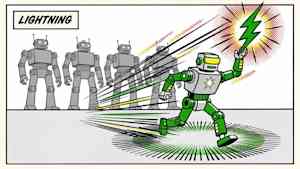
Here is our honest take: the pairing is the story, not the model. Lightning alone is a competent 30-billion-parameter open model, but Nvidia isn't pretending it beats the frontier on general intelligence, it scores a 24 on the Artificial Analysis Intelligence Index, tied with gpt-oss-120b and behind several peers. The claim is narrower: it matches Qwen3.6-35B's accuracy about 30% faster on agentic tasks. That's useful, but it's not the reason to pay attention. The reason is Switchyard, the open-source routing library that decides which model handles which step of an agent's workflow, live, based on agent state and even predicted token verbosity. That's the missing piece. A router alone has nothing efficient to route to, and a cheaper model alone doesn't adapt to the shifting complexity of a multi-step task. By owning both layers under one open license, Nvidia is making a bet that the market has been circling for a while: the differentiator isn't the best model, it's the best system for matching models to work.
The early results from Nvidia's nine test partners are worth taking seriously, even with the vendor-supplied caveat. LangChain reported a 74% cost reduction across 145 multi-turn tasks by routing just 7% of calls to a frontier model, at a 6% accuracy tradeoff. Ramp matched frontier performance on its SWE-Bench while cutting costs 58%. Cognition integrated Switchyard into Devin Desktop and cut mean cost 28% relative to routing everything to a single frontier model. Those are not trivial numbers, and they point to a practical reality: most agent tasks are routine, and only a small fraction genuinely require frontier-level reasoning. The challenge has always been identifying which is which in real time, without building a bespoke system that requires constant maintenance. Switchyard's integration with existing gateways like Kong, LiteLLM, and OpenRouter is the pragmatic move here. It doesn't ask enterprises to rip out their current stack; it slips into the routing layer they already use, which is how you get adoption.
What we would tell a reader asking whether to care is this: watch the routing layer, not the model card. The competitive question has already shifted from which open model is cheapest to which vendor can prove their routing logic holds up in production, across changing workflows and cost pressures. Nvidia's real rival here isn't just other open models, it's Not Diamond and RouteLLM, which already route across providers but don't ship their own model. Owning both sides of that decision, under one open license, is a structural advantage that router-only competitors will struggle to match. The specific thing to watch is whether Switchyard's cost predictions, based on model verbosity, hold up outside Nvidia's benchmark suite. If they do, the default enterprise architecture stops being a single model and becomes a portfolio of models managed by a smart dispatcher. That's a future we'd happily route toward.