Presentation: Instrumentation at Scale: Having Your Performance Cake and Eating It Too
Our take
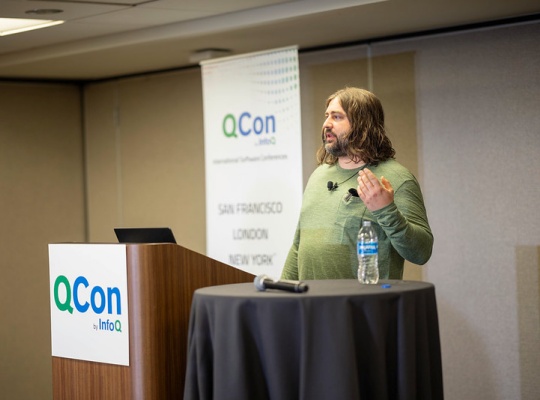
The relentless pursuit of observability is a cornerstone of modern software engineering, yet it often introduces a subtle but significant performance tax. Brian Martin’s presentation, "Instrumentation at Scale: Having Your Performance Cake and Eating It Too," tackles this head-on, offering practical strategies for maintaining comprehensive system visibility without compromising speed. Martin’s work at IOP Systems, detailed in the presentation, demonstrates that achieving this balance isn't merely aspirational; it's achievable through carefully considered architectural choices. The challenges he outlines – the real-world performance costs of seemingly innocuous metrics libraries – resonate deeply with anyone building high-performance systems. It’s a problem that’s increasingly relevant as data volumes explode and the demand for real-time insights intensifies, a demand we’ve seen mirrored in articles like [This Python Library Can Run Pandas Workloads Up to 20x Faster], highlighting the constant need for performance optimization across the stack. The shift towards more efficient instrumentation techniques is, in essence, a recognition that observability shouldn't *become* the bottleneck it's meant to monitor.
Martin’s exploration of atomic primitives, per-CPU sharding, lock-free histograms, and eBPF integration provides a tangible roadmap for achieving “fearless” instrumentation. The beauty of his approach lies in its pragmatism; it’s not about abstract theoretical improvements but about concrete techniques that can be implemented today. The focus on low-overhead instrumentation is particularly crucial. Traditional metrics libraries, while providing valuable insights, often introduce significant latency, especially in high-throughput environments. Martin’s strategies aim to minimize this impact, ensuring that observability doesn’t come at the expense of application responsiveness. This aligns with the broader trend towards rethinking visualization as well, as explored in [Presentation: Beyond Line Charts: Why Some Diversity in Telemetry Visualization Is Long Overdue] – the data itself must be efficiently collected and processed before it can be effectively visualized and acted upon. The sophisticated techniques he advocates – leveraging eBPF for kernel-level observability, for example – represent a powerful evolution in how we instrument and understand complex systems.
The broader significance of Martin's work extends beyond the immediate concerns of performance optimization. It speaks to a deeper shift in how we approach observability – moving away from a reactive, after-the-fact analysis to a proactive, integrated approach. The ability to instrument systems with minimal overhead allows for continuous monitoring and real-time feedback, enabling developers to identify and address performance bottlenecks as they arise. This is increasingly important in the age of microservices and distributed systems, where traditional monitoring techniques often fall short. Furthermore, the insights gleaned from these low-overhead instrumentation techniques can inform architectural decisions, leading to more robust and efficient system designs. The ongoing advancements in techniques like Sliding Window Attention, discussed in [Sliding-window attention beats linear on long-context reasoning], illustrate the constant innovation occurring to improve efficiency, a principle that directly informs Martin’s approach to instrumentation.
Ultimately, Martin’s presentation is a call to action for software architects and engineering leaders. It challenges the assumption that observability and performance are mutually exclusive goals and provides a practical framework for achieving both. The future of observability lies in embracing techniques that minimize overhead, maximize visibility, and empower developers to build more efficient and resilient systems. A key question moving forward is how these low-overhead instrumentation strategies can be further integrated into the development lifecycle, becoming a seamless part of the software development process rather than an afterthought.
Brian Martin discusses the real-world performance costs of metrics libraries and shares strategies for low-overhead, "fearless" instrumentation. Drawing from his work at IOP Systems, he explores atomic primitives, per-CPU sharding, lock-free histograms, and eBPF integration to help software architects and engineering leaders maintain full system visibility without sacrificing performance.
By Brian MartinRead on the original site
Open the publisher's page for the full experience