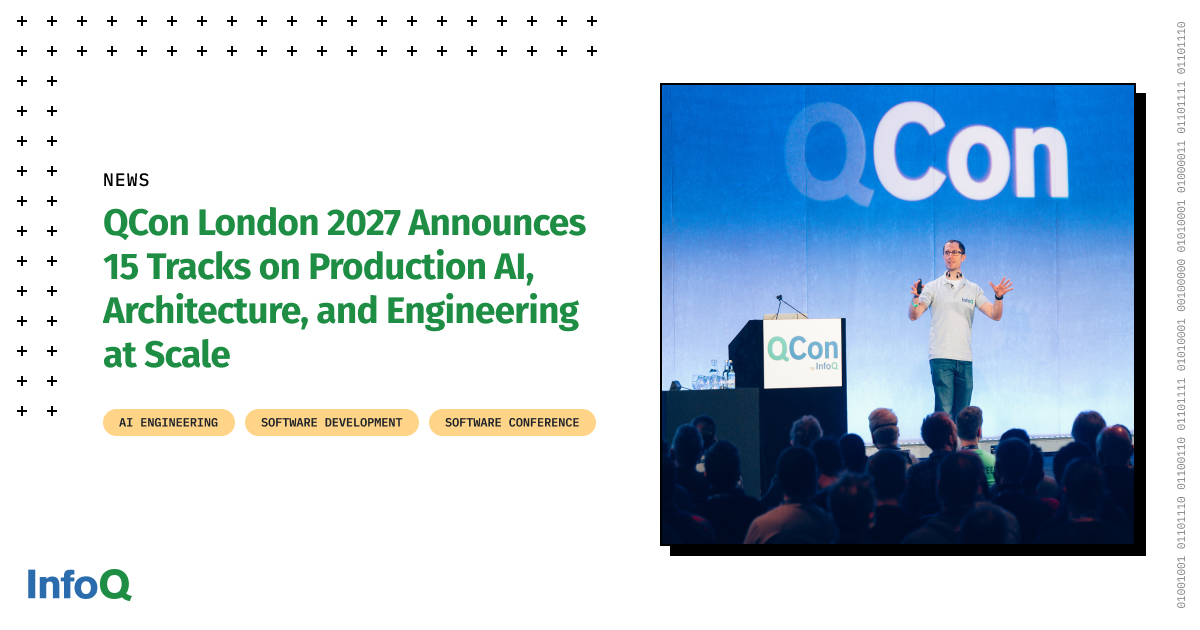
The QCon London 2027 program, with its fifteen tracks spanning agent evaluation, AI-era architecture, and distributed-system debugging, signals something important: the engineering community has moved past the hype and is now building the infrastructure that makes AI reliable at scale. This is not another conference about possibilities. It is a working session for the problems that keep practitioners up at night.
Our take is direct: the most valuable conversations at QCon will not be about what AI can do, but about how to trust what it does. The track on agent evaluation and guardrails directly addresses this. As we explored in our piece on Designing AI Agent Guardrails: Essential Patterns for Data Engineers, the patterns that make agents safe are not theoretical, they are architectural decisions about observability, fallback logic, and constraint enforcement. The QCon program validates that these patterns are now core engineering concerns, not afterthoughts. For data engineers and platform teams, this means the question is no longer "should we build guardrails?" but "which guardrails fit our system's shape?"
The conference's structure also reflects a maturation in how teams think about cost and performance. Model routing, for instance, is evolving from a tactical optimization into a deliberate design choice. Our coverage of Model Routing Becomes a Design Choice With This Cost-Effective Jev Approach highlighted how routing decisions now impact latency, accuracy, and budget in ways that demand upfront planning. QCon's high-performance engineering track will likely surface similar tradeoffs, pushing teams to decide where precision matters and where speed wins.
What makes this program noteworthy is its insistence on engineering fundamentals. Distributed-system debugging and modern data platforms are not glamorous topics, but they are where AI projects fail. A system that cannot be observed cannot be trusted. A data platform that cannot scale with agentic workflows will strangle innovation. The conference implicitly argues that the teams that master these basics will be the ones that ship AI features users actually rely on.
The concrete takeaway for our readers is this: if your team is building AI-enabled features, your roadmap for the next six months should include at least one of these tracks as a dedicated workstream. Whether it is establishing agent guardrails, choosing a model routing strategy, or investing in observability for distributed systems, the work is no longer optional. The QCon program is a practical checklist, not a vision board.
One specific consequence to watch: the Staff+ leadership track suggests that engineering organizations are realizing that AI-era architecture demands new management patterns. The engineers who succeed will be those who can translate technical tradeoffs into strategic decisions. The open question is whether current team structures can adapt fast enough. We will be watching how QCon attendees answer that.