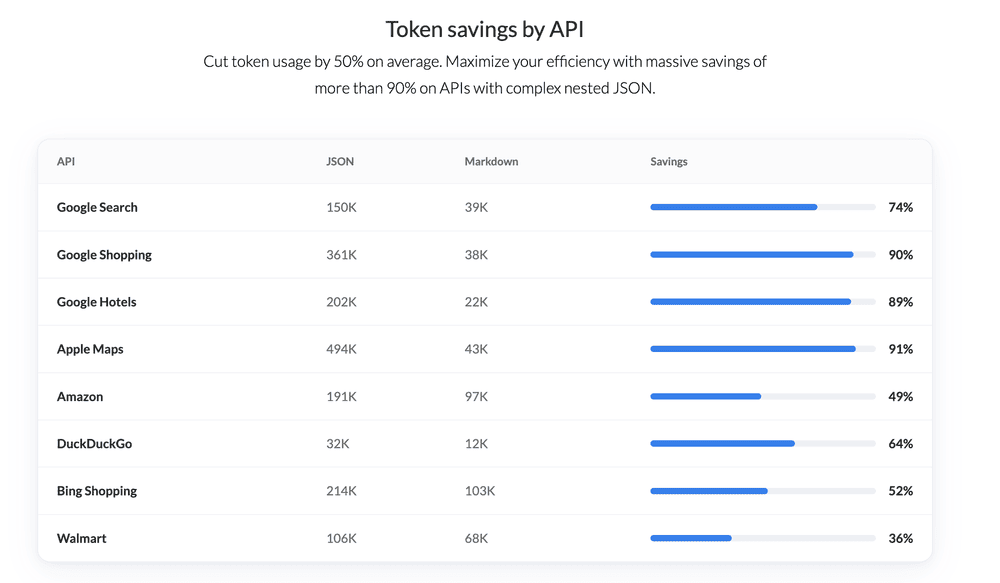
Every time an AI agent reaches for a search result, it pays a toll. That toll is measured in tokens, the invisible currency that determines both cost and context-window headroom. SerpApi's recent breakdown of what actually lives inside a typical search result, clocking in at 24,723 tokens in its raw form, is a useful reality check for anyone building on top of large language models. The finding that Markdown output can shave that down by up to 74% is not just a nice optimization tip. It is a fundamental shift in how we should think about preparing data for AI consumption.
The gap between raw HTML and a lean Markdown version is where the inefficiency hides. A search engine results page is a cluttered place, full of navigation menus, tracking parameters, and layout scaffolding that an LLM neither needs nor understands. When you strip that away, you are left with the actual signal: the titles, the URLs, the snippets, the dates. SerpApi's analysis is a reminder that token reduction is not about squeezing a few extra characters out of a string. It is about removing the noise that dilutes the model's attention. For developers running multi-step agentic workflows, this is the difference between fitting a full day's worth of queries into a single context window and constantly hitting the ceiling mid-task. We would tell any reader who is serious about scaling their AI operations to look at this as a cost-per-query problem, not a one-time engineering chore.
This is also a story about the discipline of data minimalism, a concept that resonates beyond the search API world. If you have been following the broader shift in how we train and deploy models, you know that efficiency is the new frontier. Distributed training methods, like those explored in Unlock LLM Training: A Practical Guide to Distributed Algorithms, are all about getting more done with the same hardware. Token optimization is the inference-side equivalent. You are not making the model smarter; you are making the data smarter, or at least leaner. The same logic applies to the skills now demanded of AI engineers. The roles we see in Navigating AI/ML Job Requirements: A Shift in Expected Skills increasingly require a pragmatic understanding of system costs, not just model architecture. Knowing how to format inputs so that they are cheap to process is becoming a core competency, not a footnote.
The practical takeaway here is direct: if you are building an AI agent that relies on live search, you are likely overpaying by a factor of four on every single request. That is not a small leak in the pipeline; that is a structural cost that compounds across millions of calls. SerpApi's Markdown output is one solution, but the principle applies broadly to any data source you feed into a model. Audit your input formats. Strip the chrome. Your context window will thank you, and so will your monthly bill. The specific number to watch is not the 74% savings, but the question of how much more you can build when that headroom becomes your new baseline.