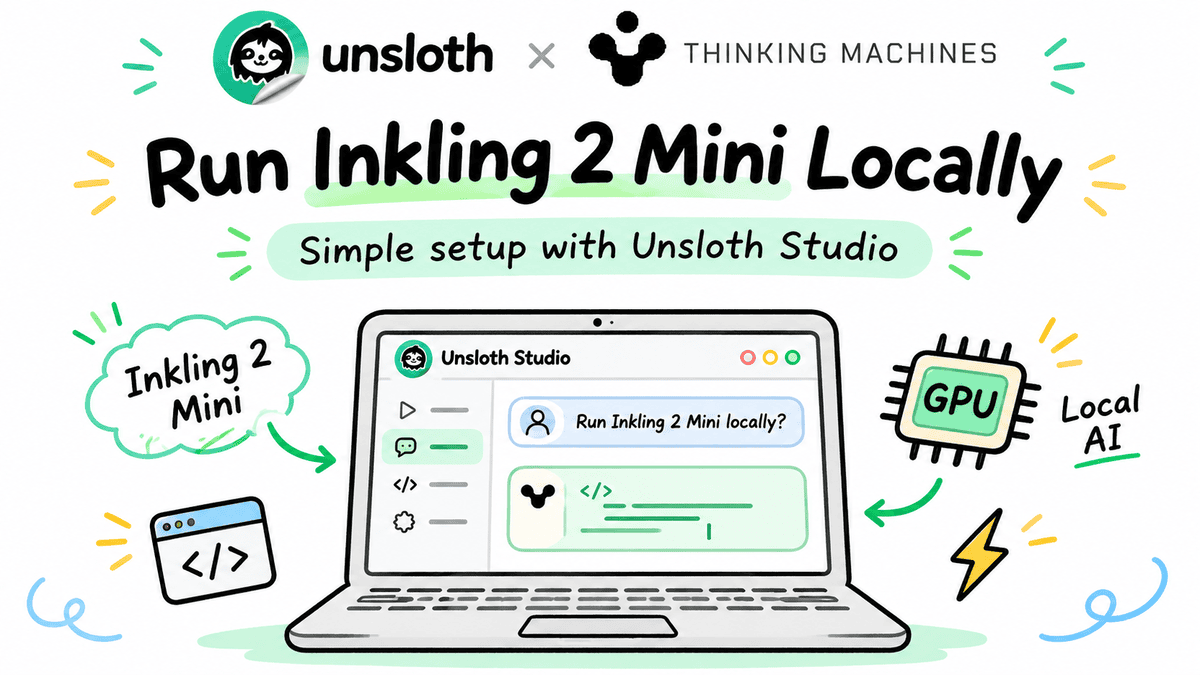
The return of American open-source AI is not a nostalgia trip, it is a practical signal that powerful models can run where your data already lives. The ability to run Inkling 2 Mini on an RTX 3090 using Unsloth Studio proves that fast inference and capable AI coding agents no longer require expensive API subscriptions or cloud dependencies. This matters because it shifts control back to the person at the keyboard.
For too long, the conversation around local AI has been dominated by compromises: smaller models that underdeliver or hardware requirements that feel out of reach. Inkling 2 Mini on a widely available consumer GPU changes that equation. It is a concrete example of what Why Enterprise AI Inference Demands More Than Fast Token Generation actually looks like in practice, operational reality where latency, privacy, and cost are managed on your own hardware, not outsourced. When inference happens locally, the conversation shifts from token speed to workflow integration, and that is where real productivity gains emerge.
This also connects directly to how teams are already rethinking their development pipelines. Netflix engineers have retrofitted their software development lifecycle so that AI coding agents ship alongside human-written architecture records, as described in How Netflix engineers and AI agents ship together with architecture records. Running Inkling 2 Mini locally means any developer can experiment with that same agent-driven workflow without worrying about API costs or data leaving their machine. The barrier to entry drops from a corporate budget line to a single GPU purchase.
The practical takeaway is straightforward: if you have an RTX 3090 sitting in your workstation, you already own the infrastructure for serious local AI work. Unsloth Studio handles the optimization, and Inkling 2 Mini delivers the reasoning. The question is not whether you can afford the hardware, it is whether you are ready to reconfigure your workflow to take advantage of it. Watch how quickly local inference changes the economics of prototyping and iteration for teams that previously defaulted to the cloud. That is the shift worth paying attention to.