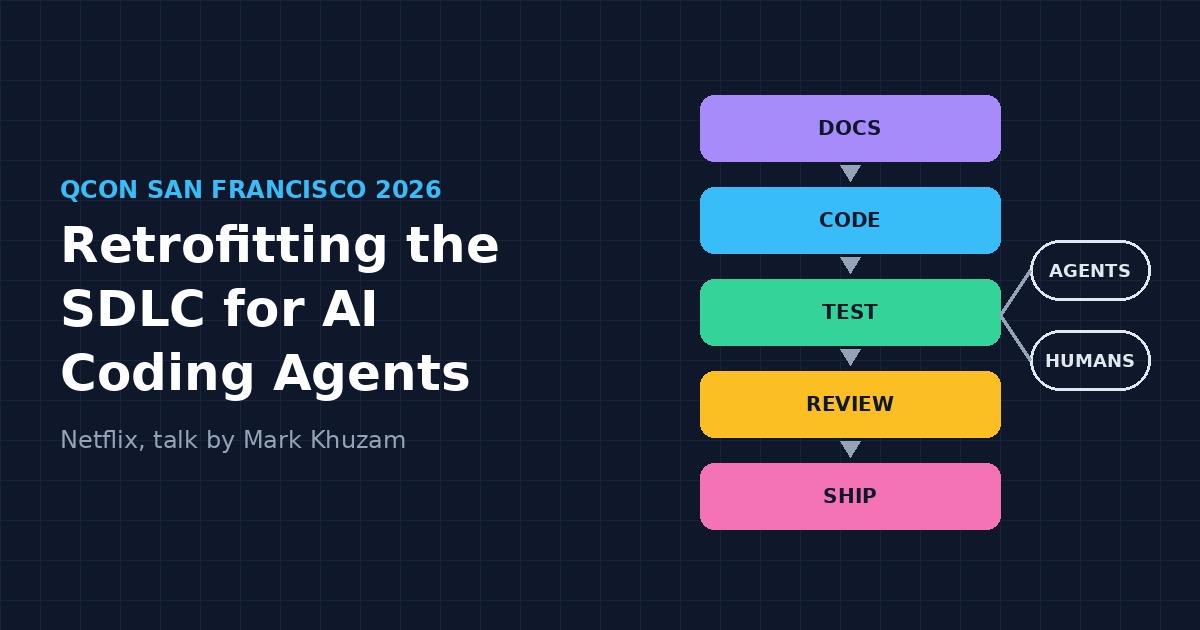
Netflix's Commerce team has quietly solved one of the most pressing problems in modern software development: how to make human engineers and AI coding agents collaborate without descending into chaos. At QCon San Francisco 2026, Mark Khuzam revealed that the team wrote 45 architecture decision records (ADRs) designed for both people and agents, introduced a review bot that posts only verified blockers, and serves per-domain GraphRAG context through a single MCP tool. This is not a futuristic experiment, it is a production system that is shipping code today. What makes this approach worth studying is its humility. Rather than pretending AI agents can replace engineering judgment, Netflix treats them as fast, fallible teammates that need explicit guardrails. That distinction matters more than any model update.
The practical lesson here is that documentation, not prompt engineering, is the bottleneck for agent reliability. Most teams trying to integrate AI coding tools discover that agents hallucinate or drift because they lack structured, authoritative context. Netflix's solution, 45 ADRs that read as clearly for a language model as for a human, treats architecture records as a shared protocol. This aligns with a theme we saw earlier at the same conference: Explore how the AI harness shapes agent safety, just as an OS manages your computer. The harness concept and Netflix's ADR approach both acknowledge that agents need an operating system of constraints, not just a prompt. The difference is that Netflix's solution is concrete and already deployed. Any team can start writing ADRs tomorrow. That is the point.
What stands out is the review agent that posts only verified blockers. Most automated code review tools drown teams in noise, false positives, style nits, irrelevant warnings. By filtering its output to genuine, confirmed problems, Netflix's agent earns the team's trust. Trust is the currency that makes human-agent collaboration sustainable. Without it, engineers ignore the bot or disable it entirely. This is a subtle but critical design choice: the agent is not trying to be smart; it is trying to be useful. The same philosophy extends to the per-domain GraphRAG context served through a single MCP tool. Instead of building one giant knowledge base that confuses agents with irrelevant data, Netflix scopes the context to exactly what a given agent needs for a specific domain. This is a lesson for anyone building agentic systems: context precision beats context volume every time. For a deeper look at how staff engineers align technical strategy across teams, From Netflix to Your Team: How Staff Engineers Align Technical Strategy offers a complementary perspective on the organizational habits that make such discipline possible.
The open question that lingers is whether this pattern scales beyond Netflix's Commerce team. Writing and maintaining 45 ADRs is a substantial investment. Teams with less engineering maturity or tighter deadlines may struggle to replicate the discipline. But the specific takeaway is actionable: start with one domain, write one ADR that both your team and an agent can follow, and measure whether the agent's error rate drops. That single experiment will tell you more about your readiness for AI-assisted development than any vendor demo. Netflix has shown that the bottleneck is not the technology, it is the architecture of shared understanding.