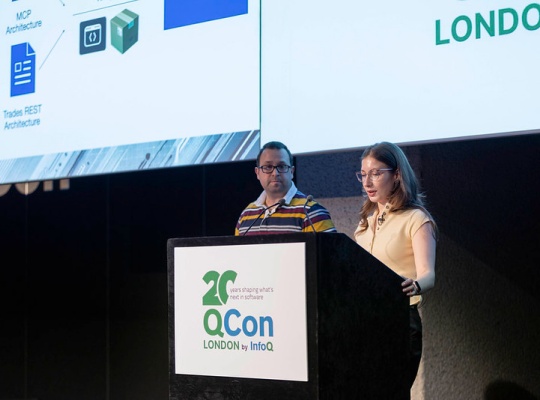
Morgan Stanley's approach to modernizing its API program is a masterclass in practical evolution. Jim Gough and Andreea Niculcea detail how the firm is using Architecture as Code with CALM to bring order to the chaos of enterprise AI. This is not about chasing novelty; it is about building a stable foundation for agentic workflows. For teams still wrestling with brittle, hand-maintained documentation, the move toward codifying architecture is the difference between hoping your systems work and knowing they will. This story connects directly to the broader challenge of Exploring Real-World Computer Vision: Deployments, Edge Models, and Current Challenges, where the gap between a promising model and a production-grade system remains the true hurdle.
What stands out here is the emphasis on automated governance through deployment gates. Many organizations talk about guardrails, but Morgan Stanley is treating them as a non-negotiable part of the pipeline. This is the kind of discipline that separates a pilot project from an enterprise standard. If you are a data leader, this should resonate. It is not enough to have a clever model or a well-architected service; you need the machinery to enforce standards before code ever reaches production. The integration of Model Context Protocol (MCP) and Agent-to-Agent (A2A) communications is particularly telling. It signals a move away from isolated AI experiments and toward a world where agents are first-class citizens in the architecture. This aligns with the concerns raised in Verify Your AI's Understanding: A Simple Check for Tax Season, where the real risk is not a model being wrong, but being confidently wrong in ways that slip past existing checks.
The zero-downtime platform upgrades are the quiet hero of this story. Anyone who has managed a complex system knows that the hardest part is not adding new features; it is replacing the engine while the car is moving. Morgan Stanley's ability to execute these upgrades without disrupting service should be the benchmark for any organization claiming to be AI-ready. This is not a theoretical exercise. It is a direct response to the operational reality that Navigating AI/ML Job Requirements: A Shift in Expected Skills highlights: the industry is no longer just looking for people who can train models, but for those who can deploy, monitor, and evolve them in production.
Our take is straightforward: if you are still treating architecture as an afterthought in your AI strategy, you are building technical debt, not a platform. The specific takeaway to quote is this: enforce your governance through code, not through committee. The moment you rely on manual reviews to catch architectural drift, you have already lost the pace of modern development. Watch how your own deployment gates handle the introduction of a new agent protocol. That will be the real test of whether your architecture is as adaptive as the AI you are trying to run on it.