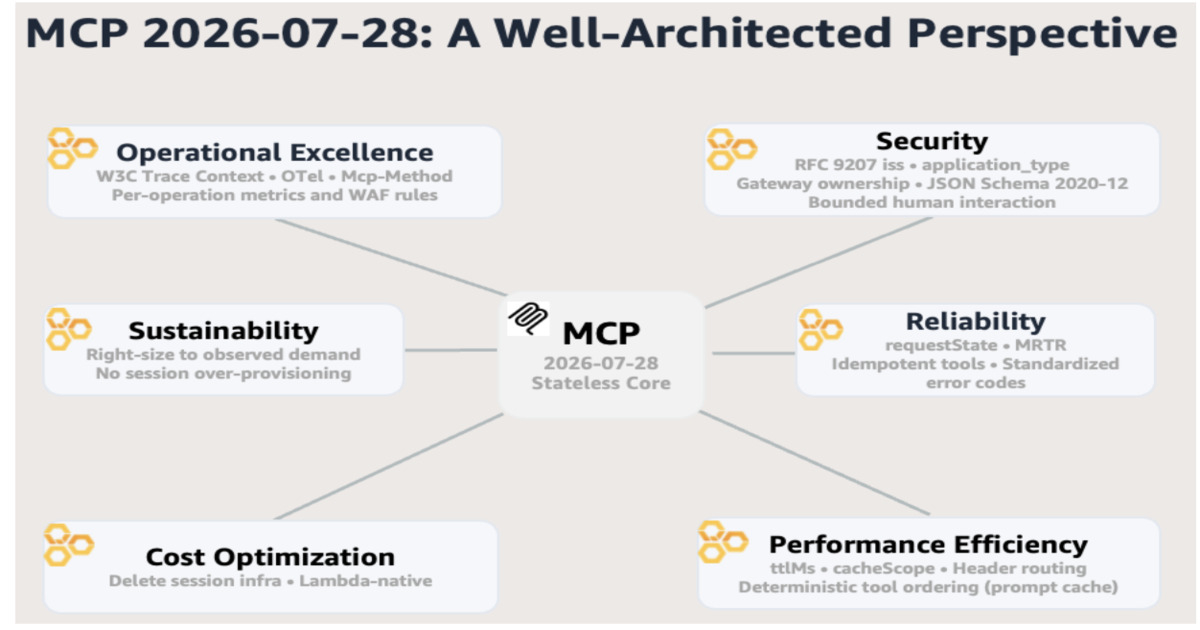
The Model Context Protocol is growing up, and AWS just gave us a clear sign of what maturity looks like. The latest specification removes protocol-level sessions, sticky-session requirements, and session storage for remote MCP servers. That might sound like plumbing talk, but it is the difference between a tool that works in a demo and one that survives contact with production traffic. For anyone who has wrestled with scaling AI-assisted workflows, this is the kind of quiet, structural change that matters more than any flashy feature.
What AWS is really saying is that MCP servers no longer need to hold a conversation hostage. By dropping sticky sessions, requests can route to any available instance, which means horizontal scaling becomes a matter of adding capacity rather than managing affinity. This is a direct answer to a problem we have been circling for a while now: how do you build AI tools that behave like reliable infrastructure instead of fragile experiments? It is worth remembering that this is not the first attempt to make AI workflows more practical. A recent visual guide to MCP already showed how the protocol can orchestrate tools like Claude Code and GitHub, and this update makes that kind of orchestration far less brittle at scale.
The trade-off is honest, and we appreciate that AWS did not bury it. Application state, retries, observability, and idempotency do not disappear. They move to other layers. That means the protocol is no longer trying to be the whole platform. It is becoming a lean, fast lane for requests, and the surrounding ecosystem has to pick up the slack. For teams, this is both a relief and a responsibility. You are no longer fighting the protocol's session management, but you do need to bring your own answers for state and failure handling. This is the same kind of shift we saw when bridging retrieval and action forced teams to think about how agents connect to real systems, and it is also reminiscent of how persistent observability for Cypress tests required teams to treat test output as live infrastructure rather than a static report.
Our take is straightforward: this is the right kind of simplification. It does not dumb anything down. It pushes complexity to where it belongs, which is exactly what a protocol should do. The practical consequence for you is that standing up a remote MCP server no longer needs to feel like a high-wire act. You can route requests independently, scale out without breaking affinity assumptions, and stop worrying about whether your session store is going to become a bottleneck. The open question is how quickly the broader MCP ecosystem embraces this stateless model, because a protocol change only matters if the clients and servers in the wild actually adopt it. Watch for how tool vendors handle state and retries in the coming months, because that will tell you whether this stays a clean spec or becomes a patchwork of workarounds. The foundation is solid. The next move is everyone else's.