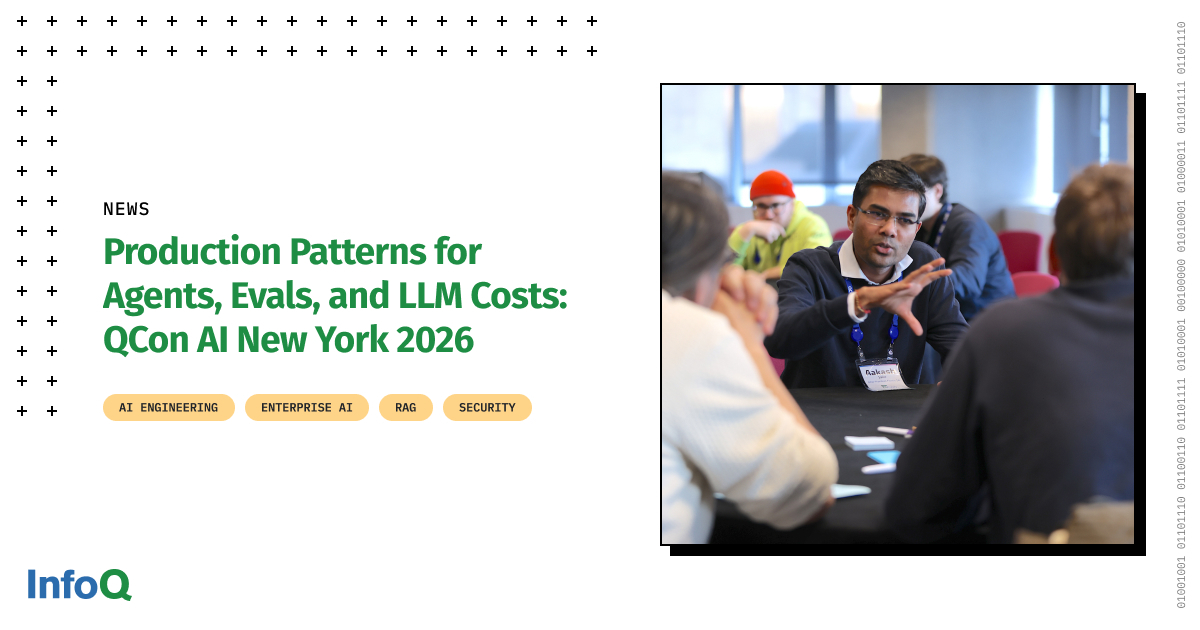
The shift from building AI features to operating them in production is where the real discipline begins, and it's encouraging to see the QCon AI New York 2026 agenda treat that transition with the seriousness it deserves. The confirmed sessions on agent guardrails, rising token costs, and evaluation quality point to a maturity that the industry desperately needs, moving past the novelty of what AI can do toward the harder question of what it should do reliably. This is a sign that the conversation is finally catching up to the realities faced by teams who have already deployed systems and are now living with the consequences.
For practitioners, the most pressing takeaway is that evaluation is no longer a pre-launch checkbox but an ongoing operational commitment. The story notes that evals have to be "good enough to act on," which is a subtle but critical distinction from the perfect-sounding benchmarks we see in research papers. In practice, this means building feedback loops where production data continuously informs test sets, and where a failed eval triggers a human review rather than an automated rollback. This aligns with the cautionary tale from Anthropic restricts internal AI tests from live internet to ensure control, which showed that even well-resourced labs can lose confidence in their evaluation environments. The lesson for the rest of us is that your eval infrastructure is a living system, not a static artifact, and it needs the same monitoring and incident response as your production stack.
Token costs are the other quiet multiplier that rarely gets the attention it deserves in architecture reviews. When code arrives faster than it can be reviewed, as the story describes, the financial implications of every prompt template and agent loop compound quickly. Teams that treat token spend as a post-hoc billing concern rather than a design constraint are going to find themselves making painful cuts later. The practical move is to instrument token usage per feature from day one, tying cost to specific user journeys so that optimization decisions are based on data, not surprise invoices. This is the kind of operational thinking that separates teams who sustain AI systems from those who merely demo them.
The agent permissioning question is where the industry's philosophical divides become concrete. Granting agents access to production systems requires a level of trust that most organizations have not yet earned, and the guardrails mentioned in the story are not just technical controls but organizational policies. Who approves an agent's ability to write to a database? What happens when an agent's reasoning leads it to a valid but unintended action? These are not hypotheticals; they are the daily realities for the engineers speaking at the conference. The broader ecosystem is responding with tooling like Turn Python libraries into MCP servers with Integrum's reflective approach, which standardizes how agents interact with existing code, but standardization only solves the interface, not the judgment. As more startups enter this space, as highlighted by Three days out: 300 startups ready to reshape what spreadsheets can do, the pressure to ship agentic features will only increase, making the guardrail conversation more urgent, not less. The specific detail to watch is how these engineers define "good enough" evals in their talks, because that threshold will become the de facto industry standard for what counts as safe deployment.