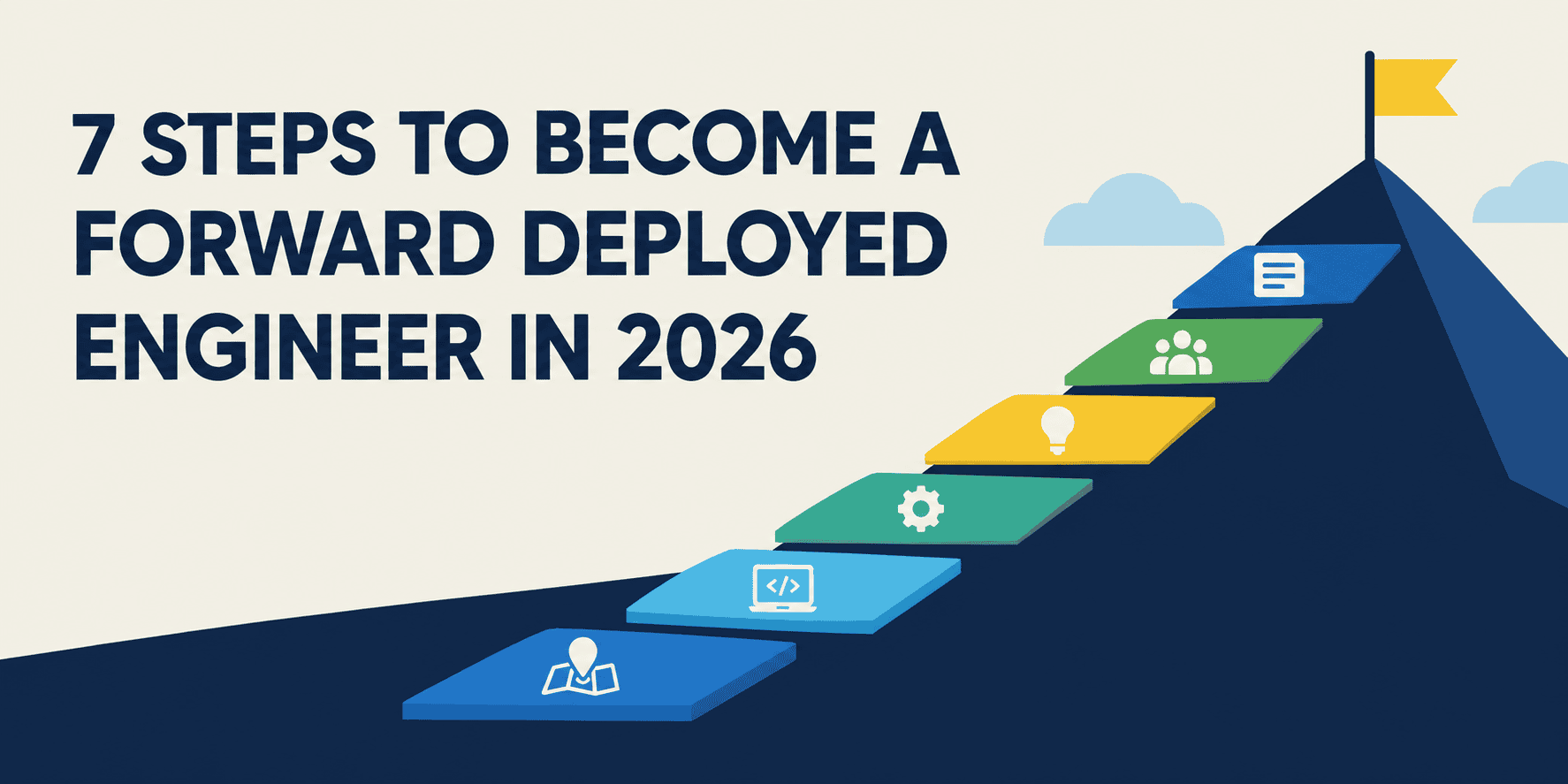
The rise of the forward deployed engineer is a direct response to a hard truth we're seeing play out across the industry: building a great model is no longer the hard part. The hard part is making that model useful inside messy, real-world workflows. This 7-step roadmap acknowledges that the most valuable person in the AI room isn't the one writing the most elegant attention mechanisms, but the one who can map a business problem to a concrete, working solution. We've watched the skill sets for AI roles blur and expand, as we noted in our analysis of Navigating AI/ML Job Requirements: A Shift in Expected Skills, and this guide feels like the natural next chapter in that story.
The piece rightly emphasizes that an FDE's superpower is context, not just code. It's about understanding the unspoken friction in a user's day, and then having the technical chops to wire up an LLM to solve it without requiring a PhD to maintain. This is a significant departure from the old model of handing a spec over the wall. For our readers, the practical takeaway is that the roadmap isn't just a career hack; it's a blueprint for how to future-proof yourself. The days of being a pure specialist are numbered. Instead, you're being asked to become a translator, fluent in both the language of business outcomes and the syntax of prompt engineering and API calls.
What stands out is the emphasis on verification and iteration, a theme that resonates deeply with our own work on validating model understanding in high-stakes scenarios, such as our guide to Verify Your AI's Understanding: A Simple Check for Tax Season. An FDE can't just assume the model gets it right; they have to build the guardrails and tests that prove it. That's the difference between a demo and a deployment. If you're considering this path, don't just focus on learning the latest framework. Spend time learning how to break things, how to define success metrics for ambiguous tasks, and how to communicate those metrics to stakeholders who don't care about token probabilities.
Our honest take is that this role is a reaction against the over-engineered complexity that plagues a lot of AI initiatives. The most effective FDEs we see are minimalists at heart. They resist the urge to build a custom platform when a well-crafted prompt and a few lines of Python will do. The roadmap's final steps, likely covering how to scale your impact beyond a single integration, are the real differentiators. That's where the job transitions from being a consultant to being a force multiplier. The question that will define your success isn't "Can you build it?" but rather "Can you make it so simple that the business unit doesn't need you to babysit it?" Watch for how quickly you can remove yourself from the equation; that is the metric that truly matters.