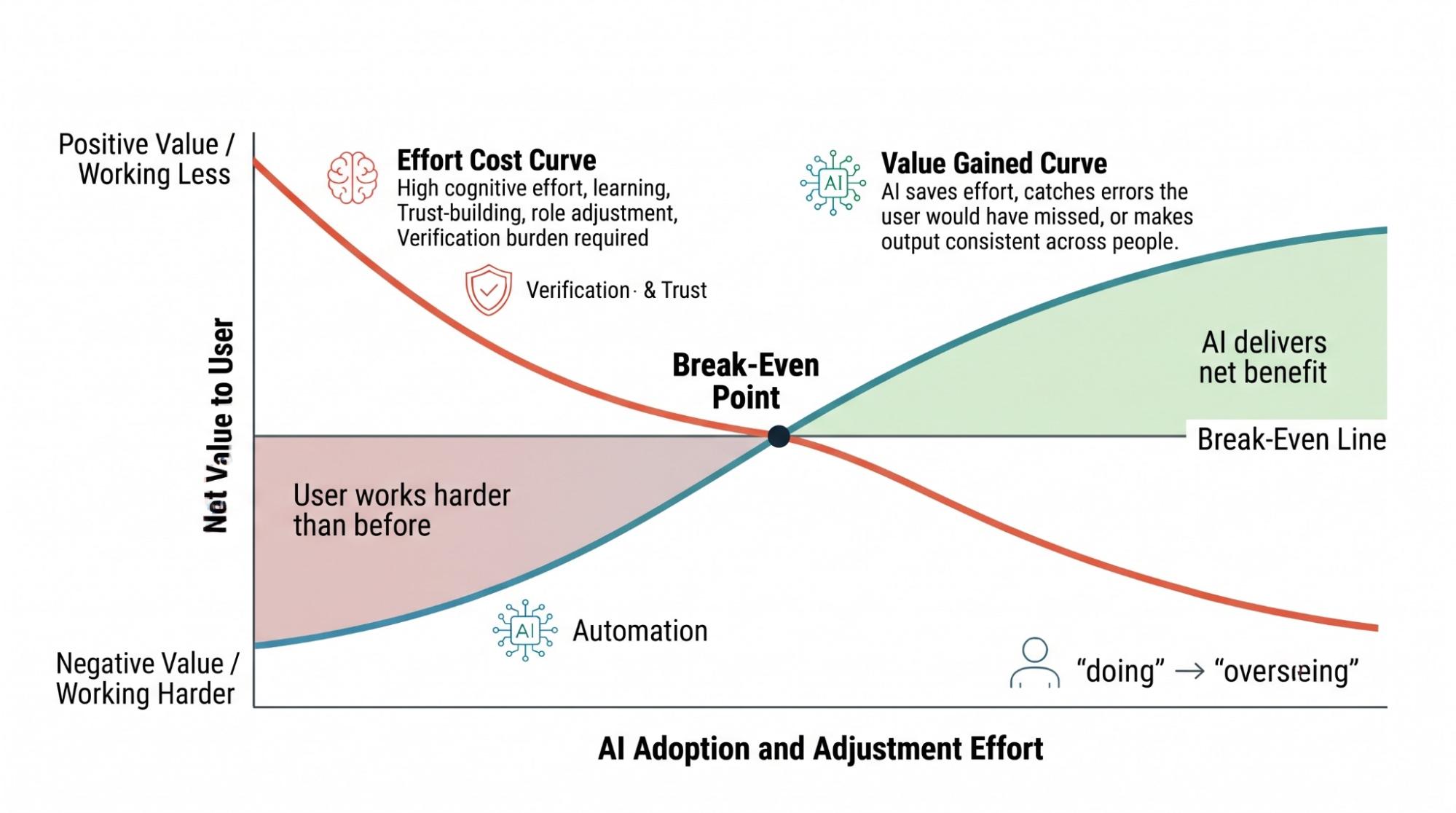
The break-even line for AI features is not a technology problem, it's an attention problem. The health insurer's experience, where specialists abandoned an AI that wrote appeal determinations because reviewing the output took as long as writing it from scratch, reveals something product teams too often miss: a feature that works as specified can still fail the user. This is the same kind of mismatch we see when Time-series AI models stumble against the simple baseline in market forecasting, where technical capability does not translate to practical advantage. The lesson is that every AI addition demands a clear-eyed audit before anyone writes a line of code.
The audit outlined here gets at something fundamental. It asks product teams to count the full cost of an AI feature, not just the clicks it removes, but the attention it requires for checking, learning, and rebuilding mental models. Nelson Cowan's working memory research, cited in the story, puts the limit at roughly four items held in mind at once. Every interface change draws from that supply. When AI turns a specialist into a checker who must verify output for mistakes they would never have made, the feature adds friction to a task the user had already mastered. This is why the insurer's rescoped version, which surfaced relevant policy provisions and left the writing to the specialist, succeeded. It removed search effort without displacing the specialist's core competence. The same principle applies to Automating Bayesian optimization hits a wall when file extraction fails mid-run, where automation fails not because the algorithm is wrong, but because the handoff between systems introduces a failure point that demands human intervention.
The four questions in this audit are worth taking seriously. Question 1 asks whether the feature reduces total effort, counting the checking the user inherits. Question 2 compares the AI approach against the user's current method, including their spreadsheets and workarounds. Question 3 asks whether the user can actually catch the AI's errors, a problem that becomes acute when errors are invisible, as with a trip planner that suggests a museum on its closed day. Automation bias, documented by Parasuraman and Manzey, makes these invisible errors worse because users trust the output without scrutiny. The final question, which the story introduces but does not finish, addresses professional identity: what happens when the feature threatens the very expertise the user built their career on. The physicians in Sophia Ackerhans's 2025 study reported that AI explanations raised both trust and identity threat together, which is a tension no dashboard can resolve.
The concrete takeaway for any product team is this: before building an AI feature, sit down with one person who does the task for a living. Ask them to walk through the task step by step, then map the attention cost of the AI version against the current method. If the checking burden exceeds the effort saved, the feature fails the break-even test for that user. The health insurer found that the search step was worth automating, but the writing was not. That distinction, which part of the task the AI handles, is the difference between a feature that earns its place and one that adds work. The open question is whether product teams will adopt this kind of audit before shipping, or learn the same lesson the hard way.