Whatsapp Tests on Device ML for Scam Detection with Privacy Preserving Analytics
Our take
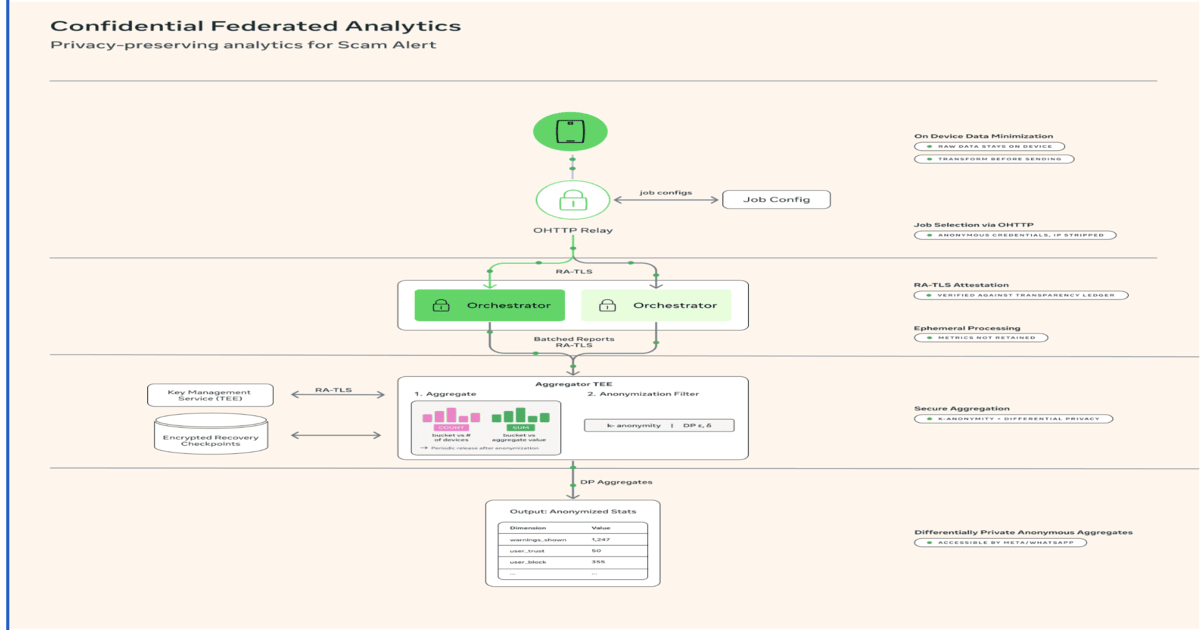
The ongoing arms race against digital fraud continues to escalate, and WhatsApp's recent testing of on-device machine learning for scam detection represents a significant, and nuanced, step forward. It's encouraging to see Meta prioritize user safety while simultaneously addressing critical privacy concerns—a balance that’s often difficult to achieve. This isn't simply about deploying a new algorithm; it’s about rethinking the infrastructure required to deliver AI-powered security in a messaging context. The approach, leveraging confidential computing, Oblivious HTTP, differential privacy, and model transparency, demonstrates a commitment to responsible AI development, especially relevant given discussions around ethical considerations within machine learning, as explored in [how can I learn Machine Learning for Astronomical use? [D]]. The fact that they’re tackling this problem at the device level, rather than relying solely on centralized servers, is a crucial distinction and a key differentiator from many existing solutions.
The cleverness of WhatsApp's architecture lies in its ability to keep sensitive message content on the user's device while still allowing for the analysis needed to detect potential scams. This circumvents many of the privacy objections that would arise from sending message data to a central server for processing. This approach is particularly timely, considering the increasing sophistication of phishing and social engineering attacks delivered via messaging platforms. It’s also interesting to consider this in the context of other AI applications, like the puzzle assistant built using computer vision detailed in [Jigsaw Jeeves: Building a Puzzle Assistant using Computer Vision]. Both demonstrate the potential for powerful AI capabilities to be delivered locally, minimizing data transmission and maximizing user control. The focus on model transparency, specifically, allows for ongoing auditing and refinement, which is critical for maintaining trust and ensuring fairness in AI-driven security systems. Many researchers are exploring similar concepts in real-world applications, as highlighted in [Looking for 1 teammate — RealPDE Competition (NeurIPS 2026)[D]], demonstrating a growing interest in applying these techniques to solve complex problems.
The broader significance of this development extends beyond WhatsApp's user base. It sets a precedent for how large messaging platforms can integrate AI-powered security features without compromising user privacy. The techniques employed – confidential computing and differential privacy – are increasingly becoming essential tools for organizations handling sensitive data. While the current implementation is in beta and limited, the underlying principles are broadly applicable to other areas where on-device AI can enhance security and privacy. The challenge will be scaling this approach to handle the massive volume of messages processed by platforms like WhatsApp while maintaining both accuracy and performance. It’s also worth noting that scammers are constantly adapting their tactics; therefore, a continuously learning and evolving AI model is essential for long-term effectiveness. The success of this initiative hinges on the ability to proactively anticipate and mitigate new scam techniques, ensuring that the system remains a step ahead of malicious actors.
Ultimately, WhatsApp's Scam Alert beta provides a glimpse into the future of AI-powered security – a future where sophisticated threat detection doesn't require sacrificing user privacy. The commitment to on-device processing and responsible AI practices is commendable and could inspire similar innovations across the industry. A key question moving forward will be how effectively this approach can be adapted to detect other forms of harmful content, such as misinformation and hate speech, while remaining sensitive to the nuances of human communication. It will be fascinating to observe how Meta refines this technology and whether it becomes a standard feature across its messaging platforms, and, more broadly, a model for other companies grappling with the challenges of AI-powered security and privacy.
WhatsApp is testing Scam Alert in limited beta, using on device machine learning to detect potential scam messages from non contacts. Meta's architecture keeps message content on the device while using confidential computing, Oblivious HTTP, differential privacy, and model transparency to measure performance and protect model delivery.
By Leela KumiliRead on the original site
Open the publisher's page for the full experience