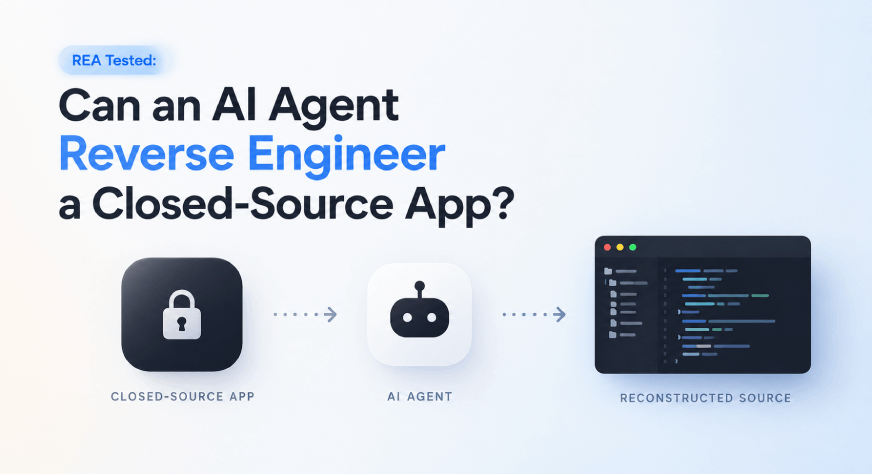
Every developer knows the moment: a feature misbehaves, the documentation is silent, and the source is locked behind a compiled binary or a wall of minified JavaScript. The traditional path forward means hours in a disassembler, wrestling with Ghidra or IDA, and hoping the stack traces eventually confess. It is tedious, specialized work that most of us avoid until we absolutely cannot. That is why the arrival of Reverse Engineer Anything (REA), an open-source project with over 200,000 GitHub stars, deserves more than a passing glance. It connects coding agents directly to compiled binaries, asking a simple question: can AI do the heavy lifting when closed code refuses to open?
Our take is straightforward: yes, but with eyes wide open. REA is not magic, and it is not a replacement for the deep expertise that reverse engineering demands. What it offers is something more practical: a way to lower the barrier to entry. Instead of spending hours mapping memory layouts by hand, you can explore how AI agents unlock hidden insights in compiled binaries and let the model surface patterns you might have missed. That is a genuine shift in workflow, not a hype cycle. For developers who are productive but not necessarily fluent in assembly, this turns a wall into a door. The same logic applies beyond debugging: if AI can help you understand code you did not write, it can also help you understand the systems you rely on daily, from legacy enterprise tools to open-source dependencies you have never fully audited.
This matters because the problem is not rare. Every modern stack is built on layers of code nobody fully reads. We trust libraries, binaries, and black-box services because reading everything is impossible. REA does not eliminate that trust gap, but it gives you a way to interrogate it. Instead of accepting that a mysterious binary behaves a certain way, you can ask the AI to trace the logic, explain the control flow, and flag anything suspicious. That is a meaningful upgrade in autonomy. It also connects to a broader trend we have been watching closely: the same analytical power that Aurora PostgreSQL gains from DuckDB's acquisition is appearing in tooling that was previously reserved for specialists. The pattern is consistent: AI is democratizing access to complex technical work, whether that is querying large datasets or cracking open compiled code.
The practical consequence for you is this: the next time you hit an unexplainable bug in a third-party library, you have a new option. You can still dive into the disassembler, but you no longer have to start there. REA lets you bring an AI agent into the investigation, and that changes the economics of the task. The hours shrink, the frustration drops, and the learning curve flattens. That is the kind of outcome we care about, not because it is flashy, but because it makes you more capable in your daily work. The open question worth watching is how far this goes: can AI move from explaining code to safely modifying it? That would be the next step, and it is one we will be following closely. For now, the takeaway is concrete: when closed code will not open, AI can do the heavy lifting, and you should let it.