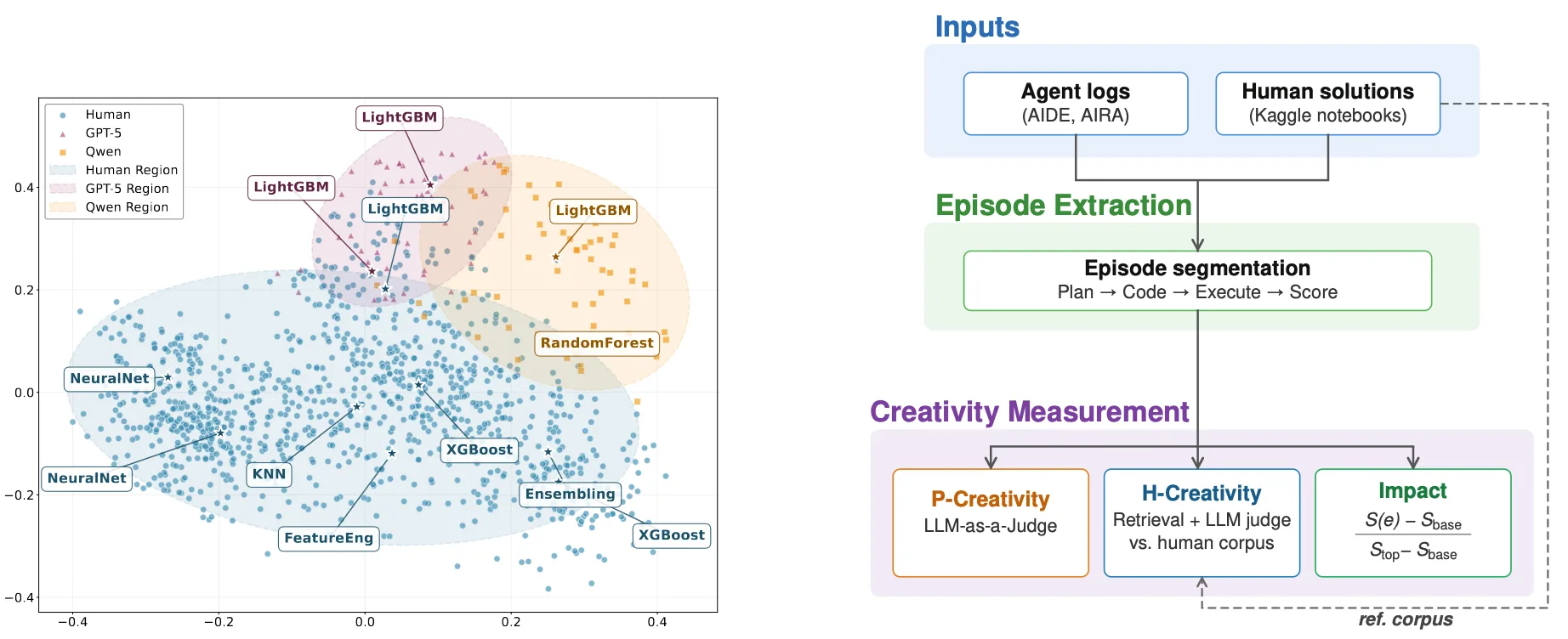
The question of whether AI agents can match human creativity in data discovery is fascinating, but it frames the conversation backward. The real question isn't whether LLM agents can replicate human creativity, it's whether they can unlock forms of insight that humans consistently miss. The recent exploration of this topic through the lens of creativity potential is a useful starting point, but it needs a dose of practical reality. We think the answer is less about competition and more about augmentation. If you are spending hours hunting for patterns in a spreadsheet, an agent that surfaces unexpected correlations isn't replacing your creativity, it is feeding it. This aligns closely with the challenge of Grant Your LLM Safe Autonomy in 9 Practical Steps, where the focus shifts from asking whether an agent can think to asking how we let it act without losing control.
The creativity test applied to LLM agents is a clever exercise, but it misses the point that human creativity in data work is often bottlenecked by rote labor. We spend more time cleaning, sorting, and searching than we do interpreting. An agent that can propose a novel grouping or flag an outlier we would have scrolled past is not mimicking a human insight, it is creating the conditions for one. The real innovation here is not that an agent can be creative; it is that an agent can make us more creative by removing the friction that buries discovery. This is a different kind of intelligence, and it is far more useful. Understanding how neural networks themselves evolved under empirical pressure, as explored in How the ReLU Shift Reshaped Our Understanding of Neural Networks, reminds us that the tools we build are never fixed commitments, they are hypotheses tested under real-world pressure. The same applies to agent creativity.
What this means for anyone working with data is a shift in expectations. Stop asking whether an agent can match your best creative moment. Ask whether it can handle the thousands of small, repetitive decisions that drain your energy before you ever get to a creative moment. That is where the value lives. The comparison to human creativity is a distraction. The practical test is whether an agent can surface something you would not have found on your own within a reasonable timeframe. The recent work on trimming API calls during an apartment search, Trim 2,500 API Calls From One Apartment Search and Keep the Matches, shows exactly this principle in action: removing unnecessary model work to keep the agent focused on what actually matters. Creativity in data discovery is not about generating more ideas. It is about generating the right ones with less noise.
Here is the specific takeaway: the next time you test an agent for data discovery, do not measure it against a human benchmark. Measure it against your own baseline of missed opportunities. If the agent finds one pattern you would have overlooked in a dataset you have stared at for weeks, that is not a simulation of creativity. That is a new capability entirely. The open question is whether we will design agents to chase human-like discovery or to chase what humans consistently fail to see.