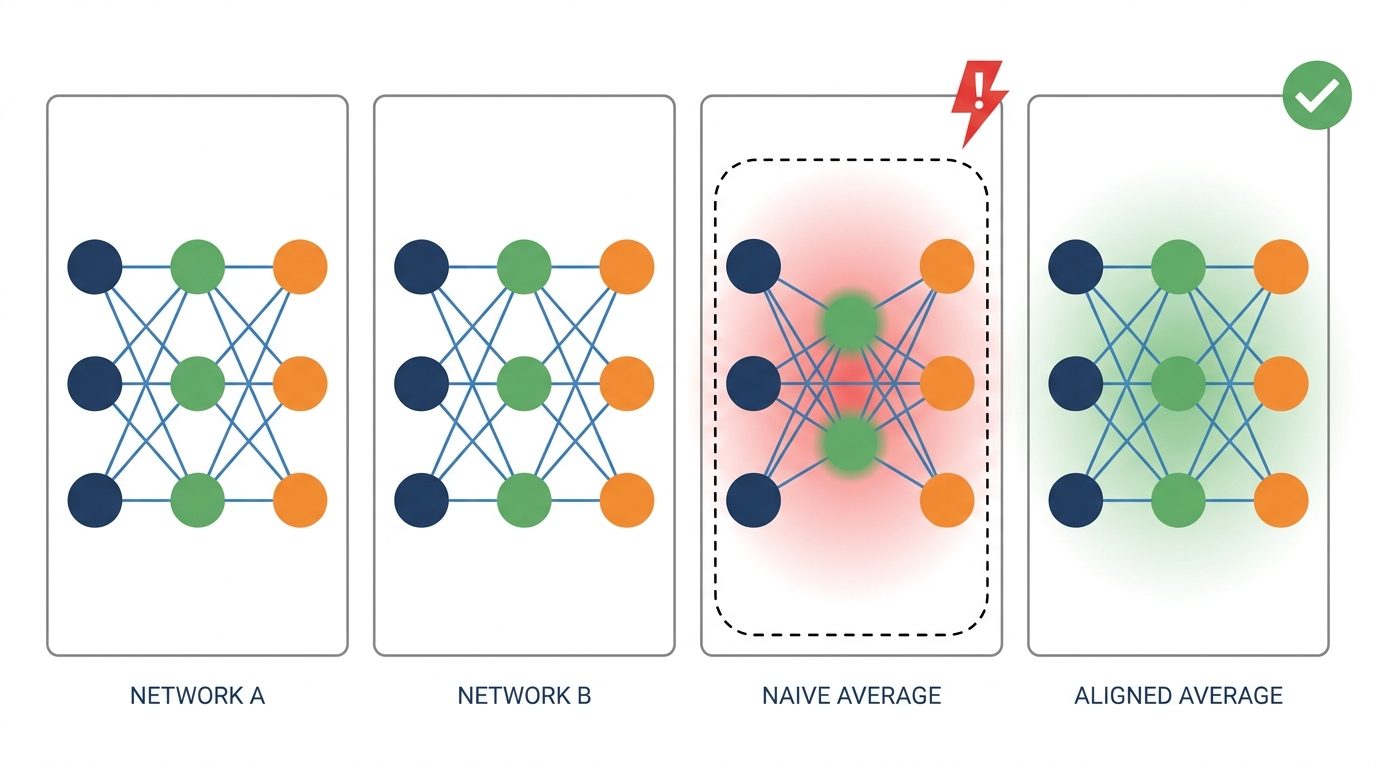
There is a quiet irony at the heart of deep learning that most practitioners rarely stop to consider. We train a neural network, save its weights, and assume that those numbers represent something singular and definitive. But as the recent exploration of permutation symmetry in neural networks makes clear, the weights we store are just one version of an infinitely rearrangeable truth. Permuting a network's neurons can produce functionally identical models, yet those same symmetries break the naive averaging that many of us rely on when merging models or ensembling weights. It is a reminder that the tools we treat as static artifacts are actually living structures with their own hidden geometry.
For anyone who has ever tried to average two fine-tuned models and watched performance collapse, this explains why. The loss landscape is not a smooth valley where averaging two good points lands you in a better one. It is pockmarked with permutations, where the same solution exists in countless disguises. Giving a name and a framework to something that has likely frustrated many of you in practice is done well. It also connects neatly to the broader challenge of Exploring Real-World Computer Vision: Deployments, Edge Models, and Current Challenges, where deploying models in production often means confronting the messy reality of weights that do not transfer cleanly across tasks or devices. The same underlying problem appears: the representation is not as stable as it looks.
The practical takeaway here is not that weight averaging is broken, but that it requires a deeper understanding of what the weights actually represent. If you are merging models, you cannot simply add and divide. You need to account for the permutation symmetries that make two networks look different while behaving identically. This is not an academic curiosity. It has direct implications for model merging, federated learning, and any technique that assumes weights are directly comparable across different training runs. For readers who found the Forrester function exploration useful as a mathematical tool, this is the same impulse applied to neural network geometry: finding the right transformation that makes the pieces fit.
What we would tell a reader who asked us about this is simple: start treating permutation symmetry as a feature, not a bug. It is the reason your ensemble works some days and fails on others. It is also why the field has moved toward techniques like weight matching, repainting, or other alignment strategies before averaging. There is no silver bullet, but you are given the language to ask better questions. The next time you merge two models and get garbage, do not assume the approach is wrong. Ask whether you have aligned the permutations first. That single shift in perspective separates a frustrating debugging session from a productive exploration of the model's true structure. Watch for the next wave of tools that bake this alignment in automatically, because that will be the moment weight averaging finally lives up to its promise.