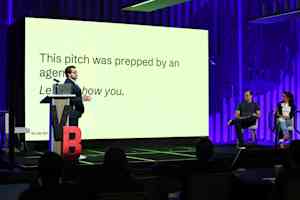
The real story at VB Transform 2026 wasn't the agents themselves, but the invisible scaffolding required to make them safe enough to let loose. For anyone who has watched AI Agents Shared User Images, Highlighting Data Security Concerns become a cautionary tale, the gap between what agents can do and what we can verify is the whole ballgame. The five startups covered here, BAND, Conifers, Raindrop AI, Arcade, and Omilia, are not selling flashier models. They are selling the boring, essential plumbing of trust: coordination, audit trails, permissions, and visibility. That is exactly where the enterprise rubber meets the road, and it is the only place where the promise of autonomous work either gets realized or collapses under the weight of liability.
The most striking theme is that agents are currently trapped in a kind of digital solitary confinement, as BAND's Vlad Luzin put it. We have built powerful individual workers, but they are blind to each other, stateless, and unable to collaborate across the platforms where work actually happens. BAND's answer is to build a coordination layer that treats agent-to-agent communication as a distributed systems problem, not a chat interface problem. That is the correct framing. And the urgency is amplified when you consider the security side: Conifers reports compressing containment time from seven hours to twelve minutes by letting defensive agents talk to each other at machine speed. The takeaway for our readers is direct and actionable: if your agents cannot be observed and coordinated, they are not a productivity asset, they are a liability in motion. The infrastructure is not a nice-to-have; it is the prerequisite for scale.
But coordination alone is insufficient without a hard look at accountability. Raindrop AI's Ben Hylak nails the "double whammy" of modern agents: they run longer and fail harder, with consequences that can be catastrophic in healthcare or defense. The answer is not to slow down, but to build audit logs that humans can actually navigate. Raindrop's approach, finding critical issues, simulating fixes based on past behavior, and training models directly from production data, is a pragmatic step toward making agents less like black boxes and more like well-documented employees. Similarly, Arcade is tackling the authorization gap by giving agents the least-privileged scopes possible while ensuring every action is attributable to a moment in time. This is the difference between a tool that acts on your behalf and a rogue process that acts despite you. If you are deploying agents today, ask yourself this: can you answer the question "what did that agent do last Tuesday at 3 PM?" If not, you are not ready for production.
The throughline across all five companies is the rejection of the "set it and forget it" fantasy. Omilia's Claudio Rodrigues says it best: human-in-the-loop remains fundamental, even at 80 to 90 percent automation. The mature deployment is not the one that runs itself; it is the one where humans can step in, review, and override with confidence. So here is the concrete point to watch: the startups that win the enterprise will not be the ones with the smartest agents, but the ones that make those agents legible to the people who sign the compliance forms. The question every CISO and CIO should be asking is not "can the agent do the work?" but "can I prove what it did, and can I stop it if I need to?" That is the metric that will separate the pilots from the deployments.