large dataset processing
Beyond Market Intelligence keeps large dataset processing in one place: 87 stories so far. The section currently leads with “Trunk Tools cuts document review by 50 days with specialized AI architecture”, “Choosing the Right Data Skills Platform for Your Growth in 2026”, and “Mistral OCR 4 brings structured document intelligence to enterprise workflows”. Construction data presents a unique challenge: most general-purpose AI models struggle with the industry’s jargon-dense, abbreviation-heavy documents. Navigating the world of data skills requires choosing the right learning platform. Acme AI is the next-generation, AI-powered spreadsheet platform built to replace Excel and redefine how analysts, data scientists, and enterprise teams work… The list below is every large dataset processing story on Beyond Market Intelligence, newest first.

Trunk Tools cuts document review by 50 days with specialized AI architecture
Construction data presents a unique challenge: most general-purpose AI models struggle with the industry’s jargon-dense, abbreviation-heavy documents. Trunk Tools addresses this by building a specialized, three-layer architecture—perception, semantics, and agents—to transform data chaos into agent-ready workflows. This purpose-built stack has dramatically reduced document review cycles from months to days and prevents costly field errors.

Choosing the Right Data Skills Platform for Your Growth in 2026
Navigating the world of data skills requires choosing the right learning platform. DataCamp and Coursera are both popular options, but cater to different needs. DataCamp focuses exclusively on data science and analytics, while Coursera offers a vast marketplace of courses across numerous disciplines. This comparison weighs pricing, course catalogs, and more to determine which platform delivers the most value in 2026. For deeper insights into related AI challenges, explore "Your RAG Pipeline Is Probably Useless. Here’s a Better Alternative."

Mistral OCR 4 brings structured document intelligence to enterprise workflows
Mistral AI has launched OCR 4, transforming document extraction into a full enterprise AI solution. This fourth-generation model delivers structured document representations, including bounding boxes, block classification, and confidence scores, moving beyond simple text extraction. Supporting 170 languages and deployable on-premise, OCR 4 addresses critical data sovereignty concerns, particularly relevant following recent U.S. export control actions. Early enterprise feedback highlights significant cost and latency reductions, positioning Mistral as a compelling alternative for document-intensive workflows.

Enterprise AI imagery finds its own voice with faster, open-weight generation
Enterprise-grade AI image generation in just 2 seconds is now a reality with Krea 2 Raw and Turbo, available as open weights under a custom license. Addressing concerns that AI imagery often lacks originality, Krea’s new models offer greater visual variety, prompt accuracy, and crucial customization capabilities for brands. Krea 2 Turbo’s remarkable 2-second generation speed surpasses competitors, while Krea 2 Raw provides a flexible foundation for training custom models.

AI agents that rewrite their own rules unlock smarter enterprise workflows
Researchers are introducing Self-Harness, a framework enabling AI agents to systematically refine their own operational rules, potentially boosting performance by up to 60%. While building frontier AI models remains complex, customizing the “harness”— the system governing agent behavior—is increasingly valuable for enterprises. Self-Harness addresses the challenge of manual harness tuning by leveraging the agent's own execution traces to identify and correct weaknesses, moving beyond intuition-based adjustments.
Explore how hidden gaps in time-series data can distort your analysis.
Time-series data presents unique challenges, and undetected anomalies can severely impact model performance. Recognizing this, we introduce TSAuditor, a lightweight, open-source framework designed to streamline exploratory data analysis (EDA) for time-series datasets. TSAuditor proactively identifies chronological breaks, data leakage, and sequential spikes—issues often missed by standard profiling tools.

Small model, big questions: Weibo's 3B AI challenges reasoning benchmarks.
The AI world is buzzing over Sina Weibo’s VibeThinker-3B, a surprisingly potent 3-billion parameter language model that’s challenging the conventional wisdom around AI scaling. Achieving benchmark scores rivaling those of significantly larger models from industry giants like Google and OpenAI, VibeThinker-3B demonstrates a compelling case for "Parametric Compression-Coverage," suggesting verifiable reasoning can be remarkably efficient. While real-world utility remains a subject of debate, this development compels a critical question: can focused innovation on smaller models unlock AI capabilities previously confined to massive, expensive systems?
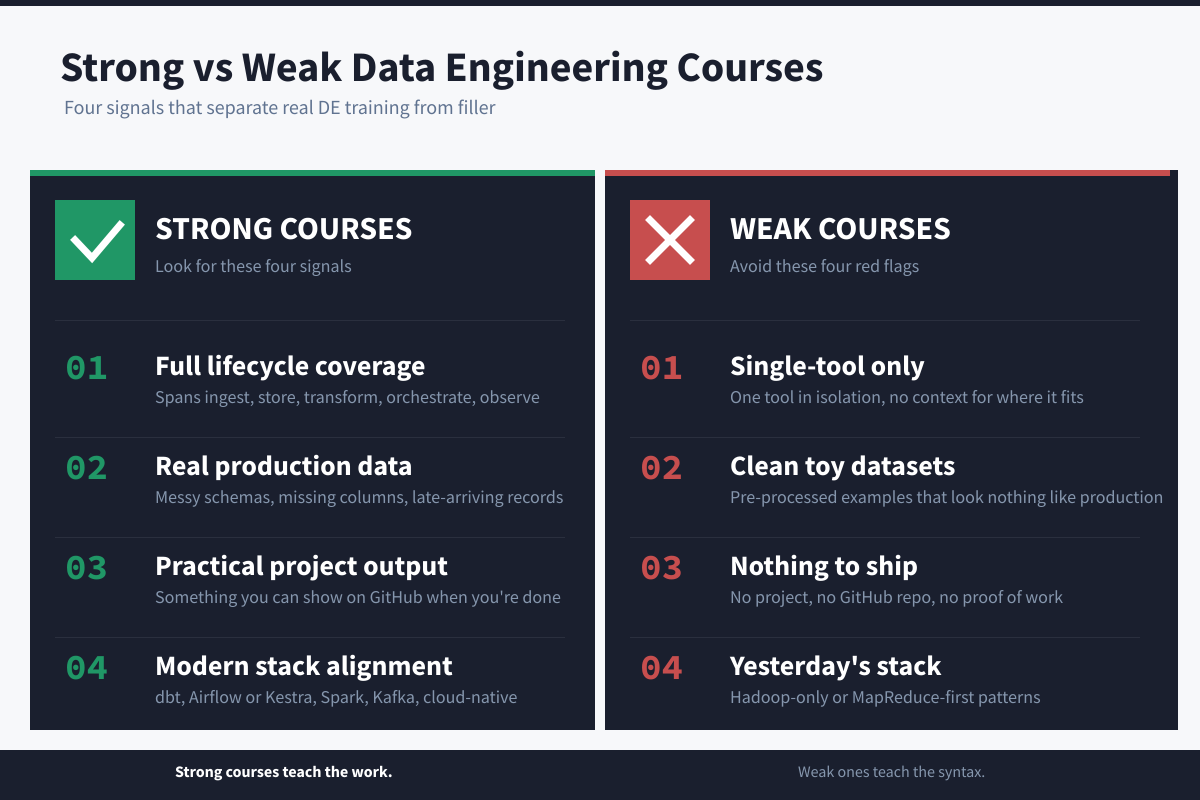
Transform Your Data Skills: Top Engineering Courses for 2026
Ready to elevate your data capabilities? The future of data management demands skilled engineers, and finding the right training is key. We've explored the landscape to identify ten leading data engineering courses for 2026. Discover options tailored to your experience, learning style, and goals—from beginner introductions to advanced cloud platform training. This guide provides a clear comparison, empowering you to transform your skillset and confidently navigate the evolving world of data.

Navigate the LLM Learning Landscape: Find the Right Course for You.
The landscape of Large Language Model (LLM) learning can feel overwhelming. You'll discover a vast range of options, from brief prompt engineering tutorials to extensive engineering programs. Finding the right course to match your experience and goals requires careful navigation. Explore our guide to understand what each type of LLM course prepares you for, empowering you to confidently choose the path that best transforms your data skills and unlocks your future-focused potential.

Open source search agent redefines AI retrieval with focused recall power.
Researchers from UIUC, UC Berkeley, and the open‑source vector database Chroma have unveiled Harness‑1, a 20‑billion‑parameter AI search agent that outperforms GPT‑5.4 on information recall, achieving a 73 % average score across eight complex benchmarks. Built on OpenAI’s gpt‑oss‑20B model and released under Apache 2.0, Harness‑1 demonstrates that a well‑designed external “harness” can replace brute‑force context scaling, delivering enterprise‑grade accuracy with lower compute costs.
Three ML students question if open-source robotics data is worth the work
Before diving into months of processing open-source robotics datasets, it’s crucial to assess the real challenges at play. As ML students exploring the robotics landscape, we've encountered numerous hurdles in data compatibility, from varying schemas to inconsistent metadata. This leads us to question whether the industry suffers from a data scarcity issue or a data interoperability problem instead. We invite insights from those actively working in robotics: Would a common, enriched dataset be genuinely useful, or is the demand for shared data overstated?

How MeMo lets your LLM learn new skills without starting over
MeMo's innovative memory model enables teams to enhance their large language models (LLMs) without the need for costly retraining, achieving a notable 26% performance increase. By addressing the challenges of static knowledge in enterprise AI, MeMo employs a modular architecture that separates knowledge encoding from reasoning, making it adaptable to both open-source and proprietary models. This efficient approach allows for continuous updates with minimal risk of catastrophic forgetting.

Give your agents direct access to raw data, not just summaries.
In the evolving landscape of AI-driven workflows, traditional retrieval systems often fall short, limiting agents' abilities to access real-time data. Researchers propose Direct Corpus Interaction (DCI), a game-changing technique allowing agents to interact directly with raw data using command-line tools, bypassing complex embedding models. This approach enhances precision in dynamic environments, ensuring agents can access the most relevant and current information. As enterprises adapt, DCI could redefine data management, supporting tasks that demand exact evidence and detailed insights.

Trillion-parameter AI inference runs seven times faster on Cerebras chips
Cerebras Systems has made a significant leap in the AI inference market, announcing that its chips can run the trillion-parameter Kimi K2.6 model nearly 7 times faster than any GPU cloud provider, achieving 981 output tokens per second. This milestone, independently verified by Artificial Analysis, showcases Cerebras' wafer-scale architecture's unique advantages, eliminating traditional bottlenecks. As the company positions itself at the forefront of AI technology, it invites enterprises to explore the transformative potential of its solutions.

How Interface Transparency Builds Trust in Agentic AI
In "Practical Interface Patterns For AI Transparency (Part 2)," we delve into why traditional loading patterns, such as spinners, can fall short in agentic AI experiences. By adopting interface patterns that transparently reveal the system's processes, status, and decision-making, we can significantly enhance user trust and engagement. This invites you to explore innovative approaches that prioritize transparency, ultimately empowering users in their interactions. For a deeper understanding of AI evaluation, check out our article, "Building an Evaluation Harness for Production AI Agents."

Your scanner passed the skill. The test file didn't.
In a recent analysis, Gecko Security revealed a significant blind spot in the Anthropic Skill scanner: it fails to inspect bundled test files, which can execute malicious code with full access to the filesystem. This oversight allows attackers to hide payloads in seemingly innocuous test files, circumventing the scanner's existing checks. As a result, developers inadvertently expose sensitive credentials during routine testing processes.
From 5k verified images to 150k: scaling stool analysis with AI
You have a substantial dataset of over 150,000 stool images, yet your current manual verification process may limit efficiency as you scale. While training on a meticulously curated subset of 5,000 images lays a strong foundation, the ongoing manual review could become a bottleneck. To enhance your workflow, consider incorporating semi-automated annotation tools or leveraging active learning techniques that prioritize the most informative samples.
Building Local-First Web Apps Without the Hype
In 2026, the landscape of web development is evolving, and local-first applications are at the forefront of this transformation. This perspective offers seasoned developers an honest look at the architecture of local-first web apps, addressing common skepticism surrounding quick fixes and silver bullets. By exploring the benefits and challenges of this approach, we aim to empower developers to navigate the complexities of modern web architecture with confidence. Join us in discovering how local-first strategies can enhance user experiences and redefine productivity in web development.

xAI ships Grok 4.3 and a voice cloning suite at a competitive price
xAI has launched Grok 4.3, a new large language model that enhances performance while maintaining an aggressively low pricing structure. This release comes amid ongoing legal battles involving founder Elon Musk and OpenAI co-founder Sam Altman. Grok 4.3 introduces advanced reasoning capabilities and a powerful voice cloning suite, designed to optimize user workflows. With significant improvements in specialized tasks, Grok 4.3 positions itself as a strong contender in the AI landscape, offering both affordability and functionality for developers and enterprises alike.

Discover how Runpod Flash simplifies AI development by removing container overhead.
Runpod has unveiled Runpod Flash, an open-source Python tool designed to streamline AI development by eliminating the cumbersome containerization process. This innovative platform enables developers to rapidly create, iterate, and deploy AI systems across various environments, enhancing efficiency in both research and production. By removing the "packaging tax" associated with traditional Docker workflows, Runpod Flash simplifies the development cycle, allowing for sophisticated data pipelines and seamless integration with AI agents.

Smarter AI agents learn when to think, not just which tool to use
Researchers at Alibaba have tackled a significant challenge in AI agent development by introducing Hierarchical Decoupled Policy Optimization (HDPO). This innovative reinforcement learning framework trains agents to intelligently choose between using external tools and relying on their internal knowledge. The result is Metis, a multimodal AI model that dramatically reduces redundant tool calls from 98% to just 2%, while achieving state-of-the-art reasoning accuracy. By enhancing decision-making capabilities, Metis exemplifies a shift towards more efficient and effective AI systems, prioritizing accuracy without unnecessary tool invocation.

Unlock the magic in AI by embracing the unexpected.
OpenAI's recent 'goblin' problem offers a fascinating glimpse into the complexities of AI behavior and the unintended consequences of reinforcement learning. This phenomenon, triggered by a quirky directive in the GPT-5.5 model, illustrates how a seemingly harmless personality feature can lead to widespread misunderstandings and biases. As developers and researchers dissect this incident, it becomes clear that the implications extend beyond humor, challenging us to rethink how we train and align AI systems.

Sharpen Your Python Skills with 400 Targeted Practice Exercises
Elevate your Python skills with "400+ Python Practice Exercises by Topic (2026)." This comprehensive resource features 136 free exercises and 298 premium ones, all designed to enhance your coding proficiency. Organized by topic and difficulty, these exercises can be solved directly in your browser, making practice both convenient and engaging. Additionally, the guide provides strategies for effective practice and highlights top external platforms for coding challenges. Embrace the opportunity to transform your Python journey through targeted, hands-on experience.
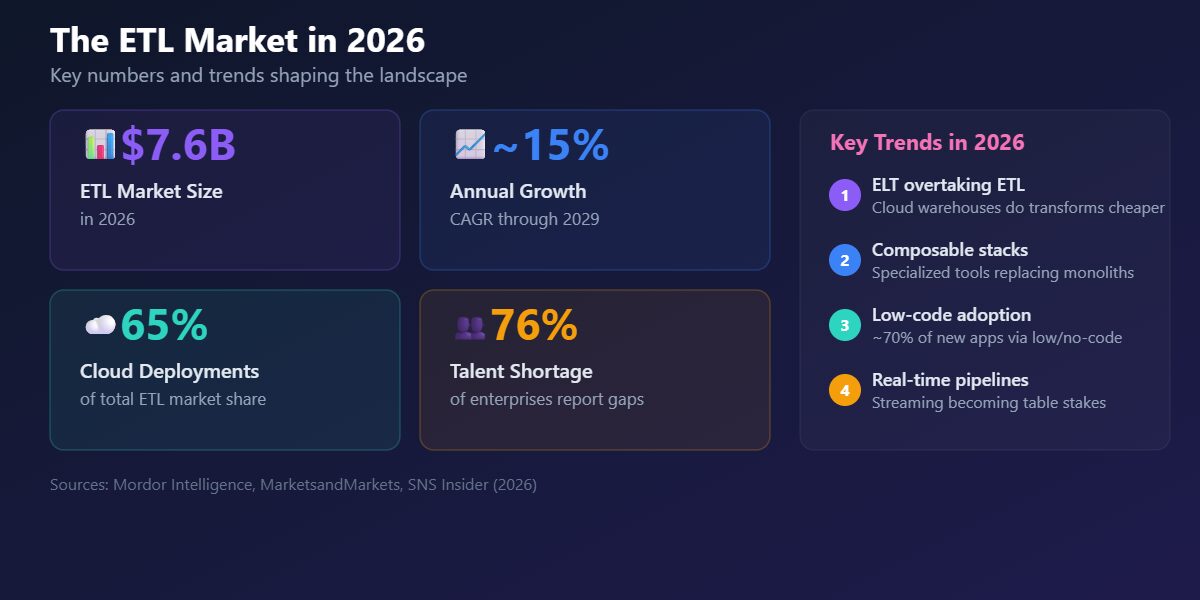
Your Data Pipeline Deserves More Than an Overcrowded Tool List
Choosing the right ETL tools is crucial when building a robust data stack, yet the abundance of overlapping options can be overwhelming. In 2026, the landscape continues to evolve, making it essential to understand which tools align with your specific needs. This practical guide not only highlights the best ETL tools available but also provides clear code examples to facilitate your decision-making process.